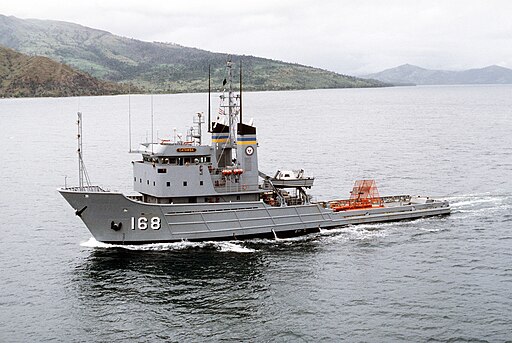
USNS Catawba (T-ATF-168) is a fleet ocean tug operated by the United States Navy under the Military Sealift Command (MSC). The vessel provides critical towing, salvage, and rescue services to support U.S. naval operations worldwide. As a fleet ocean tug, Catawba is designed for high endurance, heavy-duty towing, and support of both naval combatants and auxiliary ships. The vessel plays a vital role in maritime safety, fleet logistics, and emergency response, ensuring that ships in distress or in need of repositioning can be assisted efficiently and safely.
Named after the Catawba River and the Catawba tribe, the ship embodies strength, resilience, and the tradition of service.
Construction and Background
USNS Catawba was constructed by Marinette Marine Corporation in Marinette, Wisconsin, as part of the Powhatan-class fleet ocean tugs. This class was developed to modernize the Navy’s towing and salvage capabilities during the late 20th century. Catawba is the sixth vessel of the class and was built with a focus on towing power, seaworthiness, and long-range operational capability.
-
Keel laid: 1978
-
Launched: 1979
-
Delivered to MSC: 1980
-
Homeport: Norfolk, Virginia
The design emphasizes robust steel construction, redundant systems, and a propulsion setup capable of sustained operations under challenging oceanic conditions.
General Characteristics
-
Class and Type: Powhatan-class fleet ocean tug
-
Hull Number: T-ATF-168
-
Builder: Marinette Marine Corporation, Wisconsin
-
Operator: Military Sealift Command (MSC)
-
Primary Role: Towing, salvage, rescue, and fleet support
-
Crew: Approximately 16 civilian mariners with additional military personnel as needed for specialized missions
Physical Specifications
-
Displacement: Approximately 2,260 tons full load
-
Length overall: 225 feet (68.6 meters)
-
Beam: 42 feet (12.8 meters)
-
Draft: 15 feet (4.6 meters)
-
Hull Material: Welded steel with reinforced bow and stern
-
Deck Area: Open aft towing deck for winches, gear, and salvage equipment
-
Range: Over 10,000 nautical miles at economical speed
-
Endurance: 30 to 45 days without resupply
The ship’s hull design combines stability in heavy seas with a layout optimized for towing operations, including clear deck space and heavy-duty bollards.
Propulsion and Performance
Catawba is equipped with a diesel-electric propulsion system engineered for high torque at low speeds, essential for towing large vessels.
-
Propulsion Type: Diesel-electric
-
Engines: Two General Motors EMD diesel engines
-
Propulsion Power: Approximately 7,200 shaft horsepower
-
Propellers: Single controllable-pitch propeller for each shaft
-
Maximum Speed: 15 knots (28 km/h)
-
Sustained Speed: 13 knots under operational conditions
-
Bow Thruster: 1,000 horsepower tunnel thruster for maneuvering
The diesel-electric setup allows precise control of speed and torque, making the ship highly effective for towing operations and station keeping during salvage or rescue missions.
Towing and Salvage Equipment
USNS Catawba is outfitted with specialized gear for towing, salvage, and emergency response:
Towing Systems
-
Main towing winch: Capable of handling up to 200,000 pounds of tension
-
Synthetic and wire ropes: Multiple lines of varying lengths and diameters
-
Emergency tow fittings: Stern and bow bollards designed for rapid connection
-
Towing fairleads: Adjustable fairleads to manage heavy lines during adverse conditions
Salvage and Support Equipment
-
Heavy-duty capstan and winches for lifting and securing equipment
-
Cranes and booms: Typically 10 to 15-ton capacity for handling salvage loads
-
Diving support: Equipped to support Navy divers during salvage and underwater repairs
-
Deck-mounted firefighting monitors capable of spraying water or foam on fires
These systems ensure that Catawba can tow damaged ships, perform emergency responses, and assist in complex salvage operations at sea.
Navigation and Control Systems
Catawba features integrated navigation and control equipment to safely operate in all sea conditions:
-
Integrated bridge system with radar and ECDIS displays
-
GPS and differential GPS for precise positioning
-
Automatic Identification System (AIS) for fleet coordination
-
Shipboard sensors for speed, depth, and heading
-
Dynamic positioning capabilities for precise station keeping during towing or salvage
The navigation suite allows the vessel to operate in open ocean and coastal waters, providing reliable positioning for complex towing operations.
Crew and Accommodations
-
Civilian crew (MSC): Approximately 16
-
Additional personnel: Can accommodate small Navy detachments or divers
-
Habitability features:
-
Climate-controlled staterooms
-
Galley and mess facilities
-
Medical bay for minor injuries
-
Recreation areas for extended missions
-
The ship is designed to sustain the crew comfortably during long-duration deployments, often in challenging offshore environments.
Deck and Mission Support Facilities
The open aft deck provides space for mission equipment and towing operations:
-
Aft towing deck: Large unobstructed deck for winches, tow gear, and salvage operations
-
Deck cranes: For lifting equipment and emergency supplies
-
Modular storage: Configurable for salvage pumps, hoses, and diver gear
-
Firefighting and rescue stations: Positioned along the deck for rapid deployment
The layout allows for simultaneous towing, salvage, and support operations without interfering with crew safety or maneuverability.
Communications and Electronics
Catawba’s communications suite ensures operational coordination with fleet units and shore commands:
-
SATCOM for global voice and data connectivity
-
VHF/UHF/HF radios for line-of-sight and long-range communication
-
Shipboard LAN for monitoring propulsion, towing systems, and cargo
-
Emergency signaling and distress equipment
This ensures that Catawba can coordinate complex towing operations and emergency responses worldwide.
Operational Roles
USNS Catawba fulfills multiple roles within the U.S. Navy:
-
Towing of disabled or decommissioned ships
-
Salvage and recovery operations, including grounded or sunken vessels
-
Firefighting support for naval units
-
Rescue and recovery for personnel in maritime emergencies
-
Fleet logistics support by moving barges, floating platforms, and equipment
The ship provides critical capabilities to extend the Navy’s operational reach and ensures safety during maritime emergencies.
Operational History
Since commissioning, Catawba has supported fleet operations in the Atlantic and global theaters:
-
Participated in towing operations for training and fleet exercises
-
Assisted in salvage operations for damaged vessels
-
Supported joint exercises with allied navies
-
Provided emergency response and towing for U.S. Navy ships in distress
Her operational record demonstrates reliability, endurance, and adaptability across diverse missions.
Maintenance and Upgrades
USNS Catawba undergoes routine maintenance and periodic upgrades to remain operationally effective:
-
Overhaul of diesel-electric propulsion systems
-
Replacement and upgrade of winches and towing gear
-
Navigation system modernization with updated GPS and radar
-
Hull maintenance to prevent corrosion and extend service life
These enhancements ensure the vessel remains capable of performing high-demand towing and salvage operations well into the future.
Strategic Importance
Catawba’s role is central to fleet readiness, providing critical logistics, towing, and rescue capabilities. By ensuring that disabled or damaged vessels can be recovered, refueled, or repositioned, the ship enables the U.S. Navy to maintain operational continuity. Its salvage capabilities also support international maritime safety and humanitarian response during emergencies.
Summary
USNS Catawba (T-ATF-168) is a robust and versatile fleet ocean tug designed to provide towing, salvage, and emergency support worldwide. Built by Marinette Marine, the ship combines durable steel construction, diesel-electric propulsion, and advanced towing systems to perform demanding operations at sea. With a skilled civilian crew, modular deck space, and advanced navigation and communications systems, Catawba ensures the U.S. Navy can operate safely, recover disabled vessels, and maintain global maritime readiness. Her combination of endurance, power, and versatility makes her an indispensable asset in fleet logistics and maritime support operations.
_underway.jpg)