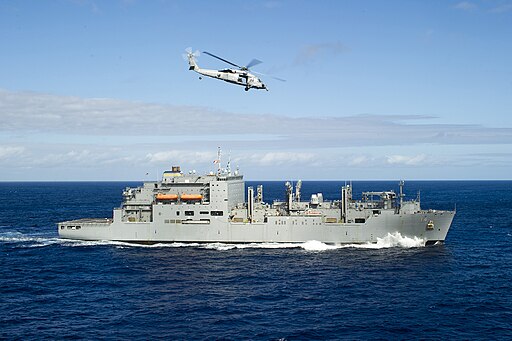
The USNS Cesar Chavez (T-AKE-14) is a Lewis and Clark-class dry cargo and ammunition ship operated by the Military Sealift Command (MSC) of the United States Navy. Designed to provide underway replenishment of ammunition, food, repair parts, potable water, and other supplies to U.S. Navy ships at sea, the vessel plays a vital role in sustaining naval operations around the globe. The ship is named in honor of Cesar Chavez, a renowned civil rights leader and labor activist who co-founded the United Farm Workers Union.
Design and Construction
USNS Cesar Chavez (T-AKE-14) was built by General Dynamics National Steel and Shipbuilding Company (NASSCO) in San Diego, California. The vessel is part of the Lewis and Clark class, which is based on a commercial design modified for naval auxiliary missions. The ship’s keel was laid on May 10, 2011, and it was launched on May 5, 2012. It was officially delivered to the Military Sealift Command on October 24, 2012.
The design incorporates a commercially proven hull and systems to reduce cost and improve maintainability. Its layout and cargo-handling systems are optimized for rapid replenishment at sea, ensuring combat ships can maintain readiness without returning to port.
Technical Specifications
-
Class and Type: Lewis and Clark-class dry cargo ship
-
Displacement: Approximately 41,000 tons (full load)
-
Length: 689 feet (210 meters)
-
Beam: 106 feet (32 meters)
-
Draft: 29.9 feet (9.1 meters)
-
Propulsion System:
-
Integrated diesel-electric system
-
Four MAN B&W 9L48/60 diesel generators
-
Combined output of 35.7 megawatts (47,900 hp)
-
Two electric propulsion motors driving a single shaft
-
Fixed-pitch propeller and bow thruster for enhanced maneuverability
-
-
Speed: 20 knots (maximum sustained)
-
Range: 14,000 nautical miles at 20 knots
-
Crew Complement:
-
124 civilian mariners (MSC)
-
Up to 11 Navy personnel (communications and supply detachment)
-
-
Endurance: 45 days of operational autonomy
Cargo Capabilities
USNS Cesar Chavez is designed to carry a variety of dry and refrigerated cargo necessary to sustain fleet operations. Its cargo-handling systems are configured to support underway replenishment (UNREP) and vertical replenishment (VERTREP) operations.
-
Cargo Capacity: Approximately 6,675 metric tons
-
Cargo Types:
-
Ammunition
-
Food provisions (dry and refrigerated)
-
Repair parts and consumables
-
Ship and aviation spares
-
Limited quantities of potable water and fuel
-
-
Cargo Handling Systems:
-
Electro-hydraulic cranes
-
Cargo elevators
-
Palletized cargo system
-
Automated material handling for efficient loading and offloading
-
-
Replenishment Stations:
-
Two standard tensioned replenishment stations per side
-
Capable of simultaneous transfer operations to multiple ships
-
Flight deck for MH-60S and MH-60R helicopters supporting VERTREP
-
Aviation Facilities
While the USNS Cesar Chavez lacks a hangar, it features a flight deck capable of supporting medium-lift helicopters for cargo transfer operations. The ship’s aviation facilities are certified for day and night operations, enabling continuous logistical support even in extended maritime operations.
Mission Profile
The ship’s primary mission is to deliver supplies to Navy combatants at sea, allowing sustained forward operations without returning to port. It supports Carrier Strike Groups (CSG), Amphibious Ready Groups (ARG), and independent deployed units. Secondary missions include humanitarian assistance, disaster relief, and theater sustainment operations.
The Lewis and Clark-class ships operate as part of the Combat Logistics Force (CLF), often working alongside fleet oilers (T-AO class) and fast combat support ships (T-AOE class) to provide comprehensive replenishment services—fuel, ammunition, and stores—in a coordinated manner.
Automation and Technology
USNS Cesar Chavez integrates advanced ship automation and cargo management systems to maximize efficiency and reduce crew requirements. Key technological features include:
-
Integrated Platform Management System (IPMS) for centralized monitoring of propulsion, power generation, and auxiliary systems.
-
Automated Inventory and Tracking Systems for cargo management.
-
Dynamic Positioning Assistance System for precise maneuvering during replenishment operations.
-
Environmental Control Systems that meet international standards for emissions, waste treatment, and ballast water management.
Habitability and Crew Facilities
Crew accommodations on the USNS Cesar Chavez are built to commercial comfort standards, a characteristic feature of MSC vessels. Facilities include private or semi-private staterooms, lounges, gymnasiums, dining areas, and internet connectivity for crew welfare. The ship’s design reflects the Navy’s commitment to maintaining high morale and operational efficiency during extended deployments.
Operational History
Since entering service in 2012, USNS Cesar Chavez has supported multiple U.S. Navy operations across the Pacific Ocean, Indian Ocean, and Middle East. The ship has played a logistical role in exercises and missions involving carrier strike groups, amphibious operations, and humanitarian assistance efforts.
The vessel operates primarily from Naval Base San Diego, though its operational deployments often span regions under the U.S. Indo-Pacific Command (INDOPACOM) and U.S. Central Command (CENTCOM).
Namesake Significance
The ship honors Cesar Chavez (1927–1993), a prominent advocate for labor rights and social justice. Chavez’s leadership in organizing farmworkers and championing nonviolent resistance earned him national recognition. Naming a naval vessel after him symbolizes the Navy’s commitment to diversity and recognition of contributions by all Americans to the nation’s history.
Strategic Importance
The USNS Cesar Chavez and its sister ships provide a critical logistical backbone for U.S. naval power projection. By ensuring continuous supply lines and enabling long-duration operations at sea, these vessels extend the global reach of the U.S. Navy. The ship’s combination of endurance, automation, and versatility makes it a vital component of modern naval logistics, ensuring combat readiness and sustained presence across the world’s oceans.
Summary
The USNS Cesar Chavez (T-AKE-14) embodies modern naval auxiliary design—efficient, reliable, and capable of supporting extended maritime operations. Its integration into the Lewis and Clark-class logistics fleet underscores the essential role of replenishment ships in maintaining the Navy’s operational tempo and global influence. Through its technical sophistication and symbolic namesake, the ship stands as both a testament to maritime engineering excellence and to the enduring spirit of service that defines the U.S. Navy.
_underway_in_December_2014.JPG)