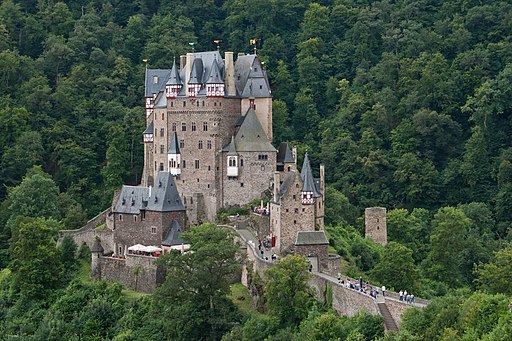
Hidden deep within a secluded valley of the Moselle region, surrounded by dense forest and the murmuring Elzbach River, Burg Eltz stands as one of Germany’s most enchanting and best-preserved medieval castles. Rising from a rocky outcrop in the Eifel hills of Rhineland-Palatinate, the castle has remained untouched by war for over 850 years and continues to be owned by the same family that built it in the 12th century. Its fairy-tale towers, timbered gables, and romantic turrets make it one of the most iconic images of Germany’s architectural and cultural heritage.
Origins and Early History
The story of Burg Eltz begins around the year 1157, when it was first mentioned in a document signed by Emperor Frederick I Barbarossa. The castle was originally constructed to control a strategic trade route between the Moselle and the Eifel region. Its location on a natural rock spur, encircled by the Elzbach River on three sides, provided both security and access to vital commercial pathways.
The earliest parts of Burg Eltz were built in the Romanesque style and consisted of a fortified house or keep. As the family’s wealth and influence grew, the castle expanded over the centuries into a complex network of buildings, courtyards, and defensive towers. Its evolution reflects not only changing architectural styles but also the rise of the Eltz family’s prominence within the Holy Roman Empire.
The Eltz Family and Their Legacy
For more than eight centuries, Burg Eltz has remained in the hands of the Eltz family — an extraordinary continuity in European history. The family divided into three main branches in the 13th century: the Eltz-Kempenich, Eltz-Rübenach, and Eltz-Rodendorf lines. Rather than splitting the castle into separate estates, they chose to live cooperatively within the same complex, each branch occupying its own section.
This arrangement resulted in the castle’s unique multi-family structure, with interconnected yet independent residences built side by side. The cooperation among the Eltz families helped the castle survive both political and military conflicts, as they presented a united front in times of crisis.
Today, Burg Eltz is still partly owned by descendants of the Eltz-Kempenich branch. The family has been instrumental in maintaining and restoring the castle, ensuring that its legacy continues as a living monument rather than a relic of the past.
Architectural Development
Burg Eltz is a masterpiece of medieval and early modern architecture, displaying an organic evolution rather than a single, uniform design. Construction took place between the 12th and 17th centuries, resulting in a harmonious blend of Romanesque, Gothic, and Renaissance elements.
The castle complex consists of eight towers, some rising over 35 meters, and more than 100 rooms arranged around an inner courtyard. The irregular shape of the structure follows the contours of the rocky ridge on which it stands, giving it a natural and almost storybook appearance.
The most notable sections include:
-
The Rübenach House (built around 1472–1478) – This part of the castle is known for its late Gothic architecture and richly decorated rooms.
-
The Rodendorf House (15th–16th centuries) – Exhibits Renaissance influences, particularly in its fireplaces, paneling, and domestic comforts.
-
The Kempenich House (17th century) – The last major addition to the castle, designed for residential comfort rather than military defense.
Each of these family houses has its own kitchen, halls, and chambers, yet they are connected by shared stairways and passages that create a labyrinthine layout.
Defense and Fortifications
Despite its romantic appearance, Burg Eltz was originally designed for defense. The outer walls are up to two meters thick, and the position of the castle on its narrow rock platform made it nearly impregnable. The surrounding forest and river valley served as natural barriers, limiting access to a single winding path that could be easily defended.
The castle was equipped with fortified gates, a drawbridge, and arrow slits for archers. However, unlike many German castles, Burg Eltz was never destroyed in battle. It successfully withstood a siege during the Eltz Feud (1331–1336), a conflict between the castle’s lords and the Archbishop of Trier, Balduin of Luxembourg. The Eltz family eventually negotiated a settlement that preserved both the castle and their autonomy.
This remarkable history of survival — through feudal wars, the Thirty Years’ War, and even World War II — contributes to Burg Eltz’s reputation as a timeless monument of peace and continuity.
The Interiors of Burg Eltz
The interiors of Burg Eltz are among the most authentic and well-preserved in Europe, offering a vivid impression of aristocratic life from the Middle Ages through the early modern period. Visitors can explore rooms furnished with original pieces from the 15th to 18th centuries, including furniture, paintings, armor, and household objects.
Highlights include:
-
The Knight’s Hall, a grand chamber where the family received guests and held councils. Its vaulted ceiling, ornate fireplace, and suits of armor reflect the power and prestige of the Eltz lords.
-
The Bedchamber of the Countess, decorated with fine wall paintings and a beautifully carved four-poster bed, showcasing Renaissance luxury.
-
The Armoury and Treasury, which houses an outstanding collection of weapons, gold and silver artifacts, and the famous golden “Eltz goblet”, one of the finest examples of German Renaissance craftsmanship.
-
The Kitchen, featuring original utensils, cauldrons, and an enormous hearth, providing insight into the domestic life of the time.
Each room is meticulously preserved, creating an authentic and atmospheric experience that sets Burg Eltz apart from many restored or reconstructed castles.
The Castle in the Landscape
The setting of Burg Eltz is as captivating as the structure itself. The castle sits in a deep forested valley surrounded by the Elzbach River, a tributary of the Moselle. The site’s isolation adds to its mystique; the nearest modern road is several kilometers away, and visitors reach the castle by foot or shuttle bus through the woods.
The surrounding landscape is part of a protected nature reserve known as the Eltzer Wald, which offers hiking trails, viewpoints, and picnic areas. From above, the castle appears as if it has grown naturally from the rock — an integral part of the valley rather than a man-made intrusion.
This harmony between architecture and nature is one of the reasons Burg Eltz is often compared to castles found in fairy tales and legends.
Preservation and Family Stewardship
The Eltz family’s dedication to preserving their ancestral home has been essential to its survival. In the 19th century, Count Karl zu Eltz initiated a major restoration project to stabilize and repair the aging structure while maintaining its original character. Later generations continued this work, ensuring that modern interventions remained subtle and historically accurate.
The castle opened to the public in 1871, making it one of the first privately owned castles in Germany to welcome visitors. Today, guided tours provide access to much of the interior, and the site continues to be maintained without state ownership or large-scale commercialization. This balance between heritage preservation and limited tourism allows Burg Eltz to retain its authenticity and charm.
Burg Eltz in Culture and Popular Imagination
Burg Eltz has long inspired artists, writers, and travelers. Its silhouette has appeared in countless paintings, travel posters, and photographs, symbolizing the romantic ideals of medieval Europe.
The castle has also featured in literature and film, and it frequently appears in international media as one of the world’s most beautiful castles. Its image even graced the reverse side of the 500 Deutsche Mark banknote before the introduction of the Euro, cementing its status as a national icon.
Visiting Burg Eltz Today
Burg Eltz is open to visitors from spring through late autumn, attracting travelers from across the world who come to experience its authenticity and scenic beauty. The approach to the castle — a winding walk through the woods followed by the first breathtaking glimpse of its towers — remains one of the most memorable experiences in Germany.
Guided tours lead guests through more than 40 rooms, explaining the history, art, and daily life of its inhabitants. The surrounding forest trails and picnic spots invite exploration, while the small café near the entrance offers local food and refreshments with views of the castle and valley.
Conclusion
Burg Eltz stands as a living link between the medieval past and the modern world. Its survival through centuries of war and change, its architectural splendor, and its continued family ownership make it one of Europe’s most extraordinary historical treasures.
