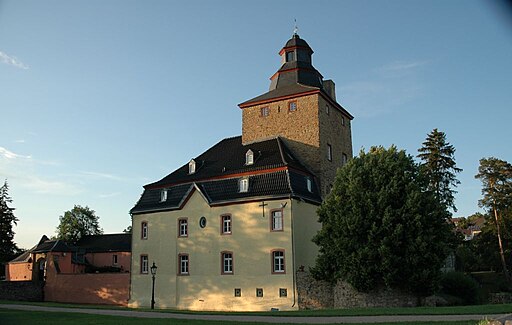
Burg Kirspenich is a striking example of a lowland water castle located in the district of Kirspenich, part of the town of Bad Münstereifel in the Euskirchen district of North Rhine-Westphalia, Germany. Its origins stretch back to the second half of the 12th century, and over the centuries it has seen phases of defence, residency, decline, and restoration. Today its features combine historic architecture, aesthetic water-surroundings and modern usage as an event venue. This article explores its location, history, architectural evolution, restoration, and present function in detail.
Location and Setting
Burg Kirspenich stands within the village of Kirspenich at an elevation of about 231 metres above sea level. It occupies a site originally characterised by a small island or water-surrounded spur, with a moat supplied by a branch of the local stream, giving it the features of a water castle (Wasserburg). Its access via the surrounding marshy land or moat emphasises the defensive nature of the castle’s siting: rather than a hill-fortress, it is a fortress built in a typically watered and flatter terrain. The village setting and integration into the local landscape render the castle both a local landmark and an interesting piece of regional heritage.
Origins and Early History
While the earliest phases are not exhaustively documented, the site is acknowledged as existing in the 12th century. In 1166 a person styled “Hermann of Kirspenich” appears, suggesting the castle or its associated estate was already functioning then. The construction of the main tower (a square keep of 28.5 metres high) is usually dated to around the late 13th or early 14th century. Around 1301 the castle is explicitly described as a water castle with a separate fore-castle (Vorburg) and was granted in feudal tenure to the counts of Jülich. Through the Middle Ages, the castle belonged to varying knightly and ministerial families, often under the overlordship of the Archbishopric of Cologne or the County of Jülich. Its location near the boundary of those territories meant its strategic role was influenced by shifting power relations in the region.
Architectural Features and Evolution
The Keep and Moat System
The dominant visual and structural feature of Burg Kirspenich is its massive square tower (Wohnturm) rising to some 28.5 metres. This tower stands on an essentially island-like base surrounded by water. The use of a moat and water defences is typical for “lowland castles” in the Rhineland and the Eifel region, providing protection that relied on water rather than height. The masonry of the keep is built of rough-hewn stone (Bruchstein) and retains medieval proportions and character.
Fore-castle, Outer Walls and Later Residential Wings
In addition to the keep, the castle included a fore-castle (Vorburg) with water defences and service buildings. The lower-lying terraces contained the living quarters, storerooms, and ancillary structures. Over time (especially in the Baroque period and into the 17th/18th centuries) significant residential additions were made: notably a main building with one of the earliest Mansard roofs in the Rhineland. The residential wings, gardens and water features transitioned the castle from purely military-residential use to a more stately home environment.
Structural Condition and Restoration Indicators
The fact that the keep and major walls survive substantially intact is notable. Many castles of similar age and type have collapsed or been reduced to scant remains. For Burg Kirspenich the presence of surrounding moats and retained structural phases has aided its preservation. Modern restoration (especially in the 1990s) has stabilised and revived the fabric; the site is privately owned but maintained.
Historical Context and Ownership
Burg Kirspenich’s fortunes followed the broader currents of feudal and territorial politics in the middle Rhineland. Situated in the border-zone between the Archbishopric of Cologne and County of Jülich, the castle’s ownership shifted. For example, Gerlach of Dollendorf held the site in 1278. After the significant Battle of Worringen in 1288 the Jülichs increased their influence in the region, which had implications for castles such as Kirspenich. In the early modern era the estate came under the control of the Freiherren von Friemersdorf genannt Pützfeld, and subsequently the complex changed function, at times serving non-noble purposes (a guest-house, restaurant) before restoration.
Modern Use and Visitor Functions
In recent years Burg Kirspenich has been adapted for modern use, leveraging its historic ambience for events, weddings, receptions and gatherings. The main hall (approx. 500 m²) and large courtyard are designed to accommodate up to 150 persons for private celebrations. The merging of its historic character (water castle ambience, medieval tower, moated setting) with modern event infrastructure makes the site a popular locale for upscale functions.
Although it is privately owned and not fully accessible to the public at all times, its exterior, moat, tower and water setting make it a rewarding sight for visitors and walkers. The castle is also part of the “Wasserburgen‑Route” — a long-distance bicycle route that links many moated castles in the Eifel and Kölner Bucht region. For anyone exploring the region by bike or on foot, Burg Kirspenich is a suitable stop.
Significance and Preservation Challenges
Burg Kirspenich is significant on several fronts. Architecturally it represents one of the better-preserved examples of lowland, water-defended castles of the Rhineland/Eifel region. Historically it embodies the shifting feudal and territorial dynamics of the Middle Ages and Early Modern period. Culturally it demonstrates how heritage sites can adapt to new functions (event venue) while preserving essential historic character.
At the same time, the castle faces preservation challenges typical of water-surrounded buildings: moisture control, structural settlement, maintaining moat water levels, managing vegetation and visitor pressure from event usage. The conflict between historic conservation and modern adaptation (for weddings, events, catering) means that careful management is required to preserve authenticity while deriving economic viability.
Why Visit and What to See
A visit (or external view) of Burg Kirspenich offers several highlights:
-
The imposing square keep rising above the water moat, giving a sense of the medieval defensive design.
-
The water surroundings (moat, reflections) which are rare and lend atmospheric quality.
-
The later residential wings and Mansard-roofed building demonstrating how the castle evolved from fortress to stately home.
-
The setting within Kirspenich village makes it accessible, and walking around the water-edge and viewing angles offer good photographic opportunities.
-
The castle’s inclusion in the Wasserburgen-Route makes it part of a broader network of heritage sights, ideal for cyclists or lovers of historical landscapes.
Summary
Burg Kirspenich stands as a quietly impressive monument: a virtually island castle formed in medieval times, adapted across centuries, and now maintained as a private but visible heritage complex and event venue. Its water-defended origins, mixed military-residential architecture, and modern use as a high-end celebration location make it distinctive. While not as widely known as larger hill castles, its significance lies in typology (lowland water castle), preservation state and adaptability. For visitors to the Bad Münstereifel / Euskirchen region interested in castle architecture, medieval feudal geography or historic event settings, Burg Kirspenich is a superb find.
