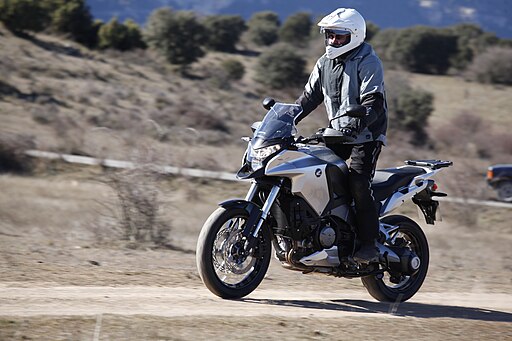
The Honda Crosstourer, also known as the VFR1200X, is a premium adventure-touring motorcycle that blends Honda’s renowned V4 performance heritage with long-distance comfort and rugged all-terrain capability. Introduced in 2012, the Crosstourer was conceived as a high-end touring platform based on the VFR1200F, featuring the same powerful 1,237 cc V4 engine but re-engineered for versatility, upright ergonomics, and off-pavement stability.
Unlike pure off-road adventure bikes, the Crosstourer was designed as a “crossover” machine—a motorcycle equally comfortable on highways, mountain roads, and light trails. With its advanced electronics, shaft drive, optional Dual Clutch Transmission (DCT), and robust chassis, it became Honda’s flagship adventure-tourer, sitting above the Africa Twin in refinement and long-haul performance.
Design Philosophy
The Crosstourer was built around a clear engineering vision: to deliver a motorcycle capable of tackling multiple terrains with the comfort, stability, and performance of a grand tourer. Honda’s engineers sought to combine the soul of a V4 sports engine with the practicality of an adventure chassis.
Its design emphasized mass centralization, ergonomic balance, and aerodynamic efficiency. Every component—from the fairing to the fuel tank—was sculpted to enhance airflow, reduce turbulence, and protect the rider from wind and rain during long journeys.
The Crosstourer’s styling was both muscular and functional. Its tall stance, large spoked wheels (on later models), and prominent front beak echoed classic adventure aesthetics, while its sculpted fairing and integrated side panels gave it a modern, aerodynamic silhouette.
Engine and Performance
The heart of the Crosstourer is its 1,237 cc 76° V4 engine, derived from the VFR1200F sport-tourer. However, it was extensively retuned for adventure use, emphasizing low-end and midrange torque rather than peak horsepower. The engine’s unique V4 configuration provides smooth, linear power delivery and a distinctive exhaust note that distinguishes it from parallel-twin or inline-four adventure bikes.
-
Engine Type: 4-stroke, liquid-cooled, 76° V4, SOHC, 16-valve
-
Displacement: 1,237 cc
-
Bore x Stroke: 81.0 mm × 60.0 mm
-
Compression Ratio: 12.0:1
-
Fuel System: PGM-FI (Programmed Fuel Injection)
-
Ignition System: Digital transistorized ignition
-
Maximum Power Output: Approx. 127 hp (95 kW) at 7,750 rpm
-
Maximum Torque: Approx. 126 Nm (93 lb-ft) at 6,500 rpm
To adapt the engine to off-road and touring scenarios, Honda revised the throttle mapping and intake system for smoother response at low speeds. The shaft drive system was retained for reliability and low maintenance—ideal for long-distance travelers.
The engine’s distinctive Uneven Firing Interval gives it an unmistakable sound and feel, with consistent traction and minimal vibration. Power delivery is exceptionally smooth, making the Crosstourer comfortable for extended touring yet capable of spirited performance when the terrain opens up.
Transmission and Drivetrain
A key technological highlight of the Crosstourer is its optional Dual Clutch Transmission (DCT)—a system that allows automatic or manual shifting without a clutch lever. This advanced gearbox provides smooth, rapid shifts and eliminates the possibility of stalling, making it particularly effective for touring and off-road maneuvering.
-
Transmission: 6-speed manual or 6-speed Dual Clutch Transmission
-
Clutch Type: Wet, multi-plate hydraulic
-
Final Drive: Shaft drive
The DCT system offers two automatic modes—D (Drive) for fuel-efficient riding and S (Sport) for more aggressive power delivery—as well as a manual mode with handlebar-mounted shift triggers. For off-road use, Honda fine-tuned the DCT’s logic to improve traction and control during low-speed maneuvers and loose surfaces.
The manual version features a precise, light-action gearbox that complements the engine’s smooth torque curve, while the shaft final drive ensures quiet operation and virtually maintenance-free performance.
Chassis and Frame Construction
The Crosstourer’s chassis was designed for strength, balance, and comfort. It employs a twin-spar aluminum frame similar in concept to the VFR1200F’s, but reinforced for adventure touring. The engine acts as a stressed member, contributing to rigidity while minimizing overall weight.
-
Frame Type: Twin-spar aluminum diamond frame
-
Rake (Caster Angle): 28°
-
Trail: 107 mm
-
Wheelbase: 1,595 mm
The longer wheelbase and relaxed rake provide excellent stability at high speeds and when carrying luggage or a passenger. The chassis geometry was optimized for predictable steering and confidence-inspiring handling across varied terrain.
Suspension System
The Crosstourer’s suspension setup was tailored for adventure riding, offering generous travel and adjustability.
-
Front Suspension: 43 mm upside-down telescopic forks, fully adjustable for preload and rebound
-
Rear Suspension: Pro-Link monoshock with hydraulic preload adjustment and rebound damping
-
Front Wheel Travel: 165 mm
-
Rear Wheel Travel: 146 mm
This combination provides a comfortable, composed ride over rough roads while maintaining excellent stability and control on pavement. The suspension’s versatility allows the bike to transition seamlessly from touring highways to gravel tracks.
Braking and Safety Systems
Braking performance was a major focus for Honda engineers. The Crosstourer features a Combined ABS system that links the front and rear brakes for balanced stopping power while allowing independent control when necessary.
-
Front Brakes: Dual 310 mm floating discs with 3-piston calipers (ABS-equipped)
-
Rear Brake: Single 276 mm disc with 2-piston caliper
-
ABS: Standard (selectable on later models)
-
Traction Control (HSTC): Standard (adjustable on later models)
The Honda Selectable Torque Control (HSTC) system helps maintain rear-wheel traction on slippery or uneven surfaces. It can be toggled off for experienced riders who prefer direct control off-road.
Aerodynamics and Ergonomics
The Crosstourer’s bodywork was shaped to deliver long-distance comfort and optimal airflow management. Its adjustable windscreen deflects air efficiently at high speeds, reducing fatigue on long journeys.
Ergonomically, the bike provides an upright, commanding riding position with a wide handlebar for leverage and control. The seat is broad and supportive, suitable for hours of riding without discomfort.
-
Seat Height: 850 mm (adjustable options available)
-
Handlebar Width: 910 mm
-
Riding Position: Neutral upright stance for control and visibility
Honda’s attention to detail extends to practical elements like handguards, luggage mounts, and integrated passenger grab rails, all designed to enhance touring convenience.
Wheels and Tires
The Crosstourer’s wheels are designed for strength and versatility, capable of handling both paved and unpaved routes.
-
Front Wheel: 19-inch cast aluminum (spoked version available later)
-
Rear Wheel: 17-inch cast aluminum
-
Front Tire: 110/80 R19
-
Rear Tire: 150/70 R17
Later models offered spoked tubeless wheels, increasing durability for riders who frequently venture off-road.
Electrical and Electronic Systems
The Crosstourer integrates a modern suite of electronics and instrumentation aimed at enhancing both safety and convenience.
-
Electrical System: 12V DC
-
Battery Capacity: 12V, 11.2Ah
-
Lighting: Dual halogen headlights (later models featured LED upgrades)
-
Instrumentation: Multi-function LCD display with analog tachometer, digital speedometer, fuel consumption data, gear indicator, trip meter, and ambient temperature
Later iterations included refinements to DCT behavior, improved traction control, and selectable ABS, aligning the Crosstourer with the growing expectations of electronic rider aids in the adventure segment.
Dimensions and Weight
-
Overall Length: 2,285 mm
-
Overall Width: 915 mm
-
Overall Height: 1,335 mm
-
Wheelbase: 1,595 mm
-
Seat Height: 850 mm
-
Ground Clearance: 180 mm
-
Curb Weight: 275 kg (manual) / 285 kg (DCT)
-
Fuel Tank Capacity: 21.5 liters
Despite its substantial size, the Crosstourer’s balance and low center of gravity make it manageable in urban traffic and controllable at slow speeds.
Performance and Riding Experience
The Honda Crosstourer delivers a riding experience that is both commanding and refined. Its V4 engine offers a deep, muscular soundtrack and immediate throttle response, while the shaft drive ensures smooth, maintenance-free power delivery.
On the highway, it feels planted and stable even at high speeds, aided by its aerodynamics and long wheelbase. On twisty roads, the bike remains surprisingly agile, thanks to its balanced chassis geometry and adjustable suspension.
Off-road, while not as dirt-oriented as the Africa Twin, the Crosstourer handles gravel and rough tracks with composure. The traction control system and optional DCT transmission simplify low-speed maneuvers, making it well-suited for touring riders who occasionally venture off the pavement.
Variants and Model Evolution
Over its production life, the Crosstourer evolved through continuous refinement rather than radical redesigns:
-
2012 – Original Release: Manual and DCT variants, combined ABS, traction control, and 19-inch front wheel.
-
2014 – Updated Version: Improved throttle response, revised DCT logic, adjustable traction control, and spoked wheel option.
-
2016 – Final Major Update: LED lighting, updated instrument cluster, improved ergonomics, and compliance with Euro 4 standards.
In 2016, Honda also introduced the Crosstourer Highlander Edition, equipped with a touring windscreen, panniers, engine guards, and heated grips for long-distance adventure touring.
Legacy and Market Impact
The Honda Crosstourer solidified Honda’s reputation for engineering excellence in the adventure-touring class. While it never achieved the same cult following as lighter competitors like the BMW R1200GS, it appealed to riders seeking refinement, reliability, and V4 character in a segment dominated by twins.
Its Dual Clutch Transmission technology set a benchmark for seamless power delivery and became a cornerstone feature in Honda’s touring and adventure lineup, influencing future models like the Africa Twin DCT and NT1100.
The Crosstourer demonstrated Honda’s ability to merge advanced engineering with practicality, offering a motorcycle that could handle long-distance touring, spirited riding, and light off-road adventures—all with characteristic Honda smoothness.
Conclusion
The Honda Crosstourer (VFR1200X) stands as a masterpiece of versatility and engineering sophistication. It combined the soul of Honda’s legendary V4 engines with the body and functionality of an adventure-tourer, creating a motorcycle that excels in performance, comfort, and reliability.
Its shaft drive, adjustable suspension, and advanced DCT system make it a practical choice for riders who value long-term dependability and effortless performance. Though production ended in the early 2020s, the Crosstourer remains one of the most technically advanced and refined adventure motorcycles ever built—an enduring testament to Honda’s pursuit of perfection in every segment it enters.
