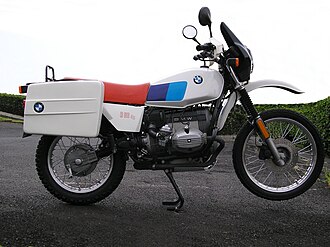
There are motorcycles that follow trends, and then there are motorcycles that create entirely new categories. The BMW R80G/S belongs firmly in the latter group. Introduced in 1980 by BMW Motorrad, it did not merely expand BMW’s lineup—it redefined what a motorcycle could be. Combining long-distance touring capability with genuine off-road performance, the R80G/S is widely regarded as the world’s first true “adventure motorcycle,” a machine equally at home crossing deserts as it was cruising highways.
This article explores the R80G/S in exhaustive detail—its origins, engineering philosophy, technical innovations, performance characteristics, and lasting legacy—while presenting a deep technical breakdown of its design and specifications.
The Context: A Crisis That Sparked Innovation
BMW in the Late 1970s
By the late 1970s, BMW Motorrad found itself in a difficult position. Japanese manufacturers such as Honda, Yamaha, and Kawasaki were dominating the market with faster, lighter, and more affordable motorcycles. BMW’s traditional air-cooled boxer twins, though reliable, were increasingly seen as conservative and outdated.
The company needed something radically different—not just a faster motorcycle, but a new concept entirely.
The Birth of an Idea
The R80G/S project began almost informally. BMW engineers, inspired by off-road competitions and rally raids, experimented with combining an existing road bike platform with off-road capability. The idea was simple but revolutionary: create a motorcycle that could do everything.
The name itself tells the story:
- G = Gelände (off-road)
- S = Straße (road)
This dual-purpose philosophy would define not just the R80G/S, but an entire category of motorcycles for decades to come.
Engineering Philosophy: Balance Over Specialization
Unlike traditional motorcycles designed for a single purpose, the R80G/S was engineered to excel in multiple environments. This required a careful balance of competing priorities:
- Lightweight construction vs durability
- Off-road suspension vs road stability
- Torque delivery vs fuel efficiency
BMW’s solution was not to compromise, but to innovate.
Engine Architecture: The Airhead Boxer Evolves
Core Configuration
At the heart of the R80G/S lies BMW’s classic air-cooled boxer engine:
- Configuration: Horizontally opposed flat twin
- Displacement: 797.5 cc
- Valvetrain: OHV (overhead valve), 2 valves per cylinder
- Cooling: Air-cooled
This engine, often referred to as the “airhead,” had been refined over decades. In the R80G/S, it reached a new level of usability and versatility.
Bore, Stroke, and Compression
The engine’s internal geometry was designed to balance torque and efficiency:
- Bore × stroke: 84.8 mm × ~70 mm
- Compression ratio: approximately 9.2:1
This setup allowed the engine to deliver strong low-end torque while maintaining reliability under demanding conditions.
Power and Torque Characteristics
The R80G/S produced:
- Power: 50 hp at 6,500 rpm
- Torque: 57 Nm at 5,000 rpm
These figures may appear modest, but they were perfectly suited to the bike’s intended purpose. The emphasis was on usable torque rather than peak horsepower.
Fuel System and Ignition
Carburetion
The engine was fed by twin Bing carburetors, which offered:
- Reliable fuel delivery
- Easy maintenance
- Adaptability to varying conditions
Electronic Ignition
Unlike earlier BMW models, the R80G/S featured electronic ignition, improving:
- Starting reliability
- Ignition timing precision
- Overall engine efficiency
Transmission and Drivetrain
Gearbox
The R80G/S was equipped with a:
- 5-speed manual transmission
This allowed for:
- Smooth gear transitions
- Optimal power distribution across terrains
Shaft Drive
BMW retained its signature shaft drive system, offering:
- Low maintenance
- Durability
- Clean operation compared to chain drives
This feature was particularly valuable for long-distance and off-road riding.
The Monolever Revolution
A Breakthrough in Suspension Design
One of the most significant innovations of the R80G/S was the Monolever system:
- Single-sided swingarm
- Integrated driveshaft
- Single rear shock absorber
This design reduced weight and complexity while improving handling and ease of maintenance.
Advantages of the Monolever
- Simplified rear wheel removal
- Increased structural rigidity
- Reduced unsprung mass
It also laid the foundation for future BMW suspension systems, including the Paralever.
Chassis and Frame Design
Lightweight Yet Strong
The R80G/S used a modified version of the R65 frame:
- Steel tubular construction
- Reinforced for off-road use
Despite its strength, the bike maintained a relatively low weight:
- Wet weight: approximately 186 kg
Geometry and Handling
The geometry was carefully tuned to balance:
- Stability at high speeds
- Agility in off-road conditions
Suspension System: Long Travel Capability
Front Suspension
- Telescopic forks
- Long travel for off-road absorption
Rear Suspension
- Monolever with single shock
This combination allowed the R80G/S to handle rough terrain with surprising competence.
Wheels and Tires
Off-Road Focus
The R80G/S featured:
- 21-inch front wheel
- 18-inch rear wheel
- Wire-spoked rims
These characteristics improved:
- Stability on loose surfaces
- Obstacle clearance
Braking System
Disc and Drum Combination
- Front: Single 260 mm disc brake
- Rear: 200 mm drum brake
While not exceptional by modern standards, this setup provided adequate stopping power for the era.
Dimensions and Ergonomics
Key Measurements
- Wheelbase: 1,465 mm
- Seat height: 860 mm
- Fuel capacity: 19.5 liters
Rider Position
The ergonomics were designed for versatility:
- Upright seating position
- Wide handlebars for control
- Comfortable long-distance riding
Performance: Real-World Capability
Top Speed and Acceleration
- Top speed: approximately 167 km/h (104 mph)
Off-Road Performance
The R80G/S excelled in:
- Gravel roads
- Desert terrain
- Mountain trails
Its combination of torque, suspension travel, and lightweight design made it uniquely capable.
Motorsport Success: Dakar Dominance
The R80G/S proved its capabilities in the most demanding environment imaginable: the Dakar Rally.
Key Achievements
- 1981: Victory by Hubert Auriol
- 1983: Another win for BMW
- 1984 & 1985: Wins by Gaston Rahier
These victories cemented the R80G/S’s reputation as a true adventure machine.
Design and Aesthetics
Functional Simplicity
The R80G/S featured:
- Minimal bodywork
- High-mounted front fender
- Round headlight
Every design element served a purpose.
Paris-Dakar Edition
BMW later introduced a special edition featuring:
- Larger fuel tank
- Rally-inspired graphics
- Enhanced touring capability
Cultural Impact: The Birth of Adventure Motorcycling
The R80G/S did more than succeed—it created a new market segment. It inspired:
- Long-distance adventure travel
- Dual-sport riding culture
- A new generation of motorcycles
Today’s GS lineup, including models like the R1250GS, traces its lineage directly to the R80G/S.
Riding Experience: Then and Now
Period Experience
In the 1980s, the R80G/S offered:
- Unmatched versatility
- Reliable performance
- Comfortable touring
Modern Perspective
Today, it is appreciated for:
- Mechanical simplicity
- Classic design
- Authentic riding feel
It lacks modern electronics, but that is part of its charm.
Legacy and Influence
The R80G/S is often called:
- The first adventure bike
- The foundation of the GS series
With over 500,000 GS motorcycles produced since its introduction, its influence is undeniable. (Wikipedia)
Technical Specifications Table
| Parameter | Specification |
|---|---|
| Model | BMW R80G/S |
| Production Years | 1980–1987 |
| Units Produced | 21,864 |
| Class | Dual-sport / Adventure |
| Engine Type | Air-cooled OHV flat-twin (boxer) |
| Displacement | 797.5 cc |
| Bore × Stroke | 84.8 mm × ~70 mm |
| Compression Ratio | ~9.2:1 |
| Power Output | 50 hp @ 6,500 rpm |
| Torque | 57 Nm @ 5,000 rpm |
| Fuel System | Twin Bing carburetors |
| Ignition | Electronic |
| Transmission | 5-speed manual |
| Clutch | Single-plate dry clutch |
| Final Drive | Shaft drive |
| Frame | Steel tubular |
| Front Suspension | Telescopic fork |
| Rear Suspension | Monolever (single shock) |
| Front Brake | Single 260 mm disc |
| Rear Brake | 200 mm drum |
| Wheelbase | 1,465 mm |
| Seat Height | 860 mm |
| Fuel Capacity | 19.5 L |
| Weight (wet) | ~186 kg |
| Top Speed | ~167 km/h |
Conclusion: A Motorcycle That Changed Everything
The BMW R80G/S is more than a motorcycle—it is a turning point in motorcycling history. It demonstrated that a single machine could successfully combine road comfort, off-road capability, and long-distance reliability.
Its innovations—particularly the Monolever suspension and dual-purpose design—set the standard for future adventure motorcycles. Even decades later, its influence can be seen in nearly every adventure bike on the market.
