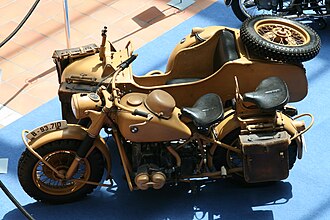
The BMW R75 is one of the most technically fascinating motorcycles ever produced—not because it chased speed or luxury, but because it redefined what a motorcycle could be under extreme conditions. Developed for military use during World War II, the R75 was not just a motorcycle—it was a hybrid between a vehicle and a machine tool, engineered to traverse mud, sand, snow, and battlefield debris with a level of reliability that few vehicles of its time could match.
Unlike civilian motorcycles designed for paved roads and leisure riding, the R75 was conceived as a strategic mobility platform. It had to carry soldiers, equipment, and sometimes mounted weapons across unpredictable terrain, often in harsh climates and under logistical constraints such as poor fuel quality. The result was a machine that combined mechanical ingenuity, rugged construction, and innovative drivetrain technology—features that would influence motorcycle engineering for decades.
Historical Background: Engineering for War
The Military Requirement
In the late 1930s, the German military recognized the need for a versatile, off-road capable vehicle that could supplement or replace traditional transport methods like bicycles and light trucks. BMW was tasked with developing such a machine, and in 1938, work began on what would become the R75.
The requirements were demanding:
- High off-road capability
- Ability to operate in extreme climates
- Low maintenance requirements
- Compatibility with sidecar use
- Capacity to run on low-quality fuel
These requirements shaped every aspect of the R75’s design.
Production and Deployment
The R75 entered production in 1941 and remained in service until 1944, with some units assembled after the war.
It was widely used on multiple fronts, including:
- Eastern Front (Soviet Union)
- North Africa
- Western Europe
Its role ranged from reconnaissance and communication to transporting troops and equipment.
Engineering Philosophy: Utility Over Speed
The R75 was not designed to be fast—it was designed to be unstoppable. BMW engineers prioritized:
- Traction over top speed
- Reliability over complexity
- Adaptability over specialization
This philosophy led to one of the most advanced drivetrain systems ever installed on a motorcycle.
Engine Design and Technical Architecture
Flat-Twin Boxer Engine
At the core of the R75 is a 745 cc air-cooled flat-twin engine. This boxer configuration offered:
- Excellent balance
- Reduced vibration
- Efficient cooling
The engine produced approximately 26 horsepower, which may seem modest, but was sufficient for its intended purpose.
Internal Specifications
Key engine parameters included:
- Displacement: 745 cc
- Configuration: OHV flat twin
- Bore × stroke: 78 mm × 78 mm
- Compression ratio: approximately 5.8:1
- Carburetion: dual carburetors
The relatively low compression ratio allowed the engine to run on low-octane fuel—a critical requirement in wartime conditions.
Torque-Oriented Performance
The engine was tuned for torque rather than speed, enabling the R75 to:
- Climb steep inclines
- Navigate loose surfaces
- Carry heavy loads
This made it more akin to a utility vehicle than a traditional motorcycle.
Drivetrain Innovation: Two-Wheel Drive System
Driven Sidecar Wheel
One of the R75’s most revolutionary features was its drivetrain:
- Power was delivered to both the rear wheel and the sidecar wheel
- A locking differential ensured traction in difficult terrain
This effectively transformed the motorcycle into a three-wheeled drive vehicle.
Transfer Case and Gear Ratios
The R75 featured a transfer case with:
- Road gearing
- Off-road (low-range) gearing
This allowed the rider to adapt to different terrain conditions, similar to modern four-wheel-drive vehicles.
Reverse Gear
Unlike most motorcycles, the R75 included a reverse gear, making it easier to maneuver in tight spaces or difficult terrain.
Chassis and Structural Engineering
Heavy-Duty Frame
The R75 utilized a reinforced steel tubular frame designed to withstand:
- Heavy loads
- Rough terrain
- Combat conditions
Weight and Stability
With a dry weight of approximately 420 kg (including sidecar), the R75 was significantly heavier than conventional motorcycles.
This weight contributed to:
- High stability
- Improved traction
- Increased durability
However, it also required considerable skill to operate.
Suspension and Handling
Front Suspension
The front utilized a leading-link fork, which provided:
- Better stability under braking
- Increased durability
Rear Suspension
The rear suspension was relatively simple but robust, designed to handle:
- Heavy loads
- Uneven terrain
Off-Road Capability
The combination of:
- Two-wheel drive
- Low gearing
- Heavy construction
allowed the R75 to traverse terrain that would be impassable for most motorcycles.
Braking System
The R75 was equipped with drum brakes on both wheels. While not advanced by modern standards, they were sufficient for the bike’s operational requirements.
Key characteristics:
- Mechanical drum brakes
- Designed for durability rather than performance
Dimensions and Physical Characteristics
The R75’s size and proportions reflected its military purpose:
- Length: approximately 2.4 meters
- Weight: ~420 kg
- Crew capacity: 1–2 riders plus sidecar passenger
The sidecar could also be equipped with:
- Storage compartments
- Weapon mounts
Operational Performance
Speed and Range
The R75 had a top speed of approximately 95 km/h, though it was rarely used at maximum speed in combat conditions.
Terrain Adaptability
Its drivetrain allowed it to:
- Operate in mud, sand, and snow
- Climb steep inclines
- Maintain traction in adverse conditions
Fuel Efficiency
Efficiency was less important than reliability, but the engine was designed to operate under inconsistent fuel quality.
Comparison with Contemporary Machines
Zündapp KS 750
The R75’s main competitor was the Zündapp KS 750. Both machines shared similar roles and features, and later, parts standardization was introduced between them.
Advantages of the R75
- Advanced drivetrain
- Reliable engine design
- Versatility
Limitations
- High production cost
- Complex maintenance
- Heavy weight
Cultural and Historical Impact
The R75 became one of the most recognizable military motorcycles of World War II. It has appeared in numerous films and remains a symbol of wartime engineering.
Despite its association with a controversial period in history, the R75 is studied today for its technological innovations and engineering excellence.
Post-War Legacy
Influence on Future BMW Models
The R75’s OHV engine design influenced post-war BMW motorcycles such as:
- R51/3
- R67
- R68 (Wikipedia)
Collector Status
Today, the R75 is highly sought after by collectors due to:
- Its rarity
- Unique engineering
- Historical significance
Restored examples are often displayed in museums or used in historical reenactments.
Riding Experience: A Mechanical Challenge
Operating an R75 today is vastly different from riding a modern motorcycle:
- Heavy steering due to sidecar
- Complex gear selection
- Unique handling characteristics
However, it offers a rare glimpse into the mechanical ingenuity of the past.
Technical Specifications Table
| Parameter | Specification |
|---|---|
| Model | BMW R75 |
| Production Years | 1941–1944 (some units assembled until 1946) |
| Class | Military motorcycle with sidecar |
| Engine Type | Air-cooled OHV flat-twin |
| Displacement | 745 cc |
| Bore × Stroke | 78 mm × 78 mm |
| Compression Ratio | ~5.8:1 |
| Power Output | 26 hp |
| Carburetion | Twin carburetors |
| Transmission | 4-speed + reverse |
| Final Drive | Shaft drive with differential |
| Drive System | Two-wheel drive (rear + sidecar wheel) |
| Gear Ratios | Road and off-road selectable |
| Frame | Steel tubular |
| Front Suspension | Leading-link fork |
| Rear Suspension | Rigid / basic suspension |
| Brakes | Drum brakes (front and rear) |
| Length | ~2.4 m |
| Weight | ~400–420 kg (with sidecar) |
| Top Speed | ~95 km/h |
| Fuel Type | Low-octane compatible |
| Crew Capacity | 1–3 persons |
Conclusion: A Machine Built for Survival
The BMW R75 is not just a motorcycle—it is a technological artifact that represents a unique moment in engineering history. Built for war, it pushed the boundaries of what a motorcycle could achieve, introducing innovations such as two-wheel drive and selectable gear ranges that remain impressive even today.
Its legacy is complex, shaped by both its technical brilliance and the historical context in which it was created. Yet from an engineering perspective, the R75 stands as one of the most advanced and capable motorcycles of its time—a machine that prioritized function above all else and succeeded in redefining mobility under extreme conditions.
