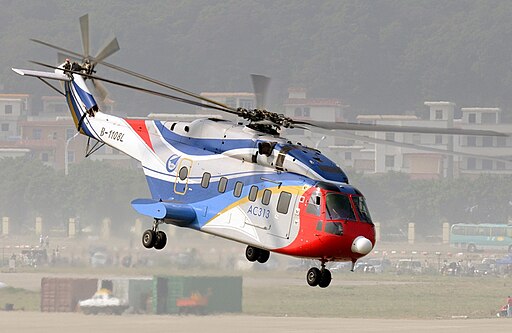
The Avicopter AC313 is a large, multi-role, three-engine helicopter developed by the Aviation Industry Corporation of China (AVIC). It represents a major milestone in China’s aviation industry, being the country’s first domestically developed civil helicopter with a maximum takeoff weight exceeding 13 tons. Designed for both civilian and paramilitary applications, the AC313 is capable of performing a wide range of missions, including passenger and cargo transport, search and rescue (SAR), medical evacuation, and disaster relief operations.
Development Background
The AC313 was developed by AVIC Helicopter Co., Ltd. (Avicopter) as part of China’s strategic effort to advance its domestic rotorcraft capabilities. Its development began in the early 2000s, building upon design experience from the Harbin Z-8 series, which itself was based on the French Aérospatiale SA 321 Super Frelon.
The AC313 features significant improvements in aerodynamics, materials, avionics, and performance over its predecessors. It conducted its maiden flight on March 18, 2010, in Jingdezhen, China. The design was certified by the Civil Aviation Administration of China (CAAC) for civil use, signaling China’s commitment to creating a self-sufficient aerospace sector.
Design and Structure
The AC313 features a conventional helicopter layout with a single main rotor and a tail rotor configuration. The fuselage is constructed using lightweight composite materials and corrosion-resistant alloys to reduce weight and improve structural durability. The large, boxy fuselage offers ample interior space, capable of accommodating passengers, cargo, or mission-specific equipment.
The helicopter incorporates a five-blade main rotor system designed for improved lift efficiency, vibration reduction, and noise minimization. The rotor blades are made from advanced composites for enhanced strength-to-weight ratio and fatigue resistance. The tail rotor features a four-blade configuration optimized for stability and control, even in high crosswind conditions.
The landing gear is a retractable tricycle-type system, allowing for smoother landings and reduced drag during flight. The AC313 is designed to operate in a wide range of environments, including high-altitude plateaus, deserts, and maritime regions.
Cabin and Crew Configuration
The spacious cabin is a defining feature of the AC313. It can be configured for multiple mission types:
-
Passenger Transport: The cabin accommodates up to 27 passengers, with comfortable seating and wide access doors for boarding.
-
Cargo Transport: The aircraft supports internal and external cargo loads, including sling operations for large equipment or humanitarian supplies.
-
Search and Rescue (SAR): Equipped with rescue hoists, life rafts, and medical equipment, the AC313 can conduct long-range SAR missions over land or sea.
-
Medical Evacuation (MEDEVAC): The helicopter can carry stretchers, medical monitoring systems, and medical personnel for airborne emergency response.
The cockpit is designed for a crew of two pilots, featuring advanced avionics for improved situational awareness and mission flexibility.
Avionics and Flight Systems
The AC313 incorporates a digital integrated avionics suite with a glass cockpit. The flight deck includes multi-function liquid crystal displays (LCDs), engine monitoring systems, a flight management system (FMS), and an automatic flight control system (AFCS). These features reduce pilot workload and enhance flight safety, particularly in poor weather or low-visibility conditions.
Navigation and communication systems include GPS, inertial navigation (INS), VHF/UHF radios, and weather radar. Optional equipment includes terrain awareness and warning systems (TAWS), collision avoidance systems, and infrared cameras for night operations.
Powerplant and Performance
The AC313 is powered by three Pratt & Whitney PT6B-67A turboshaft engines, each producing around 1,940 shaft horsepower (shp). The triple-engine configuration ensures redundancy, providing continued safe flight even in the event of an engine failure.
Power from the engines is transmitted through a main gearbox system optimized for efficiency and durability. The helicopter also includes a de-icing system for both the rotor blades and windshield, allowing operations in cold and icy environments.
Key Performance Parameters
-
Crew: 2 (pilots)
-
Passenger Capacity: Up to 27 passengers or 15 stretchers in medical configuration
-
Length: Approximately 23 meters (rotors turning)
-
Height: Around 6.5 meters
-
Main Rotor Diameter: About 18.6 meters
-
Empty Weight: Approximately 8,500 kilograms
-
Maximum Takeoff Weight: 13,800 kilograms
-
Engine Type: 3 × Pratt & Whitney PT6B-67A turboshafts
-
Maximum Power Output: ~1,940 shp per engine
-
Maximum Speed: 315 km/h (170 knots)
-
Cruising Speed: 280 km/h (150 knots)
-
Range: Up to 900 kilometers (extendable with auxiliary tanks)
-
Service Ceiling: 6,000 meters
-
Hover Ceiling (IGE): 4,500 meters
-
Hover Ceiling (OGE): 3,000 meters
-
Rate of Climb: Approximately 8 meters per second
Mission Capabilities
The AC313’s modular design enables a wide spectrum of operational roles:
-
Civil Transport: Regional passenger movement, VIP transport, and logistics.
-
Search and Rescue: Equipped with advanced sensors, floodlights, and hoists, it can conduct maritime or mountain rescues.
-
Firefighting: Capable of carrying external water buckets or tanks for aerial firefighting.
-
Medical Evacuation: Interior can be rapidly reconfigured to accommodate stretchers and medical staff.
-
Disaster Relief: Used in emergency response scenarios, including earthquakes, floods, and other natural disasters, for evacuating civilians and delivering supplies.
Operational Flexibility and Environmental Adaptability
The AC313 is designed for extreme weather and high-altitude environments. It can operate effectively in temperatures ranging from -40°C to +50°C and perform missions at altitudes exceeding 4,000 meters, making it suitable for regions such as the Tibetan Plateau. The helicopter’s systems are reinforced to resist corrosion and moisture, enabling long-term maritime and tropical operations.
Safety and Redundancy Systems
Safety is built into the AC313’s design through its triple-engine configuration, crashworthy fuel tanks, energy-absorbing landing gear, and structural crash zones. The helicopter includes redundant hydraulic and electrical systems, ensuring reliability in mission-critical situations. Modern avionics and automatic flight controls further reduce pilot workload and improve safety margins during demanding operations.
Variants and Future Development
The baseline AC313 has already spawned several specialized configurations, with plans for an upgraded variant known as the AC313A, featuring improved digital flight controls, next-generation avionics, and new domestic engines. The AC313A is expected to expand the helicopter’s operational ceiling, payload capacity, and fuel efficiency, aligning with China’s vision for self-reliant aerospace development.
Conclusion
The Avicopter AC313 stands as a symbol of China’s growing capability in advanced rotorcraft engineering. Combining modern avionics, robust powerplants, and multi-mission versatility, it is among the most capable heavy-lift civil helicopters in the world. Its ability to operate across diverse environments—from sea level to high mountains—positions it as a vital asset for both civilian and emergency missions. With ongoing enhancements and future iterations, the AC313 family will continue to play a critical role in China’s civil aviation infrastructure and humanitarian response capabilities.
.jpg)