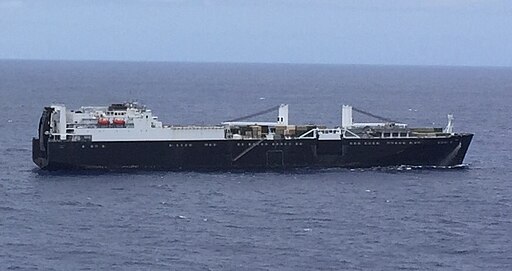
The USNS Dahl (T-AKR-312) is a Watson-class Large, Medium-Speed Roll-on/Roll-off (LMSR) cargo ship operated by the Military Sealift Command (MSC) of the United States Navy. Designed for the rapid deployment and transport of U.S. Army and Marine Corps vehicles, equipment, and supplies, the Dahl serves as a vital component of the nation’s strategic sealift capability — the logistical backbone that sustains forward-deployed military operations and humanitarian missions worldwide.
Development and Naming
USNS Dahl is named in honor of Specialist Larry G. Dahl (1949–1971), a U.S. Army Medal of Honor recipient who sacrificed his life in Vietnam to save fellow soldiers from a grenade attack. The ship’s name carries a legacy of valor and dedication, symbolizing the selfless service of American armed forces.
The vessel was constructed by General Dynamics NASSCO (National Steel and Shipbuilding Company) in San Diego, California, and delivered to the Military Sealift Command in July 1999. It is one of eight Watson-class LMSRs, all commissioned between the late 1990s and early 2000s as part of the Strategic Sealift Enhancement Program to modernize the U.S. Navy’s prepositioning and surge sealift fleets.
Mission and Role
The USNS Dahl’s primary mission is to provide rapid, large-scale ocean transport of combat vehicles, heavy equipment, ammunition, and supplies required by the U.S. Army and Marine Corps. It serves as part of the Surge Sealift Fleet, capable of deploying massive volumes of cargo during the early stages of military operations before follow-on forces arrive.
In peacetime, the ship remains on reduced operating status (ROS), typically crewed by a minimal team of civilian mariners, allowing for rapid activation when required. When called upon, it can be made fully operational within five days, ensuring quick readiness for global deployment.
Design Overview
As part of the Watson-class LMSR, the USNS Dahl features a massive, box-like hull optimized for internal vehicle storage and efficient cargo handling. The design emphasizes modular cargo decks, roll-on/roll-off access, and flexible load configurations to handle everything from light vehicles to main battle tanks.
-
Class & Type: Watson-class Large, Medium-Speed Roll-on/Roll-off (LMSR)
-
Hull Number: T-AKR-312
-
Builder: National Steel and Shipbuilding Company (NASSCO), San Diego, CA
-
Operator: Military Sealift Command (MSC)
-
Homeport: Charleston, South Carolina (prepositioned sealift base)
The ship’s internal configuration features multiple cargo decks connected by ramps and elevators, allowing wheeled and tracked vehicles to drive directly into position without reliance on dockside cranes.
Technical Specifications
| Specification | USNS Dahl (T-AKR-312) |
|---|---|
| Displacement (full load) | 62,100 tons |
| Length | 950 feet (290 meters) |
| Beam | 106 feet (32.3 meters) |
| Draft | 34 feet (10.4 meters) |
| Propulsion | Diesel-electric; 2 × medium-speed diesel engines |
| Power Output | Approx. 32,000 shaft horsepower |
| Propellers | Twin shafts, controllable-pitch propellers |
| Speed | 24 knots (maximum) |
| Range | 13,000 nautical miles at 20 knots |
| Crew (ROS) | ~30 civilian mariners |
| Crew (Full Activation) | Up to 50+ crew and support staff |
| Vehicle Deck Area | Over 380,000 square feet (approx. 35,000 m²) |
| Cargo Capacity | 58,000 measurement tons (approx. 1,000+ vehicles) |
| Container Capacity | 700+ standard 20-foot equivalent units (TEUs) |
| Helicopter Landing Pad | 1 × landing spot (V-22/MH-60 capable) |
| Endurance | 45 days without resupply |
The USNS Dahl’s massive cargo decks are equivalent to nearly eight football fields in area, capable of transporting an entire U.S. Army heavy brigade’s worth of equipment in a single voyage.
Propulsion and Engineering
The Dahl’s propulsion system is based on a diesel-electric drive configuration, combining fuel efficiency with operational reliability and redundancy.
-
Main Engines: 2 × medium-speed diesel engines driving generators
-
Propulsion Motors: Electric motors driving twin controllable-pitch propellers
-
Bow Thrusters: Twin 1,500 kW units for precise maneuvering
-
Power Generation: 4 × diesel-driven generators providing shipwide electrical power
-
Auxiliary Systems: Independent power and HVAC systems for cargo spaces
This propulsion arrangement provides excellent fuel economy for sustained operations and the ability to maintain high speed even under heavy load — a crucial factor during surge deployments.
Cargo Handling Systems
The heart of the Dahl’s functionality lies in its Roll-on/Roll-off (Ro-Ro) architecture and sophisticated cargo handling systems designed for rapid loading and unloading operations.
-
Stern Ramp: Heavy-duty ramp supporting main battle tanks (up to 70 tons each)
-
Side Port Ramp: Port-side loading ramp for dockside operations
-
Internal Ramps: Multi-deck internal ramps enabling drive-on vehicle access
-
Cargo Elevators: High-capacity elevators for vertical transport between decks
-
Cranes: 2 × 110-ton cranes for self-sustained cargo handling
-
Deck Load Strength: Rated for armored vehicles and containerized cargo
These systems allow the Dahl to conduct autonomous cargo operations, even in ports with limited or damaged infrastructure, making it essential for operations in contingency zones and disaster areas.
Ship Layout and Configuration
The vessel’s interior is divided into six primary cargo decks, optimized for maximum space utilization and operational efficiency.
-
Upper Decks: Primarily for wheeled vehicles and containers.
-
Lower Decks: For heavy tracked vehicles and armored platforms.
-
Superstructure: Located aft, housing crew accommodations, bridge, and engineering spaces.
-
Flight Deck: Located atop the superstructure for helicopter and vertical lift operations.
In addition to vehicle stowage, the ship includes workshops, spare parts storage, and cargo monitoring systems to ensure all transported equipment remains serviceable upon arrival.
Crew and Operations
The USNS Dahl is operated by the Military Sealift Command under the Surge Sealift Program. Its civilian crew operates navigation, engineering, and cargo systems, while military detachments may embark for operational or mission-specific duties.
-
Civilian Mariners (MSC): Approximately 30–35 when in Reduced Operating Status
-
Activation Crew (Full): 50–70 personnel including logistics and deck teams
-
Operating Readiness: Can be fully operational within 96–120 hours (5 days)
While in reserve, the ship undergoes periodic maintenance cycles and readiness drills to maintain immediate activation capability.
Communication and Navigation Systems
As a strategic transport vessel, the Dahl is equipped with a suite of modern navigation, communication, and control systems for global operations.
-
Navigation Suite: Integrated Bridge System (IBS), GPS, radar, and ECDIS
-
Communication Systems: Military and commercial SATCOM, VHF/UHF/HF radios
-
Cargo Monitoring: Environmental and security sensors across all decks
-
Automation: Centralized propulsion and power management systems
These systems enable the vessel to operate autonomously across long distances while maintaining secure contact with fleet command and logistical hubs.
Operational History and Service
Since joining the Military Sealift Command in 1999, the USNS Dahl has supported numerous U.S. and NATO operations around the world. It has participated in Operation Iraqi Freedom, Operation Enduring Freedom, and multiple joint logistics exercises.
Its role is typically prepositioned support, delivering heavy vehicles, engineering equipment, and supplies to forward bases or ports of debarkation during the initial phases of deployment.
The ship has also been utilized in humanitarian missions, transporting relief materials and engineering units to regions struck by natural disasters where traditional infrastructure is compromised.
Strategic Importance
The USNS Dahl (T-AKR-312) exemplifies the core capability of the U.S. Navy’s strategic sealift and rapid deployment fleet. It ensures that large-scale military power projection remains possible across the globe — delivering the armored and logistical foundation for sustained operations.
Its combination of immense cargo capacity, high speed, and autonomous handling makes it indispensable during the early stages of a crisis or conflict, enabling ground forces to deploy rapidly with their full complement of vehicles and supplies.
Moreover, the ship’s civilian operation under MSC allows it to remain cost-effective during peacetime while maintaining readiness for rapid activation during emergencies.
Technical Summary
| Parameter | Detail |
|---|---|
| Name | USNS Dahl (T-AKR-312) |
| Class | Watson-class LMSR |
| Type | Large, Medium-Speed Roll-on/Roll-off Cargo Ship |
| Displacement | ~62,100 tons full load |
| Length | 950 ft (290 m) |
| Beam | 106 ft (32.3 m) |
| Draft | 34 ft (10.4 m) |
| Speed | 24 knots max |
| Range | 13,000 nm |
| Propulsion | Diesel-electric, twin propellers |
| Crew | 30 (ROS), 50+ (active) |
| Vehicle Deck Area | 380,000+ sq. ft. |
| Cargo Capacity | 58,000 measurement tons |
| Flight Deck | 1 × helipad (V-22/MH-60 compatible) |
| Builder | NASSCO, San Diego, CA |
| Delivered | 1999 |
| Operator | Military Sealift Command |
Conclusion
The USNS Dahl (T-AKR-312) stands as a testament to the logistical might and foresight of the United States Navy. As one of the cornerstone assets of the Watson-class LMSR fleet, it combines massive lift capacity with flexibility, speed, and reliability.
In both wartime and peacetime roles, the Dahl ensures that U.S. forces remain strategically mobile and globally responsive, capable of projecting power or delivering aid anywhere on Earth. Through its enduring service, the USNS Dahl continues to uphold the legacy of its namesake — representing courage, commitment, and readiness in every mission it undertakes.
_and_USNS_Montford_Point_(MLP-1)_underway_off_Hawaii_in_May_2015_(cropped).JPG)