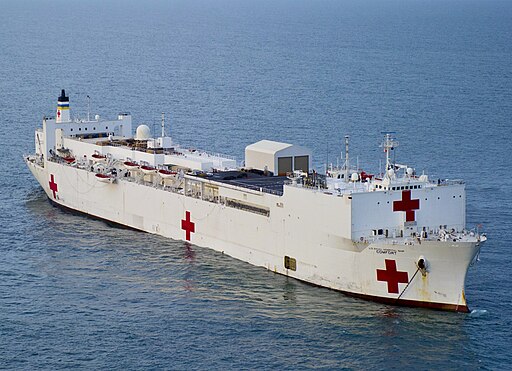
The USNS Comfort (T-AH-20) stands as one of the most iconic and capable hospital ships in the world. Operated by the Military Sealift Command (MSC), this vessel plays a critical role in both military medical operations and global humanitarian missions. Built on the hull of a converted supertanker, Comfort represents the United States’ commitment to providing advanced medical care and humanitarian assistance wherever it is needed — from combat zones to disaster-stricken regions.
Origins and Development
The USNS Comfort began life as the SS Rose City, a San Clemente-class supertanker, constructed by the National Steel and Shipbuilding Company (NASSCO) in San Diego, California. Launched in 1976, she was acquired by the U.S. Navy in 1987 and underwent a comprehensive conversion to a hospital ship, joining her sister ship, the USNS Mercy (T-AH-19).
The conversion involved transforming the tanker’s cavernous cargo spaces into fully equipped hospital wards, operating theaters, and support facilities, resulting in one of the most advanced floating medical platforms in history. USNS Comfort officially entered service on December 1, 1987, under the operational control of Military Sealift Command, crewed primarily by civilian mariners with Navy medical staff embarked for missions.
Mission and Role
USNS Comfort’s mission is twofold:
-
Combat Support: To provide rapid, mobile, and full-service hospital care for U.S. military forces engaged in combat operations.
-
Humanitarian Assistance: To deliver medical aid, disaster relief, and humanitarian services in times of crisis around the world.
The ship’s deployments have included combat support during Operation Desert Storm, Operation Iraqi Freedom, and Operation Enduring Freedom, as well as humanitarian operations such as Operation Unified Response (Haiti earthquake, 2010) and Operation Continuing Promise, providing medical aid throughout the Caribbean and Latin America.
Design and General Characteristics
Built from the hull of a large crude oil carrier, USNS Comfort retains much of its original supertanker architecture but has been completely reconfigured internally to house medical and command facilities.
-
Class and Type: Mercy-class Hospital Ship
-
Hull Type: Converted San Clemente-class supertanker
-
Builder: National Steel and Shipbuilding Company (NASSCO), San Diego, CA
-
Homeport: Norfolk, Virginia
-
Displacement: ~69,360 tons (full load)
-
Length: 272 meters (894 feet)
-
Beam: 32.2 meters (105.6 feet)
-
Draft: 10 meters (32.8 feet)
-
Propulsion: Steam turbine, single shaft
-
Power Output: 24,500 shaft horsepower
-
Maximum Speed: 17.5 knots
-
Range: 13,400 nautical miles at 17 knots
-
Endurance: 50 days at sea
The Comfort’s design focuses on stability and endurance, ensuring it can serve as a stationary medical facility near crisis areas for extended periods without needing to refuel or resupply frequently.
Medical Facilities and Capabilities
The USNS Comfort’s medical complex rivals a modern, shore-based hospital in both scale and sophistication. The ship is capable of providing full-spectrum medical care, from emergency triage and surgery to intensive care, radiology, and rehabilitation.
Medical Capacity:
-
Total Beds: 1,000
-
80 Intensive Care Unit (ICU) beds
-
20 Recovery (post-anesthesia) beds
-
280 Intermediate Care (Step-down) beds
-
120 Light Care beds
-
500 Limited Care beds
-
-
Operating Rooms: 12 fully equipped surgical suites
-
Radiology: X-ray, CT scanner, digital imaging suite
-
Laboratory: Full clinical laboratory and blood bank
-
Pharmacy: Onboard stock of over 2,000 pharmaceuticals
-
Dental Facilities: 4 dental operating rooms and a dental lab
-
Oxygen Generation Plant: Produces medical-grade oxygen onboard
The medical staff can perform a wide range of procedures, including trauma surgery, orthopedics, burn treatment, reconstructive surgery, and maternal care. The ship’s modular ward design allows sections to be reconfigured for specialized missions such as infectious disease isolation or mass casualty care.
Command, Communications, and Support Systems
As a floating medical base, Comfort features advanced command and control infrastructure for coordinating large-scale medical and humanitarian operations.
-
Integrated Communications: Secure satellite communications, HF/VHF/UHF radios
-
Medical Data Systems: Digital patient recordkeeping and telemedicine support
-
Navigation Suite: Redundant GPS and radar systems for global deployment
-
C4ISR Support: Networked systems for coordination with joint and allied commands
The ship’s operations are coordinated through a Joint Medical Operations Center (JMOC) onboard, providing real-time communication with the Department of Defense, the Department of State, and international relief agencies.
Crew and Personnel
The USNS Comfort operates with a hybrid crew structure—civilian mariners operate and maintain the ship, while Navy personnel staff the medical and command components.
-
Civilian Mariners: ~75 from Military Sealift Command
-
Medical and Support Staff (Full Deployment): Up to 1,200 Navy medical personnel
-
Total Personnel (Full Capacity): Approximately 1,275
This dual structure ensures the ship remains operational at all times, ready for activation within five days of notice for medical deployment.
Aviation and Logistical Capabilities
USNS Comfort features an expansive flight deck and aviation facilities that enable rotary-wing operations essential for patient transport and logistics.
-
Flight Deck: Capable of handling up to two H-60 Seahawk-class helicopters simultaneously
-
Aviation Support: Patient transfer elevator, refueling station, and medical evacuation area
-
Cargo Handling: Internal cargo elevators and conveyors for rapid reconfiguration
-
Boat Facilities: Small boats and landing craft for patient and supply transfer in ports lacking infrastructure
Helicopter operations are vital for moving patients from remote or combat zones directly to the ship’s medical facilities, especially when operating offshore or in disaster regions where airfields are unavailable.
Power and Life Support Systems
The Comfort is designed to operate autonomously for extended missions with robust onboard utilities.
-
Power Generation: Steam turbine-driven electrical generators providing 14 MW total output
-
Water Production: Two desalination plants generating up to 300,000 gallons/day
-
Waste Management: Medical waste incinerators, biological containment, and waste treatment systems
-
Air Conditioning: Fully climate-controlled spaces for tropical and temperate climates
These systems enable the ship to operate independently, supporting both its crew and hundreds of patients in isolated or damaged environments without reliance on shore-based resources.
Notable Deployments and Operations
Since entering service, USNS Comfort has participated in numerous missions showcasing its versatility and value:
-
Operation Desert Shield/Desert Storm (1990–1991): Treated over 8,000 patients during the Gulf War.
-
Operation Iraqi Freedom (2003): Provided trauma care to military personnel and civilians.
-
Hurricane Katrina Relief (2005): Delivered aid to the U.S. Gulf Coast.
-
Haiti Earthquake Response (2010): Treated more than 1,000 patients and performed 800 surgeries.
-
Operation Continuing Promise (2007–2022): Annual humanitarian deployments in Latin America and the Caribbean.
-
COVID-19 Response (2020): Deployed to New York City, providing medical relief and overflow capacity for overwhelmed hospitals.
Each deployment demonstrates the ship’s adaptability to both wartime and peacetime missions, bridging military logistics and humanitarian compassion.
Technical Summary
| Specification | USNS Comfort (T-AH-20) |
|---|---|
| Class & Type | Mercy-class Hospital Ship |
| Builder | National Steel and Shipbuilding Co. |
| Launched | 1976 (as SS Rose City); converted 1987 |
| Length | 272 m (894 ft) |
| Beam | 32.2 m (105.6 ft) |
| Draft | 10 m (32.8 ft) |
| Displacement | ~69,360 tons (full load) |
| Propulsion | Steam turbine, single shaft |
| Power Output | 24,500 shp |
| Speed | 17.5 knots |
| Range | 13,400 nm at 17 knots |
| Crew | ~75 civilians + up to 1,200 medical/navy staff |
| Medical Beds | 1,000 total |
| Operating Rooms | 12 |
| Helicopter Deck | 2 x H-60 capable spots |
| Endurance | 50 days at sea |
Strategic Importance
The USNS Comfort (T-AH-20) embodies America’s soft power projection — a vessel that heals, stabilizes, and assists populations around the globe. It serves as a mobile extension of U.S. medical diplomacy, reinforcing alliances and strengthening goodwill through humanitarian missions.
In wartime, Comfort is a critical element of the Navy’s medical support chain, capable of receiving casualties directly from combat zones and delivering surgical and rehabilitative care unmatched by any other floating platform.
Whether providing medical care after natural disasters, supporting pandemic relief, or reinforcing U.S. joint operations abroad, the USNS Comfort remains one of the most strategically valuable non-combatant assets in the Navy’s global fleet.
Conclusion
The USNS Comfort (T-AH-20) is more than just a ship — it is a symbol of compassion and readiness, merging advanced naval engineering with humanitarian mission capability. Its immense capacity, global reach, and sophisticated medical infrastructure make it indispensable in both defense and diplomacy. As the world continues to face evolving challenges, the Comfort’s enduring mission — to bring care, hope, and healing wherever it sails — remains as vital today as it was when she first entered service.
_is_anchored_off_the_coast_of_Tumaco,_Colombia,_during_(cropped).jpg)