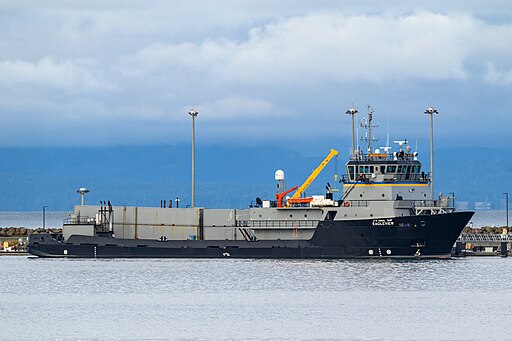
The USNS Eagleview (T-AGSE-3) is a specialized auxiliary vessel operated by the Military Sealift Command (MSC) of the United States Navy. As part of the T-AGSE series of submarine and special warfare support ships, Eagleview plays a unique role in providing escort, surveillance, and support services to submarine operations and other specialized maritime missions. Though compact compared to major warships or large auxiliaries, its adaptability, specialized equipment, and dedicated mission profile make it a highly capable asset in the Navy’s non-combatant support fleet.
Development and Acquisition
Originally built in 2009 for commercial service, the hull that would become Eagleview was constructed by Leevec Industries in Jennings, Louisiana, for Hornbeck Offshore. In 2015 the vessel was acquired by the U.S. Navy and redesignated as T-AGSE-3, joining the Black Powder-class of submarine and special-warfare support vessels. This class was created to fill a capability gap: smaller, agile ships capable of supporting submarine escort, hydrographic survey, and special-operations support in littoral or restricted environments. The Navy’s purchase converted what had been an offshore/hospital-supply style vessel into a dedicated support asset under MSC control.
The naming—Eagleview—reflects the support role of the vessel in providing ‘oversight equipment’ (view) and support (eagle) to submarine and special-warfare operations. The ship acts essentially as a multipurpose support platform rather than a front-line combatant.
Mission and Role
Eagleview’s mission profile is centered on the following tasks:
-
Submarine Support & Escort: One of Eagleview’s chief duties is to accompany submarines—especially ballistic missile or ballistic-submarine (SSBN) units—when they transit restricted or sensitive waters, providing surface support, communications, and environmental monitoring.
-
Special Warfare Support: The ship can serve as a staging or support platform for special-operations forces (SOF), providing logistics, communications relay, and small-boat operations.
-
Oceanographic/Hydrographic Surveying: While not a dedicated survey ship, Eagleview can conduct sonar and ocean-floor environment monitoring, supporting submarine and under-sea warfare readiness by mapping bottom contours, monitoring acoustic conditions, and supporting quieter submarine operations.
-
Force Multiplication in Littorals: With its smaller size and shallow draft relative to large auxiliaries, Eagleview can operate in nearer-shore or restricted waterways, providing flexible surface presence and support where larger vessels may not fit.
In practice the vessel has been reported to escort a US Ohio-class SSBN during a transit in Puget Sound—an indication of its practical role in strategic deterrence support.
Design and Hull Characteristics
The USNS Eagleview features a compact hull form suited to high maneuverability and shallow-water operations. While official full specifications are limited, the best available publicly documented figures show:
-
Length (overall): Approximately 250 ft (≈76 m)
-
Beam: Approximately 54 ft (≈16 m)
-
Draft: Approximately 14-15 ft (≈4.3-4.6 m)
-
Gross Tonnage / Displacement: Around 2,428 gross tons; light displacement and full load displacement data are less well publicized
-
Speed: Maximum speed roughly 14 knots in initial commercial service; in Navy support operations likely similar or slightly higher
-
Construction Material: Steel hull, designed originally as an offshore supply/ support vessel then adapted for Navy use
The relatively shallow draft and moderate length grant the ship access to ports, bays, and coastal waters that larger auxiliaries cannot readily reach. The beam gives adequate stability for support-equipment operations, while the moderate size allows cost-efficient operation under MSC civilian-crew model.
Propulsion, Performance & Engineering Systems
Eagleview’s propulsion and engineering profile reflect its origins in the offshore-supply industry rather than high-combat warships:
-
Propulsion Type: Diesel engines driving shafts or possibly diesel-electric configuration (commercial reference indicates “Diesel”).
-
Powerplant: Records from commercial service identify Caterpillar engines (two units flagged) with nominal 6,000 horsepower total.
-
Maximum Speed: Approximately 14 knots in original configuration; cruising speed likely lower (e.g., 10-12 knots) when supporting mission-systems loads.
-
Range & Endurance: While exact figures are not publicly verified, as a support ship it likely can remain at sea for multiple days/weeks depending on support systems and mission profile given its size and fuel capacity.
-
Maneuvering Systems: The vessel’s career as a supply-type ship implies good maneuverability for station‐keeping and near‐shore operations, aided by thrusters or enhancements made during Navy adaptation.
Given the mission of submarine escort and special warfare support, Eagleview also likely has enhanced communications, sensor, and station‐keeping equipment to maintain position relative to submarines or performing towing/monitoring tasks.
Mission-System Equipment and Support Capabilities
Although full classification of onboard mission systems is not publicly available, the Eagleview in its role supports several unique capabilities:
-
Communications Suite: High‐capability SATCOM links, surface‐to‐submarine communications relays, VHF/UHF/HF systems, and support for secure Navy networks.
-
Sensor & Tracking Equipment: While not fully disclosed, as an escort/support vessel for submarines Eagleview may carry passive acoustic sensors, hull-mounted sonars, or tow cable sensors to monitor underwater acoustic environment or submarine wake/contact.
-
Small-Craft Handling: The vessel is equipped to deploy and recover small boats, rigid inflatable boats (RIBs), and unmanned surface or underwater vehicles; these are essential for special-warfare insertions or submarine support operations.
-
Helicopter Deck / Aviation Support: Given its size, Eagleview may have a small helicopter landing deck or at least a space for unmanned aerial systems (UAS) operations to provide aerial surveillance in support of submarine escorts.
-
Modular Mission Spaces: Interior spaces may be configured with mission-control rooms, data analysis workstations, and special-operations staging areas. The flexibility enables the ship to shift among roles such as escort, survey, or special-operations support.
-
Deck Handling & Towing Capabilities: Although not a large tug, the ship can perform tow lines or attachments to submarines during crew-exchange operations at sea, or support rescue/transfer operations for submarines in transit.
Collectively, these systems make Eagleview more than a simple escort vessel—it acts as a multipurpose platform that enhances submarine operational safety, logistical support, and underwater surveillance capability.
Crew, Accommodations & Operations
The operational model for USNS Eagleview follows the MSC practice of civilian mariner crews augmented by mission-specific personnel:
-
Core Crew: Civilian mariners under MSC management handle navigation, engineering, and ship operations—likely numbering between 12-30 depending on activation status.
-
Mission Advocates / Specialists: Additional personnel such as underwater-warfare specialists, communications operators, small-boat teams or submarine liaison officers may embark depending on mission requirements.
-
Operational Status: The ship is maintained in a state of readiness under MSC’s special-mission category. It can be rapidly deployed to support submarine transits, special-warfare insertions, or survey operations.
-
Accommodations: While modest compared to warships, the vessel provides accommodation for crew and specialist personnel, including cabins, mess areas, small conference/mission-planning spaces, and workstations for sensor/communications operations.
This model enables cost-effective readiness—civilian mariners maintain the ship in peacetime, while mission-specific military personnel embark as needed, preserving flexibility and responsiveness.
Operational History and Notable Deployments
Since acquisition by the Navy in 2015, Eagleview has engaged in several notable operational tasks:
-
The vessel was publicly highlighted by MSC in April 2025 for its role in escorting the Ohio-class ballistic-missile submarine USS Maine as it transited Puget Sound, illustrating its active support role in U.S. strategic deterrent operations.
-
Through its class (the Black Powder-class / T-AGSE series) Eagleview participates routinely in submarine transit support, special-operations support exercises, and maritime domain awareness missions.
-
The ship’s versatility has reportedly allowed it to operate in littoral zones, conduct small-boat operations, and assist with underwater monitoring tasks, though full operational details remain restricted given the nature of submarine support.
These missions underscore the ship’s utility not only for traditional logistics but as a highly specialized asset in under-sea warfare support and strategic submarine operations.
Significance & Strategic Role
USNS Eagleview occupies a unique niche in the U.S. Navy’s auxiliary fleet. Its significance can be understood in several dimensions:
-
Force Multiplication: By providing surface-support to submarines, Eagleview extends the operational envelope of the submarine force, enhances safety and readiness, and allows submarines to transit contested or restricted areas with surface support.
-
Flexible Littoral Access: The vessel’s moderate size permits operations closer to shorelines, in areas where larger ships would be constrained—making it valuable for near-coast support, small-boat operations, or shallow-water missions.
-
Cost-Efficient Asset: As a civilian‐crewed MSC ship, Eagleview represents a cost-effective method to provide high-value support missions without deploying a full commissioned warship or large auxiliary vessel.
-
Special Operations Integration: Its capability to handle small boats, unmanned systems, and special-missions personnel means it bridges the gap between large-scale logistics and high-end special-operations support.
-
Underwater Domain Awareness: With the growing focus on under-sea warfare, littoral surveillance, and acoustic environmental monitoring, ships like Eagleview offer specialized platforms that can enhance mapping, tracking, and monitoring of strategic underwater areas.
In short, Eagleview is an enabler—supporting core submarine missions, enabling special-warfare operations, and providing agile auxiliary capability in environments where larger platforms may be excessive or impractical.
Technical Summary
| Parameter | Specification (approximate) |
|---|---|
| Name | USNS Eagleview (T-AGSE-3) |
| Class | Black Powder-class Submarine & Spec Warfare Support Vessels |
| Builder | Leevec Industries, Jennings, Louisiana |
| Year Built | 2009 (commercial service) |
| Acquisition by Navy | 2015 |
| Length (overall) | ~250 ft (~76 m) |
| Beam | ~54 ft (~16 m) |
| Draft | ~14-15 ft (~4.3-4.6 m) |
| Gross Tonnage | ~2,428 GT |
| Maximum Speed | ~14 knots (commercial configuration) |
| Propulsion | Diesel engines (commercial) |
| Crew (Civilian) | ~12-30 (plus mission-specialists as needed) |
| Primary Missions | Submarine escort, special-warfare support, oceanographic/hydrographic support |
| Homeport / Flag | U.S. Flagged, operated by Military Sealift Command |
Conclusion
The USNS Eagleview (T-AGSE-3) may not match the size or firepower of major warships, but within its niche it serves a critical strategic role. By supporting submarine operations, sustaining special-warfare missions, and providing flexible presence in littoral and restricted waters, Eagleview helps fill the gap between traditional logistics ships and front-line combat vessels. Its acquisition and ongoing use reflect the Navy’s recognition of the importance of agile, specialized support platforms in an evolving maritime environment. Eagleview stands as an example of how targeted auxiliary vessels can enhance overall fleet capability, readiness and strategic reach.
