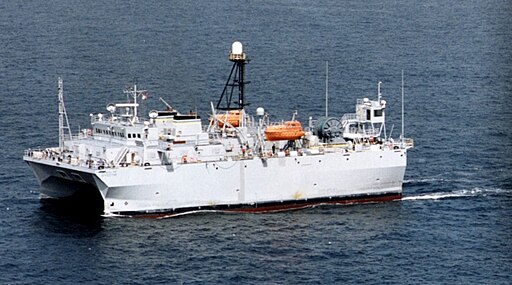
The USNS Effective (T-AGOS-21) is a Victorious-class ocean surveillance ship operated by the Military Sealift Command (MSC) of the United States Navy. As part of the Navy’s sophisticated undersea surveillance system, Effective plays a vital role in detecting, tracking, and monitoring submarine movements and undersea acoustic activity. Equipped with a Surveillance Towed Array Sensor System (SURTASS), the ship is a critical component of the U.S. Navy’s Integrated Undersea Surveillance System (IUSS), providing real-time acoustic intelligence for antisubmarine warfare (ASW) operations and maritime domain awareness.
Development and Background
The Victorious-class (T-AGOS 19-class) represents the Navy’s second generation of small waterplane area twin hull (SWATH) ocean surveillance ships, designed to replace the older Stalwart-class vessels of the 1980s. The class was built to accommodate SURTASS and Low-Frequency Active (LFA) sonar systems, both of which significantly enhanced long-range submarine detection.
The USNS Effective (T-AGOS-21) was built by McDermott Shipyards in Morgan City, Louisiana, and delivered to the Navy in January 1993. She is the third ship of her class, following the USNS Victorious (T-AGOS-19) and USNS Able (T-AGOS-20). Like other ships in her class, Effective is operated by a civilian MSC crew, with embarked Navy oceanographic and acoustic specialists responsible for surveillance operations.
The name “Effective” underscores her operational mission — to provide effective detection and tracking of undersea threats, particularly submarines operating in deep ocean and littoral waters.
Mission and Role
The primary mission of the USNS Effective is undersea surveillance — specifically, the collection of acoustic and oceanographic data in support of the U.S. Navy’s Antisubmarine Warfare (ASW) forces. Her role includes:
-
Detection and Tracking of Submarines: Using the SURTASS array, the ship identifies and tracks submarine movements across wide ocean regions.
-
Acoustic Data Collection: Gathers acoustic signatures and environmental data that enhance submarine detection algorithms.
-
Surveillance in Strategic Areas: Operates in designated maritime zones critical to national security, including open ocean and chokepoint regions.
-
Integration with the IUSS: Data collected by Effective is transmitted in near-real time to shore-based IUSS facilities, where analysts process and disseminate findings to operational commands.
-
Multinational Coordination: The ship can support joint and coalition ASW exercises with allied navies.
As a non-combatant vessel, the Effective is unarmed, relying on the protection of U.S. and allied naval forces for security in contested waters.
Design and Hull Configuration
The USNS Effective’s design follows the SWATH (Small Waterplane Area Twin Hull) configuration, which offers excellent stability and acoustic quietness — crucial for precision sonar work.
Hull Characteristics
-
Class and Type: Victorious-class ocean surveillance ship (T-AGOS)
-
Hull Design: Small Waterplane Area Twin Hull (SWATH)
-
Builder: McDermott Shipyards, Morgan City, Louisiana
-
Keel Laid: 1989
-
Launched: 1991
-
Delivered: January 27, 1993
The twin-hull design minimizes wave-induced motion, allowing for smooth towing of sensitive sonar arrays. This feature makes the ship exceptionally stable, even in rough sea states, which is essential for maintaining sonar array calibration and signal clarity.
Technical Specifications
| Parameter | Specification |
|---|---|
| Length (overall) | 235 feet (71.6 meters) |
| Beam | 88.5 feet (27 meters) |
| Draft | 19 feet (5.8 meters) |
| Displacement (full load) | 3,300 tons |
| Hull Type | SWATH twin hull |
| Propulsion System | Diesel-electric, twin propellers |
| Engines | 4 × Caterpillar 3512 marine diesel engines driving generators |
| Propulsion Motors | 2 × General Electric electric propulsion motors |
| Power Output | 3,200 shaft horsepower total |
| Maximum Speed | 16 knots |
| Operational Range | 3,000 nautical miles at 12 knots |
| Endurance | 30+ days at sea |
| Crew (MSC Civilian) | Approximately 20–25 |
| Military/Technical Detachment | 5–10 Navy personnel (SURTASS operators, technicians) |
| Homeport | Naval Station Mayport, Florida |
The ship’s modest size, slow speed, and efficient propulsion are optimized for steady-state operations rather than rapid transit — enabling prolonged, quiet surveillance in oceanic environments.
Propulsion and Power Systems
The diesel-electric propulsion system of USNS Effective was selected for its quiet acoustic signature and high efficiency during long-duration missions.
-
Prime Movers: Four Caterpillar 3512 diesel generators producing electrical power for ship systems and propulsion.
-
Electric Motors: Two large electric propulsion motors drive twin controllable-pitch propellers.
-
Power Management: Integrated power system ensures stable energy flow to propulsion and electronic systems, crucial for sonar sensitivity.
-
Maneuvering: Equipped with bow thrusters for precision station-keeping when deploying or retrieving sonar arrays.
This configuration minimizes mechanical vibrations and noise — a key factor in ensuring that the ship’s own acoustic footprint does not interfere with its sonar sensors.
Surveillance and Sensor Systems
The USNS Effective is equipped with the Surveillance Towed Array Sensor System (SURTASS) — the centerpiece of the U.S. Navy’s passive undersea surveillance network.
SURTASS System Overview
-
Function: Long-range passive sonar system designed to detect and track submarines.
-
Configuration: A long cable array (several thousand feet) towed astern, containing hydrophones that detect sound in the water column.
-
Operation: The array listens for acoustic signals, which are processed on board using advanced digital signal processing equipment.
-
Data Relay: Information is transmitted via satellite communications to the Naval Ocean Processing Facilities (NOPFs) for analysis.
LFA (Low-Frequency Active) Integration
Some ships of the Victorious-class, including Effective, are equipped or capable of being fitted with Low-Frequency Active (LFA) sonar. LFA uses low-frequency sound pulses to detect quiet submarines over vast distances — a complement to SURTASS passive capabilities.
Together, these systems make the ship a vital sensor node in global undersea surveillance operations.
Navigation and Communication Systems
Accurate positioning and reliable communication are critical for ocean surveillance missions. The USNS Effective’s systems include:
-
Navigation Suite: Integrated Bridge System (IBS), dual GPS receivers, radar systems, and electronic chart display (ECDIS).
-
Communication Systems: Military SATCOM (UHF/EHF), INMARSAT, secure HF/VHF radios, and encrypted data links to IUSS centers.
-
Acoustic Quieting: Specialized hull-mounted sensors to monitor self-noise and maintain “quiet ship” standards during operations.
-
Weather and Ocean Data Systems: Real-time meteorological and oceanographic sensors aid in sonar calibration and acoustic modeling.
These systems ensure continuous communication and precise navigation, even in remote or rough-sea environments.
Crew and Operations
USNS Effective operates under the Military Sealift Command’s Special Mission Program, with a civilian crew responsible for navigation, maintenance, and logistics, while Navy technicians manage the acoustic and surveillance systems.
-
Civilian Crew (MSC): 20–25 members, including Master, Chief Engineer, and deck/engineering officers.
-
Navy Detachment: Typically 5–10 personnel, primarily sonar technicians, acoustic analysts, and communications specialists.
-
Endurance: The ship can remain on station for over 30 days, conducting continuous towed-array surveillance.
Crew quarters and mission spaces are optimized for long-duration deployments, including living quarters, galley, data-analysis compartments, and control centers for SURTASS operations.
Operational History
Since entering service in 1993, USNS Effective has played a critical role in maintaining the United States’ undersea situational awareness. Operating largely in the Atlantic Ocean and adjacent waters, Effective has conducted numerous surveillance missions, ASW data-collection operations, and joint naval exercises.
Though the details of its missions are classified, the ship’s primary focus has been monitoring foreign submarine activity — particularly in strategic chokepoints and patrol regions vital to U.S. and NATO naval operations.
Effective’s mission profile has also included cooperation with allied navies, providing acoustic data and participating in multinational ASW exercises designed to enhance collective defense capabilities.
Significance and Strategic Value
The USNS Effective (T-AGOS-21) is an indispensable part of the U.S. Navy’s undersea surveillance infrastructure, providing persistent, covert monitoring of global submarine activity. Its ability to detect and classify acoustic signatures across thousands of nautical miles underpins U.S. dominance in the undersea domain.
Key strategic contributions include:
-
Early Warning: Detects potential submarine threats long before they approach U.S. or allied waters.
-
ASW Support: Supplies acoustic data to ASW strike groups and submarine commanders.
-
Scientific Contribution: Collects oceanographic data critical for sonar propagation modeling.
-
Intelligence Gathering: Provides long-term pattern-of-life information for foreign submarine fleets.
In essence, the Effective acts as both a sensor platform and intelligence node, extending the Navy’s underwater situational awareness far beyond the reach of individual ships or submarines.
Technical Summary
| Parameter | Details |
|---|---|
| Ship Name | USNS Effective (T-AGOS-21) |
| Class & Type | Victorious-class ocean surveillance ship |
| Displacement (Full Load) | 3,300 tons |
| Length | 235 ft (71.6 m) |
| Beam | 88.5 ft (27 m) |
| Draft | 19 ft (5.8 m) |
| Propulsion | Diesel-electric, twin screws |
| Power Output | 3,200 shp |
| Speed | 16 knots |
| Crew | 20–25 civilian, 5–10 military |
| Sensors | SURTASS, optional LFA sonar |
| Endurance | 30+ days |
| Homeport | Mayport, Florida |
| Operator | Military Sealift Command, Special Missions Program |
Conclusion
The USNS Effective (T-AGOS-21) epitomizes the quiet strength of the United States Navy’s undersea surveillance force. Designed for endurance, stability, and precision, she is a floating sensor array—a critical tool for tracking the movements of submarines and ensuring maritime security beneath the surface.
In an age where undersea dominance is central to deterrence and national defense, the Effective’s mission remains vital. Her continuous operations, silent but essential, help maintain the Navy’s awareness of global underwater activity and ensure that America’s strategic advantage beneath the oceans remains secure.
