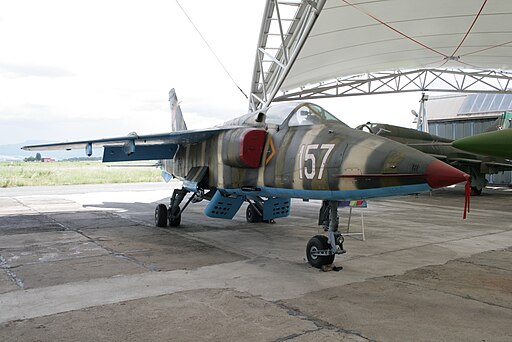
The IAR-93 Vultur was a twin-engine, subsonic, ground-attack and advanced trainer aircraft developed jointly by Romania and Yugoslavia during the late Cold War as a cost-effective alternative to Soviet-supplied strike aircraft. Conceived in the early 1970s and first flown in 1974, the program aimed to give both nations an indigenous tactical platform optimized for close air support, battlefield interdiction, and pilot training in high-performance jet operations. Rather than pursuing supersonic speed, the designers focused on robustness, ease of maintenance, low-altitude survivability, and the ability to operate from semi-prepared forward airstrips. This design philosophy resulted in an aircraft that emphasized structural strength, wide weapon compatibility, and predictable handling while remaining affordable within the industrial limits of its partner nations.
Airframe configuration and structural layout
The IAR-93 employed a conventional mid-wing monoplane arrangement with swept wings and a slender fuselage built primarily from stressed-skin aluminum alloy with reinforced load-bearing frames around the engine bays and weapon stations. The wing was shoulder-mounted relative to the fuselage centerline and featured a moderate sweep of approximately 30 degrees, optimized for stability at transonic regimes while retaining controllability at low strike altitudes. Wing structure incorporated multi-spar construction with hydraulic flaps and spoilers to improve slow-speed handling during takeoff and landing. The fuselage housed tandem seating for the trainer variant and single-seat layout for pure strike configurations, with a sharply raked windscreen providing good forward visibility during low-level attack runs. Large ventral air intakes on either side of the fuselage fed the twin engines while minimizing disruption to airflow over the wing roots.
Powerplant and propulsion systems
The aircraft was powered by two Rolls-Royce Viper Mk 632-41R turbojet engines produced under license, each delivering approximately 17.79 kN (4,000 lbf) of thrust. These engines were selected for their reliability and proven performance on several European jet trainers and light fighters, enabling simplified logistics and long service intervals. The twin-engine configuration gave the IAR-93 enhanced survivability in combat environments, allowing the aircraft to maintain controlled flight even after the loss of one engine. Fuel was stored in internal wing and fuselage tanks with provision for external drop tanks on underwing pylons, extending operational range and loiter time during close air support missions. The propulsion system emphasized rapid throttle response and resilience to foreign object ingestion, crucial for low-level operations over unimproved terrain.
Technical specifications and dimensions
In terms of physical dimensions, the IAR-93 featured an overall length of approximately 14.68 meters, a wingspan of around 9.80 meters, and a height of 4.48 meters at the tail fin. The wing area was approximately 26 square meters, supporting a maximum takeoff weight of 9,000 kilograms depending on configuration and external stores. Typical empty weight was approximately 5,300 kilograms, yielding a useful combat payload capacity of up to 2,000 kilograms distributed across six underwing and fuselage hardpoints. Maximum speed was around Mach 0.9 at altitude, with a practical service ceiling of 12,000 meters. Operational range reached roughly 1,100 kilometers with external fuel tanks, while combat radius in low-level strike configuration was typically between 250 and 400 kilometers depending on mission loadout and flight profile.
Cockpit design and avionics suite
The cockpit environment reflected a balance between operational simplicity and mission effectiveness, with the pilot seated in an ejection seat rated for zero-zero performance. Instrumentation was predominantly analog, featuring standard flight gauges, engine monitoring systems, targeting indicators, and radio navigation equipment. Later variants incorporated improved radio systems, tactical navigation aids, and limited weapon-aiming computers to increase strike accuracy. The dual-control trainer version allowed full instructor override, facilitating transition training from basic jet aircraft to frontline operational roles. The cockpit canopy was framed but offered adequate all-round visibility, essential for low-level maneuvering and target acquisition.
Armament and weapons integration
The IAR-93’s primary mission profile revolved around close air support and light tactical strike, and its armament configuration reflected this role. Fixed forward armament typically included twin internal cannons mounted in the lower fuselage, each capable of delivering high rates of fire for both air-to-ground and limited air-to-air engagement. External stores could include unguided rocket pods, free-fall bombs, napalm canisters, and light anti-armor munitions. Hardpoints were rated to carry combinations of 250 kg and 500 kg bombs, cluster munitions, and auxiliary fuel tanks. Although not designed as an air superiority fighter, the aircraft could carry short-range infrared-guided air-to-air missiles for self-defense, increasing survivability when operating near hostile airspace.
Flight performance and operational behavior
From a flight handling perspective, the IAR-93 presented stable and predictable characteristics, particularly in low-altitude mission profiles. The aircraft was optimized for sustained subsonic flight, with strong roll response and controlled pitch authority during attack maneuvers. Pilots valued its forgiving stall behavior and the redundancy offered by its twin-engine layout. Takeoff and landing distances were suitable for deployment from dispersed frontline air bases, including rough or semi-prepared runways. The airframe’s resilience allowed it to absorb battle damage and maintain structural integrity, a critical requirement for aircraft operating under heavy ground-fire conditions.
Development variants and evolutionary changes
Throughout its operational history, the IAR-93 evolved through multiple variants distinguished by structural refinements and upgraded systems. Early production versions focused on basic operational capability, while later iterations featured strengthened wings for increased payload, improved engine nacelle cooling, and updated avionics for better mission coordination. Some variants incorporated enhanced braking systems and revised landing gear geometry to support heavier loads and more aggressive landing profiles. These incremental improvements allowed the platform to remain relevant despite rapid advances in aerial combat technology during the late 20th century.
Operational service and deployment philosophy
Both Romanian and Yugoslav air forces employed the IAR-93 extensively for tactical ground attack and pilot training duties. It was stationed at multiple regional airbases, serving as a backbone aircraft for frontline strike squadrons and advanced jet instruction units. Its ability to carry diverse munitions and perform under harsh weather and terrain conditions made it well-suited to the varied operational environments of Eastern Europe and the Balkans. Training emphasis focused on low-level navigation, pop-up attack techniques, and coordinated ground-attack operations with mechanized forces.
Strengths, limitations, and legacy
The primary strengths of the IAR-93 lay in its simplicity, rugged construction, and mission adaptability. It offered a reliable solution for nations seeking independent military aviation capability without dependence on major superpower suppliers. However, its lack of advanced radar, precision-guided weapons integration, and supersonic performance limited its effectiveness against modern air defenses and fast interceptors. As technology evolved, the aircraft gradually became obsolete, replaced by more agile and digitally integrated platforms. Despite this, the IAR-93 remains an important example of regional aerospace engineering ambition, representing a successful multinational effort that balanced cost, performance, and tactical utility.
Conclusion
The IAR-93 Vultur occupies a distinctive place in Cold War aviation history as a purpose-built strike and training aircraft focused on operational practicality rather than technological extravagance. Its twin-engine configuration, solid performance envelope, and adaptable weapons capability made it a dependable platform for frontline support operations within its intended doctrine. While eventually eclipsed by modern multirole combat aircraft, its contribution to the development of Romanian and Yugoslav aviation industries and tactical air doctrine underscores its enduring significance as a pragmatic and technologically coherent military aircraft design.
