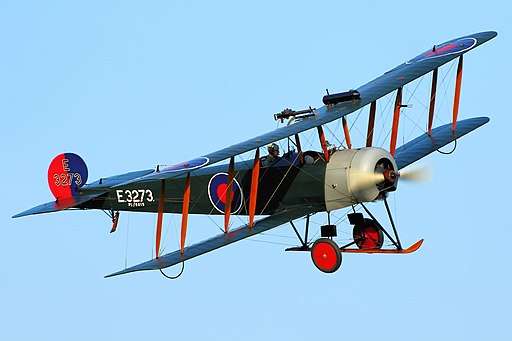
The Avro 504 was one of the most influential British aircraft of the early twentieth century, serving as a trainer, reconnaissance platform, light bomber, and experimental testbed. Introduced during the First World War and produced in large numbers, it became synonymous with pilot training well into the 1920s. Its straightforward construction, forgiving handling characteristics, and adaptability allowed it to outlive many contemporaries. By the end of its production life, the Avro 504 had accumulated a legacy as one of the most prolific biplanes ever built.
Design and Construction
The Avro 504 employed a conventional wood-and-fabric biplane design optimized for robustness and simplicity. Its fuselage consisted of a wire-braced wooden frame typically constructed from spruce longerons and ash or plywood formers, all covered in doped linen fabric. This method resulted in an airframe that was lightweight yet sufficiently strong to absorb the stresses imposed by novice pilots.
The wings were arranged in a two-bay biplane configuration with equal span and a fixed incidence. Interplane struts and bracing wires provided rigidity while allowing quick field repairs. Early variants incorporated ailerons only on the upper wings, though some later models featured ailerons on both upper and lower surfaces for improved roll response. The tailplane used a similarly light wooden structure with fabric covering, and the rudder’s gently rounded profile became one of the aircraft’s visual signatures.
Undercarriage construction consisted of a simple two-wheel setup with a cross-axle mounted on V-struts. A tailskid, reinforced with metal sheathing, provided directional stability during takeoff and landing on grass airfields. The airframe’s structural simplicity meant that damaged components could be replaced easily, a key advantage in training units where accidents were common.
Powerplant and Performance
Throughout its service history, the Avro 504 series was fitted with a variety of rotary and inline engines. Early production aircraft commonly used the Gnome Monosoupape 100 hp rotary engine, well-regarded for its power-to-weight ratio but known for its operational quirks such as heavy gyroscopic forces. Later variants, including the widely used 504J, often employed the Le Rhône 80 hp rotary engine, which offered a more manageable power output for student pilots.
Typical performance figures for the Avro 504 included a maximum speed in the range of 85 to 95 miles per hour depending on engine type and airframe modifications. Its service ceiling often exceeded 15,000 feet, aided by the low weight of rotary engines. Climb performance was modest but adequate for training scenarios. The aircraft’s endurance generally ranged from two to three hours, depending on throttle management and fuel load.
Flight Characteristics
Pilots widely regarded the Avro 504 as stable, predictable, and controllable across the flight envelope—qualities essential for a primary trainer. Its biplane configuration delivered substantial lift at low speeds, making stalls gentle and recoverable. The large tail surfaces contributed to steady longitudinal behavior, allowing new pilots to learn coordinated flight and landing approaches with reduced risk compared to contemporary single-seat fighters.
The rotary engines produced pronounced torque effects, particularly during takeoff and steep turns. Instructors viewed this as a beneficial learning feature because it prepared trainees for similar behavior in frontline fighters like the Sopwith Camel. The aircraft’s open cockpit and excellent visibility enhanced situational awareness and facilitated communication between instructor and student.
Operational History
Introduced before the outbreak of the First World War, the Avro 504 initially served in reconnaissance and light bombing roles. Early missions included a notable raid on a Zeppelin shed, demonstrating the aircraft’s operational value despite its modest power. As aircraft technology advanced rapidly during wartime, the Avro 504 transitioned to serve primarily as a trainer.
Training establishments across Britain and allied countries adopted the Avro 504 in large numbers. Its reliability and forgiving nature allowed thousands of pilots to earn their wings. Variants evolved to meet different needs, including dual-control trainers, gunnery trainers, and communications aircraft. After the war, surplus airframes became widespread in civilian aviation as sport aircraft, barnstormers, and instructional platforms.
Production continued for years after wartime demand subsided, with more than eight thousand units eventually built. This remarkable production volume cemented the Avro 504 as one of the most manufactured aircraft of its era.
Technical Specifications (Typical Avro 504K)
- Crew: Two
- Length: Approximately 29 ft
- Wingspan: Approximately 36 ft
- Height: Approximately 10 ft
- Empty Weight: Around 1,150 lb
- Maximum Takeoff Weight: Around 1,750 lb
- Powerplant: Commonly a Le Rhône 80 hp rotary engine
- Maximum Speed: Approximately 90 mph
- Range: Around 250 miles
- Service Ceiling: Approximately 15,000 ft
Legacy
The Avro 504 played a pivotal role in shaping early military aviation. Its significance extended far beyond combat, forming the backbone of the pilot training infrastructure that prepared air forces for the increasingly complex aircraft of the 1920s and 1930s. Many nations adopted it as their first standardized trainer, and numerous aerospace engineers gained formative experience working on or studying its design.
.jpg)