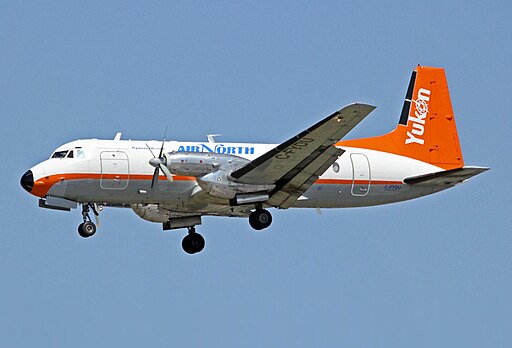
The Hawker Siddeley HS 748 is a British twin-engine turboprop airliner developed in the late 1950s and introduced in the early 1960s. It was designed primarily to serve short-haul regional routes, particularly in environments with limited infrastructure, such as undeveloped airfields and remote locations. Known for its robustness and reliability, the HS 748 became a workhorse for both civil and military operators around the world. The aircraft earned a reputation for excellent short takeoff and landing (STOL) performance, making it especially valuable in areas with short or rough runways.
Design and Development
The HS 748 was developed by Avro before the company became part of Hawker Siddeley Aviation. The aircraft’s design was driven by the need for a dependable, easy-to-maintain, and rugged airliner capable of operating in austere environments. It incorporated a high-wing monoplane design, which provided increased ground clearance for the engines and propellers and facilitated loading and unloading in less developed airports. The aircraft’s sturdy landing gear, with dual wheels on each main gear strut, was built to withstand rough field operations.
The structure of the HS 748 combined metal construction with an emphasis on ease of maintenance and serviceability. The aircraft was powered by two Rolls-Royce Dart turboprop engines, a reliable powerplant widely used in several other turboprop aircraft of the era. The propellers were four-bladed constant-speed units, optimizing thrust and fuel efficiency. The aircraft’s cabin was pressurized, offering passengers a comfortable flight experience despite its regional focus.
Technical Specifications and Performance
The HS 748 has a wingspan of 97 feet 3 inches (29.64 meters), which supports its high-wing configuration. Its length measures approximately 72 feet 9 inches (22.16 meters), while the height stands at 27 feet 3 inches (8.31 meters). This relatively compact size allowed the HS 748 to operate efficiently on short regional routes and in confined airports.
The aircraft is powered by two Rolls-Royce Dart RDa7 Mk 531-7 turboprop engines, each producing around 1,600 shaft horsepower (shp). This power output enabled the HS 748 to reach a maximum cruising speed of approximately 265 knots (305 mph or 490 km/h), with a service ceiling of 25,000 feet (7,620 meters). The aircraft’s range varied based on payload but was typically around 1,500 nautical miles (2,778 kilometers), making it suitable for medium-length regional flights.
One of the HS 748’s key strengths was its takeoff and landing performance. The aircraft required a takeoff run of about 3,350 feet (1,020 meters) and a landing distance of roughly 3,000 feet (915 meters) at maximum takeoff weight. This capability made it uniquely suited to operate from airports with limited runway length or unpaved surfaces, a frequent limitation in the developing world.
The maximum takeoff weight (MTOW) for the HS 748 was around 45,000 pounds (20,410 kilograms), with a maximum payload capacity of approximately 10,000 pounds (4,540 kilograms). Fuel capacity was about 1,300 gallons (4,920 liters), stored in integral wing tanks to maintain balance and aerodynamic efficiency. The aircraft was also equipped with robust hydraulic and electrical systems to support reliable operations in a range of conditions.
Cabin Configuration and Passenger Capacity
The HS 748 was designed to accommodate between 40 and 58 passengers, depending on the interior layout and airline preferences. The cabin was relatively spacious for a regional airliner of its time, featuring a single-aisle configuration with two seats on each side. This arrangement allowed for quick boarding and disembarking, important in high-frequency short-haul operations.
The pressurized cabin featured large windows to enhance passenger comfort and visibility. It was also designed to be flexible, allowing for rapid conversion between passenger, cargo, and mixed-use roles. Some variants included provisions for VIP transport or medical evacuation, illustrating the aircraft’s versatility.
The cargo hold was situated beneath the passenger cabin and featured easy access doors to facilitate loading of baggage and freight. Combined with its rugged landing gear and STOL capabilities, the HS 748 was favored in regions where cargo and passenger transport needed to be combined efficiently.
Avionics and Systems
The HS 748 was equipped with avionics that were advanced for its time, ensuring safe and reliable operations in varied environments. The flight deck housed dual flight controls, allowing for training and redundancy. Navigation equipment typically included VHF radio, automatic direction finders (ADF), and, in later models, inertial navigation systems (INS) or GPS-based aids. The cockpit layout prioritized functionality and ease of use, minimizing pilot workload during the demanding phases of takeoff and landing in challenging conditions.
The aircraft’s environmental control systems included a pressurization system that maintained a comfortable cabin altitude at cruising heights, as well as heating and ventilation systems for passenger comfort. Electrical systems were designed with multiple redundancies to ensure continued operation of critical systems in the event of failure.
Operational History and Usage
The HS 748 enjoyed widespread use globally, operated by numerous airlines and military forces. Its reputation for ruggedness made it particularly popular in regions such as Africa, Asia, and South America, where infrastructure challenges demanded an aircraft capable of reliable operations from less-developed airfields. Civil operators valued the HS 748’s ability to connect remote communities, contributing significantly to regional economic development and accessibility.
Military and governmental operators utilized the HS 748 for a variety of roles including personnel transport, cargo delivery, maritime patrol, and even electronic warfare adaptations. The aircraft’s ability to carry both passengers and cargo, combined with its reliability and ease of maintenance, made it a versatile asset for these users.
Production of the HS 748 began in the early 1960s and continued until the mid-1980s, with over 380 units built. The aircraft’s longevity and continued use well into the 21st century highlight the success of its design philosophy centered on versatility and reliability.
Variants and Modifications
Several variants of the HS 748 were produced to meet different customer needs. The original Series 1 featured the baseline configuration for passenger and cargo transport. Subsequent Series 2 introduced improvements in avionics, engine power, and passenger comfort. There were also military variants, such as the Andover, which incorporated additional equipment for tactical transport and airborne operations.
Specialized versions included conversions into freighter aircraft with larger cargo doors and reinforced floors to handle heavier loads. Some operators modified their HS 748s for aerial survey or electronic intelligence missions, outfitting the aircraft with specialized sensor suites and communication gear.
Legacy and Impact
The Hawker Siddeley HS 748 represents a milestone in regional airliner design, balancing performance, ruggedness, and adaptability. It bridged the gap between piston-engine aircraft and the jet age, providing a reliable turboprop solution that served countless operators under demanding conditions. The aircraft’s operational flexibility, from passenger transport to military logistics and special missions, showcased the success of a design rooted in practical needs rather than purely performance-driven goals.
Its impact extends beyond its technical specifications; the HS 748 helped expand air service to remote and underserved areas, fostering economic growth and connectivity in numerous countries. Today, despite being largely retired from frontline service, the HS 748 is still appreciated by enthusiasts and operators valuing its durability and straightforward engineering.
Conclusion
The Hawker Siddeley HS 748 is a remarkable example of a well-balanced regional turboprop airliner that excelled in versatility, reliability, and operational efficiency. Its technical specifications reflect a thoughtful design optimized for short to medium-haul routes and challenging operating environments. By combining robust Rolls-Royce Dart engines, a high-wing layout, and rugged landing gear, the HS 748 secured a lasting place in aviation history. Its continued operation decades after production ceased is a testament to the foresight of its designers and the aircraft’s enduring legacy in both civil and military aviation.
_Air_North_YVR_18JUL13_(9323744804).jpg)