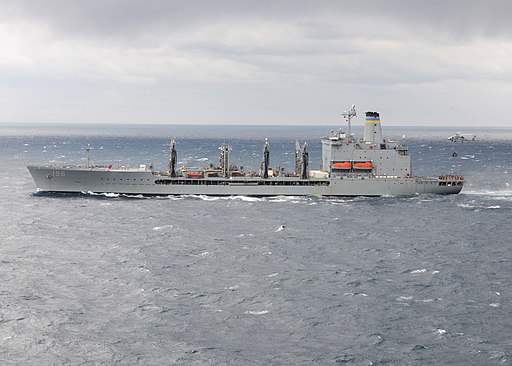
USNS Kanawha (T-AO-196) was a fleet replenishment oiler that played a critical logistical role in sustaining United States Navy operations during the Cold War era. As part of the Maumee-class oilers, Kanawha was designed to deliver fuel and limited dry cargo to combatant ships while underway, enabling extended naval presence without reliance on port facilities. Commissioned during a period when global naval operations demanded endurance, flexibility, and rapid response, Kanawha embodied the strategic shift toward mobile logistics that defined post–World War II naval doctrine.
Named after the Kanawha River in West Virginia, the ship served primarily under the Military Sea Transportation Service, later redesignated as the Military Sealift Command. Unlike traditional commissioned warships, Kanawha operated with a civilian crew supplemented by a small naval detachment, reflecting the evolving approach to non-combatant support vessels. This hybrid operational model allowed for efficient peacetime operations while retaining the capability to support combat forces during crises.
Design Philosophy and Hull Construction
USNS Kanawha was constructed to balance cargo capacity, seakeeping, and replenishment efficiency. The hull design emphasized stability during alongside and connected replenishment operations, even in moderate sea states. A broad beam and deep draft provided the necessary displacement to carry large quantities of fuel oil while maintaining predictable handling characteristics.
The ship featured a welded steel hull with internal subdivision designed to limit flooding and improve survivability. While not intended to operate in high-threat environments independently, the hull incorporated damage-control considerations such as compartmentalization and reinforced bulkheads. The overall structural design prioritized longevity, recognizing that replenishment oilers often remain in service for decades due to their strategic value and relatively lower exposure to direct combat.
Propulsion and Engineering Systems
Kanawha was powered by steam turbine propulsion, a common choice for large auxiliary vessels of her era. The engineering plant consisted of oil-fired boilers supplying steam to a single reduction-geared turbine connected to a single shaft. This configuration delivered reliable performance and simplified maintenance, which was particularly important for a ship expected to operate globally for extended periods.
The propulsion system produced approximately 16,000 shaft horsepower, allowing a sustained speed of around 16 knots. While not fast compared to destroyers or cruisers, this speed was sufficient to keep pace with carrier battle groups during replenishment operations. Auxiliary systems included ship service turbo-generators that provided electrical power for cargo handling equipment, navigation systems, and hotel services.
Cargo Capacity and Fueling Capabilities
The primary mission of USNS Kanawha was the transportation and delivery of petroleum products. She carried multiple grades of fuel, including naval distillate fuel, aviation gasoline, and jet fuel, stored in segregated tanks to prevent contamination. Total fuel capacity exceeded 180,000 barrels, enabling the ship to refuel multiple task groups before requiring replenishment herself.
Kanawha was equipped with a comprehensive underway replenishment system. This included multiple fueling stations along both port and starboard sides, fitted with span wires, transfer hoses, and tensioning equipment. The ship could conduct simultaneous fueling operations to multiple receivers, significantly increasing efficiency during fleet support evolutions. Pumping systems were designed for high flow rates while maintaining precise control to ensure safety during transfers.
Replenishment and Cargo Handling Equipment
Beyond liquid cargo, USNS Kanawha was capable of transporting limited quantities of dry cargo, including packaged supplies, spare parts, and provisions. Cargo handling was facilitated by deck-mounted cranes and winches positioned to support both alongside and vertical replenishment operations. Although not as specialized as later fast combat support ships, Kanawha’s equipment allowed her to serve as a flexible logistics asset.
The replenishment rigs were designed for rapid configuration changes, allowing the ship to adapt to different receiver types and mission requirements. Hose saddles, kingposts, and transfer stations were arranged to minimize interference and maximize operational safety. The deck layout reflected lessons learned from earlier oilers, emphasizing clear working areas and redundant systems.
Navigation, Communications, and Sensors
USNS Kanawha was outfitted with navigation and communication systems appropriate for global operations. Radar systems supported surface navigation and collision avoidance, while gyrocompasses and magnetic compasses provided reliable heading information. The bridge layout was optimized for long-duration transits and complex replenishment maneuvers.
Communications equipment included high-frequency and very-high-frequency radios, enabling coordination with fleet units, logistics commands, and shore facilities. While the ship did not carry advanced combat sensors, her systems were sufficient to integrate into naval task forces and operate safely in congested or strategically sensitive waters.
Armament and Defensive Measures
As a non-combatant auxiliary, Kanawha carried minimal armament, primarily for self-defense. Depending on the period of service, this typically included manually operated machine guns intended to deter small surface threats. The ship relied primarily on escorting combatants for protection in high-risk environments.
Defensive design considerations focused more on damage control than active defense. Firefighting systems were robust, reflecting the inherent risks of carrying large quantities of flammable fuel. Fixed firefighting installations, foam systems, and extensive training for crew members were essential elements of the ship’s safety posture.
Crew Composition and Habitability
USNS Kanawha was operated by a civilian mariner crew under the Military Sea Transportation Service, with a small contingent of U.S. Navy personnel responsible for communications, supply coordination, and mission liaison. This arrangement reduced operating costs while maintaining operational effectiveness.
Habitability standards were higher than those of many combatant ships of the era, reflecting the longer deployments and civilian crewing model. Living spaces included air-conditioned berthing areas, a galley designed for sustained operations, and recreational facilities intended to support crew morale during extended voyages. The internal layout prioritized efficient movement between workspaces while maintaining separation between engineering, cargo, and living areas.
Operational Service and Strategic Importance
Throughout her service life, USNS Kanawha supported numerous fleet operations, exercises, and deployments. Her presence enabled carrier groups and surface action groups to remain at sea for prolonged periods, projecting power and maintaining readiness without reliance on foreign ports. This capability was particularly valuable during periods of heightened geopolitical tension when access to shore facilities could not be guaranteed.
Kanawha’s operational history exemplified the often-unseen backbone of naval power: logistics. While not involved directly in combat, her contributions were essential to every operation she supported. The ship’s reliability and versatility made her a trusted asset within the fleet logistics system.
Legacy and Decommissioning
USNS Kanawha represented a transitional generation of replenishment oilers, bridging the gap between World War II–era auxiliaries and more advanced, multi-mission logistics ships that followed. Her design influenced subsequent classes by demonstrating the value of efficient underway replenishment and civilian-manned support vessels.
_underway_in_January_2014.JPG)