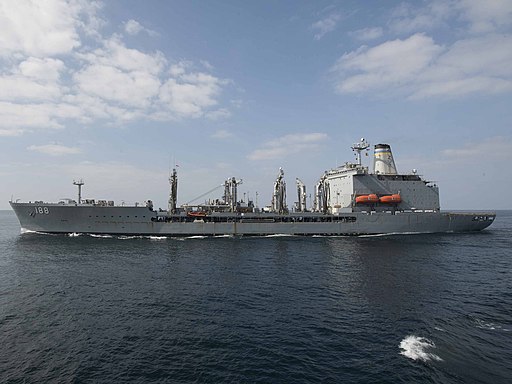
USNS Joshua Humphreys (T-AO-188) is a fleet replenishment oiler of the United States Navy operated by the Military Sealift Command. As part of the Navy’s auxiliary logistics force, the ship is designed to provide sustained fuel support to combatant vessels operating far from established ports. Its mission is central to modern naval doctrine, which relies heavily on underway replenishment to maintain persistent global presence. By delivering fuel and limited stores at sea, Joshua Humphreys enables carrier strike groups, surface action groups, and amphibious forces to operate continuously without interruption.
Class Background and Design Philosophy
Joshua Humphreys is a member of the Henry J. Kaiser-class replenishment oilers, a class developed to replace obsolete World War II–era logistics ships and to meet the fuel demands of Cold War and post–Cold War naval operations. The class was designed using commercial tanker construction practices adapted to naval requirements, prioritizing efficiency, reliability, and compatibility with fleet replenishment systems. Emphasis was placed on multi-product fuel carriage, robust underway replenishment capability, and reduced operating costs through civilian crewing. The design reflects a balance between commercial simplicity and the specialized demands of naval logistics.
Construction and General Characteristics
The ship was constructed at the Avondale Shipyard in Louisiana and entered service in the late 1980s. USNS Joshua Humphreys measures approximately 677 feet in length with a beam of about 93 feet, giving it the proportions of a large ocean-going tanker. Full-load displacement exceeds 40,000 tons, largely attributable to its extensive fuel cargo. The hull form is optimized for stability and predictable handling during replenishment operations, with a forward superstructure that provides clear deck space aft for fueling rigs and cargo handling systems. Structural reinforcement throughout the hull supports long-term durability under continuous operational stress.
Propulsion and Performance
USNS Joshua Humphreys is powered by a diesel propulsion plant consisting of two medium-speed diesel engines driving a single shaft. This configuration provides a balance of power and fuel efficiency, allowing the ship to achieve speeds of approximately 20 knots. Such performance enables the oiler to keep pace with carrier strike groups during transits and to maneuver effectively during replenishment operations. Auxiliary diesel generators supply electrical power for shipboard systems, including cargo pumps, navigation equipment, and habitability services, ensuring operational reliability during extended deployments.
Fuel Capacity and Cargo Systems
The primary function of Joshua Humphreys is the transport and delivery of naval fuels. The ship carries multiple fuel types, including marine diesel fuel and aviation fuel for carrier air wings. These products are stored in segregated tanks to prevent contamination and to allow simultaneous transfer of different fuels. Total fuel capacity is in excess of 180,000 barrels, providing sufficient volume to support multiple replenishment evolutions before resupply. The cargo system includes high-capacity pumps, extensive piping networks, and filtration systems that ensure safe and efficient fuel transfer under a wide range of conditions.
Underway Replenishment Equipment
Underway replenishment is conducted using standard connected replenishment systems installed along both port and starboard sides of the ship. USNS Joshua Humphreys is equipped with multiple fueling stations, allowing it to service more than one receiving ship at a time. These stations include tensioned span wires, fueling hoses, and control systems that maintain safe separation and alignment between vessels. The ship’s replenishment equipment is designed for rapid setup and recovery, enabling efficient operations even in challenging sea states and reducing the time ships must remain in close proximity.
Crew Structure and Habitability
The ship is operated by a civilian mariner crew employed by the Military Sealift Command, typically numbering around 80 to 90 personnel. A small Navy detachment is embarked to handle mission coordination, communications, and liaison with supported combatant forces. Living accommodations are arranged to support long-duration deployments, with private or semi-private berthing, mess facilities, recreational spaces, and medical support. The design of the habitability spaces reflects the expectation of continuous operations and the need to maintain crew efficiency and morale over extended periods at sea.
Survivability and Defensive Measures
As a non-combatant auxiliary ship, USNS Joshua Humphreys is not intended to engage in offensive operations, but it incorporates features to enhance survivability. The hull is compartmentalized to limit flooding, and the ship is equipped with comprehensive fire detection and suppression systems. During periods of elevated threat, the vessel can be outfitted with crew-served defensive weapons and small arms. Operational protection is primarily provided by escorting combatant ships and the broader defensive posture of the fleet.
Operational Employment and Service Record
Throughout its service life, Joshua Humphreys has supported U.S. Navy operations across multiple geographic regions, including the Atlantic, Pacific, and Middle Eastern theaters. The ship has been a consistent presence in carrier strike group deployments, large-scale exercises, and contingency operations. Its ability to deliver fuel reliably underpins the operational tempo of the forces it supports, allowing commanders to maintain flexibility and sustained presence. In addition to combat support, the ship has participated in humanitarian assistance and disaster response efforts, providing logistical support during crisis situations.
Strategic Importance and Legacy
USNS Joshua Humphreys exemplifies the essential role of replenishment oilers in modern naval strategy. While lacking the visibility of front-line combatants, the ship’s contribution to operational readiness is profound. By enabling sustained at-sea operations, it directly supports deterrence, rapid response, and global maritime security. As newer classes of oilers are introduced, Joshua Humphreys stands as a representative of a highly successful generation of logistics vessels that bridged commercial design and naval requirements. Its legacy lies in the quiet but indispensable support it has provided to the United States Navy across decades of global operations.
_150117-N-KB426-153_(16129286187).jpg)