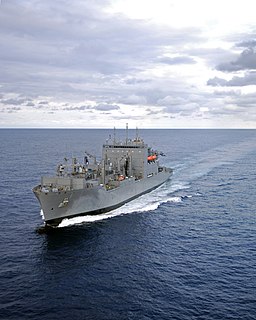
USNS Lewis and Clark (T-AKE-1) represents a significant evolution in United States Navy logistics, designed to meet the demands of modern, networked naval warfare. As the lead ship of the Lewis and Clark–class dry cargo and ammunition ships, she was conceived to replace several older classes of auxiliary vessels with a single, more efficient platform capable of delivering ammunition, provisions, spare parts, and limited fuel to fleet units at sea. The ship’s naming honors the historic Corps of Discovery expedition, symbolizing endurance, adaptability, and sustained reach, qualities central to her operational purpose.
Placed in service with the Military Sealift Command, Lewis and Clark operates as a non-commissioned vessel crewed primarily by civilian mariners with a small Navy detachment. This structure reflects contemporary logistics philosophy, emphasizing efficiency, modularity, and integration with joint and allied forces. From her introduction, the ship has served as a cornerstone of the Navy’s Combat Logistics Force, directly enabling extended forward presence and high operational tempo.
Hull Design and Structural Engineering
The hull of USNS Lewis and Clark was engineered to support heavy loads, frequent replenishment operations, and long-term structural resilience. Constructed of high-strength steel using modern modular shipbuilding techniques, the hull features a full-bodied form optimized for cargo volume and stability. A wide beam and carefully distributed mass provide excellent seakeeping characteristics, particularly during underway replenishment when relative motion between ships must be minimized.
Internal structural arrangements emphasize survivability and operational continuity. Extensive compartmentalization limits the effects of flooding or fire, while reinforced decks and bulkheads support the concentrated loads associated with ammunition magazines and cargo handling equipment. The design incorporates redundancy in critical systems and damage-control features appropriate for a ship expected to operate close to combat zones, even though it is not intended to engage in combat directly.
Principal Dimensions and Displacement
USNS Lewis and Clark has an overall length of approximately 689 feet and a beam of about 106 feet, making her substantially larger than the auxiliary ships she replaced. Her full-load draft is approximately 30 feet, reflecting the ship’s considerable cargo capacity. Displacement at full load exceeds 41,000 tons, positioning her among the largest logistics vessels in the U.S. Navy inventory.
These dimensions allow the ship to carry a diverse mix of cargo while maintaining sufficient stability and maneuverability. The increased size also supports expanded aviation facilities, advanced replenishment systems, and improved habitability. Despite her size, hull and propulsion design enable effective integration with carrier strike groups and expeditionary forces.
Propulsion System and Performance Characteristics
Lewis and Clark is powered by an integrated diesel-electric propulsion system, a departure from the steam plants used in earlier logistics ships. The propulsion arrangement consists of four medium-speed diesel generators supplying electrical power to two electric propulsion motors driving twin shafts. This system provides a total power output of approximately 29,000 shaft horsepower.
The diesel-electric configuration offers several advantages, including improved fuel efficiency, reduced maintenance requirements, and greater flexibility in power distribution. Maximum sustained speed is approximately 20 knots, allowing the ship to operate effectively with fast-moving naval task groups. The propulsion system also contributes to reduced acoustic signature and improved maneuverability, both valuable traits during replenishment operations and in congested operating areas.
Cargo Capacity and Storage Systems
The primary mission of USNS Lewis and Clark is the transportation and delivery of dry cargo and ammunition. The ship is capable of carrying more than 6,000 tons of cargo, including missiles, naval gun ammunition, food, repair parts, and general stores. Cargo is stored in a combination of refrigerated holds, dry stores spaces, and specialized ammunition magazines designed to meet stringent safety and handling requirements.
Ammunition storage areas are equipped with environmental controls, fire suppression systems, and reinforced boundaries to ensure safety and compliance with naval ordnance standards. The flexible internal layout allows mission planners to tailor cargo loads to specific operational requirements, making the ship adaptable to a wide range of missions from high-intensity conflict support to humanitarian assistance.
Replenishment at Sea Capabilities
Lewis and Clark is equipped with advanced replenishment-at-sea systems that enable simultaneous transfer of cargo to multiple ships. The vessel features multiple connected replenishment stations on both port and starboard sides, capable of handling ammunition, palletized cargo, and limited quantities of liquid cargo. These stations use modern tensioned span wire systems, automated winches, and precision control mechanisms to enhance safety and efficiency.
In addition to connected replenishment, the ship supports vertical replenishment through extensive aviation facilities. The flight deck and hangar are designed to operate two MH-60S helicopters simultaneously, dramatically increasing transfer rates and operational flexibility. This combination of connected and vertical replenishment allows Lewis and Clark to sustain fleet units even in challenging sea states or tactical situations.
Aviation Facilities and Support Systems
A key feature of USNS Lewis and Clark is her robust aviation capability. The ship includes a large flight deck rated for two medium helicopters, along with a fully enclosed hangar for maintenance and storage. Aviation fuel storage and handling systems are integrated into the ship’s design, supporting sustained flight operations during replenishment missions.
These aviation facilities enable rapid movement of high-priority cargo, such as ammunition or critical repair parts, directly to receiving ships. The ability to conduct sustained helicopter operations significantly enhances the ship’s operational reach and responsiveness, particularly when alongside replenishment is impractical or tactically undesirable.
Navigation, Communications, and Command Integration
Lewis and Clark is equipped with a modern suite of navigation and communications systems designed for global operations. Integrated bridge systems provide radar, electronic charting, and automated collision avoidance, supporting safe navigation in open ocean and congested littoral environments. The bridge layout emphasizes situational awareness and efficient watchstanding during complex replenishment evolutions.
Communications systems include secure satellite links, high-frequency and very-high-frequency radios, and data networks compatible with Navy command and control systems. These capabilities allow the ship to coordinate closely with supported units, logistics commands, and joint or allied forces, ensuring timely and accurate delivery of supplies.
Defensive Systems and Survivability Features
Although not a combatant, USNS Lewis and Clark incorporates several defensive and survivability features appropriate for operations near contested areas. The ship is fitted with crew-served weapons for self-defense and has provisions for additional defensive systems if required. Emphasis is placed on passive protection, including signature reduction measures and robust damage-control systems.
Fire suppression, flooding control, and system redundancy are integral to the ship’s design. Automated monitoring systems provide early warning of fires or mechanical failures, enabling rapid response by the crew. These features enhance the ship’s ability to survive and continue operations under adverse conditions.
Crew Structure and Habitability
USNS Lewis and Clark is operated by a civilian mariner crew under the Military Sealift Command, supported by a Navy detachment responsible for cargo operations, communications, and mission coordination. This blended crewing model combines commercial maritime expertise with naval operational knowledge.
Habitability standards reflect the ship’s role in long-duration deployments. Crew accommodations include modern berthing, climate-controlled living spaces, recreational facilities, and a well-equipped galley. Improved habitability contributes directly to crew endurance and operational effectiveness, particularly during extended periods at sea.
Operational Role and Modern Naval Logistics
Since entering service, USNS Lewis and Clark has served as a primary logistics provider for carrier strike groups, amphibious ready groups, and independent deployed units. Her ability to deliver large quantities of ammunition and supplies at sea has reduced reliance on shore-based logistics and increased operational flexibility.
The ship’s design reflects a holistic approach to modern naval logistics, integrating cargo capacity, replenishment efficiency, and crew sustainability into a single platform. By consolidating multiple legacy roles, Lewis and Clark enhances the Navy’s ability to sustain high-tempo operations across vast distances.
Enduring Significance and Class Legacy
As the lead ship of her class, USNS Lewis and Clark set the standard for a new generation of combat logistics vessels. Her successful integration of advanced propulsion, cargo handling, and aviation capabilities has influenced subsequent logistics ship designs and operational concepts.
The enduring significance of Lewis and Clark lies in her ability to quietly but decisively enable naval power. While rarely in the spotlight, her contributions underpin every sustained naval operation she supports, demonstrating that modern maritime dominance depends as much on logistics and sustainment as on combat capability.
