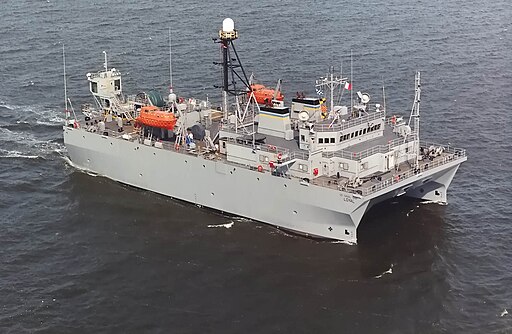
USNS Loyal (T-AGOS-22) was an ocean surveillance ship built to support the United States Navy’s undersea warfare and maritime domain awareness missions. As part of the Victorious-class (also known as the TAGOS-19 class), Loyal was designed specifically to collect, process, and relay acoustic data associated with submarine and surface vessel activity. Her mission profile reflected the strategic realities of the late Cold War and post–Cold War periods, when detecting, tracking, and characterizing increasingly quiet submarines became a central requirement of naval operations. Rather than emphasizing speed or armament, Loyal prioritized acoustic performance, endurance, and data quality.
Operating under the Military Sealift Command, USNS Loyal was crewed primarily by civilian mariners with a specialized Navy detachment responsible for operating surveillance equipment. This crewing model allowed the ship to conduct long-duration patrols with a high level of technical expertise while remaining cost-effective. Loyal’s role was quiet, persistent, and largely unseen, yet critically important to maintaining undersea situational awareness across vast ocean areas.
Hull Form and Acoustic-Oriented Design
The hull of USNS Loyal was engineered with acoustic performance as a primary design driver. The Victorious-class hull form featured a lengthened and refined shape intended to minimize self-noise and flow-induced turbulence, which could interfere with sensitive sonar systems. A bulbous bow and carefully faired underwater lines reduced hydrodynamic noise, while structural isolation techniques limited the transmission of machinery vibrations into the water.
The hull was constructed of welded steel with extensive internal damping treatments. Machinery spaces were acoustically isolated using resilient mountings, and piping systems were designed to reduce vibration and cavitation. These measures were essential for ensuring that the ship’s own acoustic signature did not degrade the performance of its towed surveillance arrays, which required an exceptionally quiet platform to detect faint underwater signals at long ranges.
Principal Dimensions and Displacement
USNS Loyal measured approximately 274 feet in overall length, with a beam of about 39 feet and a draft of roughly 20 feet. These dimensions represented a balance between stability, endurance, and acoustic performance. The ship’s displacement was in the range of 3,400 to 3,600 tons full load, providing sufficient mass to support towing operations while maintaining predictable handling characteristics.
The moderate size of the vessel allowed for efficient operation in open-ocean environments while retaining the ability to maneuver effectively during array deployment and recovery. The hull proportions were optimized to reduce wake and flow noise, reinforcing the ship’s primary mission as a surveillance platform rather than a conventional auxiliary or combatant.
Propulsion System and Quieting Measures
USNS Loyal was powered by a diesel-electric propulsion system specifically selected for low acoustic output. Diesel generators produced electrical power that was routed to an electric propulsion motor driving a single shaft. This arrangement allowed flexible control of power output and reduced the mechanical complexity associated with direct-drive systems.
The propulsion plant generated approximately 3,000 shaft horsepower, sufficient to achieve a maximum speed of around 14 knots. Operationally, the ship typically conducted surveillance at much lower speeds to optimize towed array performance. Extensive quieting measures, including vibration isolation, sound-absorbing materials, and careful propeller design, ensured that propulsion noise remained as low as practicable across the ship’s operating envelope.
Towed Array Surveillance Systems
The defining feature of USNS Loyal was her integrated towed array sonar system. The ship was equipped to deploy long, passive acoustic arrays designed to detect and classify underwater sound sources over great distances. These arrays were streamed astern and operated at carefully controlled depths and speeds to maximize sensitivity and minimize interference from surface noise.
Winches, handling equipment, and stern structures were purpose-built for safe and reliable array deployment and recovery. The ship’s stern featured a specialized handling area with reinforced decks and fairleads to manage the mechanical loads imposed by long arrays in varying sea conditions. Data collected by the array was processed onboard and transmitted to shore-based analysis centers and fleet commands.
Data Processing and Mission Systems
USNS Loyal carried sophisticated signal processing equipment to analyze acoustic data in near real time. Dedicated mission spaces housed consoles, servers, and communications equipment used by the Navy detachment. These systems allowed operators to filter, classify, and track contacts of interest while maintaining a continuous acoustic picture of the surrounding maritime environment.
The ship’s internal layout separated mission spaces from machinery and living areas to reduce noise and interference. Environmental controls maintained stable temperature and humidity conditions essential for sensitive electronic equipment. Redundant power and cooling systems ensured continuous operation during extended patrols far from shore support.
Navigation and Communications Capabilities
Navigation systems aboard Loyal were designed to support precise shiphandling during surveillance operations. Surface search radar, gyrocompasses, and electronic navigation aids allowed accurate positioning and course control, which were critical for maintaining optimal array geometry. The bridge was configured to support long-duration watchstanding with an emphasis on steady, predictable ship motion.
Communications systems included satellite links, high-frequency radios, and secure data transmission equipment. These systems enabled the ship to relay processed and raw acoustic data to naval commands while receiving tasking and updates. Communication reliability was essential, as Loyal’s mission effectiveness depended on timely integration of her data into broader undersea warfare networks.
Endurance and Seakeeping Performance
USNS Loyal was designed for extended deployments, often remaining at sea for weeks or months at a time. Fuel capacity, provisions storage, and maintenance facilities supported sustained operations without frequent port visits. The ship’s seakeeping characteristics were optimized for stability at low speeds, a key requirement for effective towed array performance.
Active and passive stabilization features reduced roll and pitch, improving both crew comfort and mission effectiveness. The ability to maintain consistent speed and heading in varying sea states allowed Loyal to continue surveillance operations under conditions that might degrade the performance of less specialized vessels.
Defensive Posture and Survivability
As a non-combatant auxiliary, USNS Loyal carried no significant offensive armament. Self-defense provisions were minimal and focused primarily on procedural measures rather than weapon systems. The ship relied on operational discretion, routing, and the broader naval presence for protection in higher-risk environments.
Survivability considerations emphasized damage control and redundancy rather than armor. Fire detection and suppression systems, compartmentalization, and emergency power arrangements were integral to the design. These features ensured that the ship could respond effectively to onboard emergencies and continue its mission when possible.
Crew Composition and Habitability
USNS Loyal operated with a mixed crew consisting of civilian mariners and a Navy mission detachment. The civilian crew was responsible for navigation, engineering, and shipboard operations, while Navy personnel managed surveillance equipment and mission execution. This division of labor allowed each group to focus on its area of expertise.
Habitability standards were tailored for long deployments, with climate-controlled berthing, a functional galley, and recreational spaces. While not luxurious, accommodations were designed to support crew endurance and morale during extended periods at sea, recognizing that sustained attention and technical proficiency were essential to mission success.
Operational Role and Strategic Importance
Throughout her service life, USNS Loyal contributed to the Navy’s ability to monitor undersea activity across critical ocean regions. By providing persistent, high-quality acoustic surveillance, she supported strategic deterrence, antisubmarine warfare planning, and maritime security operations. The data collected by ships like Loyal informed both real-time operational decisions and long-term intelligence assessments.
Her value lay in persistence and precision rather than visibility. Operating quietly and continuously, Loyal exemplified a class of ships whose impact was measured in awareness gained rather than actions taken, forming an essential layer of the Navy’s undersea sensing architecture.
Deactivation and Legacy
USNS Loyal represented a mature expression of ocean surveillance ship design, integrating quiet propulsion, advanced sensors, and long-endurance capabilities into a focused platform. As newer technologies and unmanned systems began to assume portions of the surveillance mission, ships of her class were gradually retired.
The legacy of USNS Loyal endures in the concepts she embodied: persistent presence, acoustic superiority, and the strategic importance of information dominance beneath the sea. Though seldom recognized publicly, her service contributed directly to maintaining undersea awareness and stability in an increasingly complex maritime environment.
