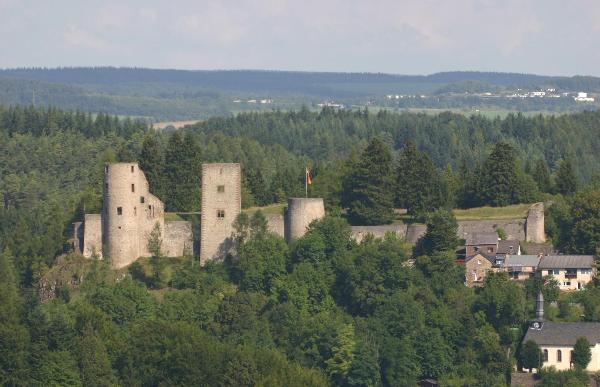
Schönecken Castle, located in the Eifel region of Germany near the village of Schönecken in Rhineland-Palatinate, is an impressive medieval fortress that exemplifies the architectural and military ingenuity of the High Middle Ages. Established in the 12th century, the castle was a strategic stronghold designed to assert control over the surrounding territory and protect vital trade routes. Over centuries, Schönecken Castle has witnessed a multitude of historical events and modifications, evolving from a purely defensive fortress into a residential and administrative center. The castle’s remains today provide valuable insights into medieval construction techniques, military architecture, and the socio-political landscape of the region.
Historical Context and Architectural Significance
Constructed in the early 1100s, Schönecken Castle was originally built by the Counts of Vianden, a powerful noble family in the region. The primary function of the castle was to serve as a military fortress and administrative hub. During the medieval period, castles like Schönecken were vital for asserting territorial dominance and securing trade and communication lines across the Eifel and adjacent regions. Over the centuries, the castle underwent several expansions and renovations, reflecting the changing military technologies and residential needs of its occupants.
Architecturally, Schönecken Castle belongs to the class of hilltop castles or Höhenburgen, strategically situated on elevated terrain to maximize defensive capabilities and visibility. The layout is characterized by a central keep surrounded by thick curtain walls, bastions, and a moat. The castle’s design demonstrates typical Romanesque and early Gothic elements, with massive stone walls, rounded arches, and narrow windows adapted for defense. Subsequent modifications introduced elements of late Gothic architecture, such as pointed arches and more elaborate stone carvings, blending aesthetics with function.
Structural Design and Defensive Features
Schönecken Castle’s construction utilizes the local volcanic rock of the Eifel region, predominantly basalt and slate, valued for their robustness and availability. The main defensive walls range in thickness from 1.2 to 2 meters, built using a combination of rubble masonry bonded with lime mortar, providing both strength and flexibility to withstand siege warfare and weathering over time. The curtain wall encircles an area approximately 1,200 square meters, creating a formidable barrier that once included crenellations and walkways for archers and guards.
The central keep or bergfried is the dominant architectural feature, standing around 25 meters tall with walls exceeding 2 meters in thickness at the base. This tower served both as a last line of defense and as a lookout point offering panoramic views over the Eifel landscape. The keep’s design includes narrow arrow slits oriented to cover all possible approaches, maximizing defensive coverage while minimizing vulnerability. Internally, the keep contained multiple floors, each with vaulted ceilings supported by heavy timber beams and stone corbels.
Surrounding the keep are ancillary buildings, including the great hall, residential quarters, and storage rooms. These structures feature thick stone walls and small, reinforced windows, designed to balance defense with habitability. The castle also includes a well shaft, sunk deep into the bedrock to guarantee a reliable water supply during prolonged sieges, a critical element in medieval fortress design.
A dry moat surrounds the castle’s perimeter, with access controlled by a fortified gatehouse equipped with a portcullis and murder holes—openings above the gate through which defenders could drop stones or boiling oil on attackers. Defensive outworks such as barbicans and bastions further enhanced protection against siege engines and infantry assaults.
Technical Specifications and Construction Techniques
The engineering behind Schönecken Castle reflects the advanced construction techniques of the medieval period, particularly in foundation work and masonry. Builders excavated down to bedrock to create stable foundations capable of supporting massive stone walls and towers. The use of basalt, a volcanic igneous rock abundant in the Eifel, was not only a practical choice but also contributed to the castle’s longevity. Basalt’s high compressive strength, typically ranging from 100 to 300 MPa, made it ideal for load-bearing walls and structural elements subjected to significant stress.
The lime mortar used as a bonding agent was carefully prepared from local limestone and sand, achieving an optimal balance between durability and flexibility. This mortar facilitated the gradual settling of the stonework, reducing the risk of cracking or collapse over time. The walls are primarily rubble masonry—composed of irregular stones tightly packed and mortared together—but feature dressed stones or ashlar blocks at corners, doorways, and window frames for added strength and aesthetic precision.
The roofing structures employ wooden trusses with carefully designed joints and reinforcements to bear heavy loads of slate tiles. These roofs typically have steep pitches exceeding 45 degrees to facilitate rainwater runoff and prevent accumulation of snow, a common architectural adaptation in the Eifel’s climatic conditions.
Modern Preservation and Archaeological Importance
In modern times, Schönecken Castle has been partially restored and stabilized to preserve its ruins as an important cultural heritage site. Preservation efforts focus on reinforcing existing masonry, preventing water infiltration, and conserving delicate architectural details such as stone carvings and window frames. Archaeological excavations have uncovered numerous artifacts, including medieval pottery, tools, and weapons, providing deeper insights into the daily life and military activities at the castle.
Technologically advanced methods such as laser scanning and 3D modeling have been employed to document the current state of the ruins, aiding in accurate restoration and virtual reconstruction projects. These digital tools help conservators identify structural weaknesses and plan interventions without causing further damage.
The castle site now serves as an educational and tourist destination, with interpretative signage and guided tours explaining its historical significance, construction techniques, and strategic importance. Efforts are also underway to integrate the castle into regional heritage trails to promote cultural tourism in the Eifel region.
Conclusion: Schönecken Castle as a Testament to Medieval Engineering
Schönecken Castle stands as a striking example of medieval fortification architecture, embodying the technical sophistication and strategic planning characteristic of its era. Its robust basalt construction, thick defensive walls, and carefully engineered structural components reveal a deep understanding of both military defense and architectural durability. The castle’s evolution from a purely military fortress to a noble residence reflects broader historical trends, while modern preservation initiatives ensure its continued relevance as a monument of cultural and technical heritage. Schönecken Castle not only offers a window into the past but also demonstrates the enduring legacy of medieval engineering excellence in the modern world.
