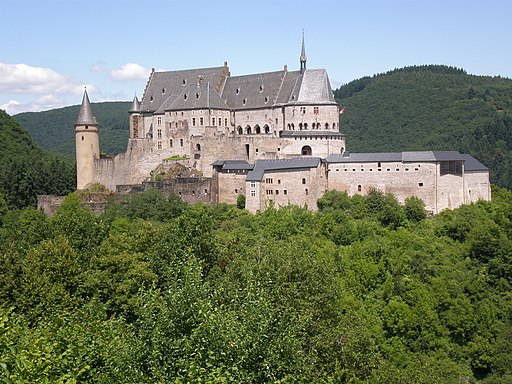
Burg Vianden is one of the most impressive and well-preserved medieval castles in Luxembourg, standing prominently on a rocky ridge overlooking the town of Vianden in the northern part of the country. Its origins date back to the 11th century, making it a vital example of feudal military architecture in the Moselle region. Throughout the Middle Ages, Burg Vianden was both a strong defensive fortress and a noble residence, serving as the seat of the powerful Counts of Vianden. The castle’s strategic location, architectural complexity, and continuous modifications over centuries reflect the evolving needs of medieval warfare and aristocratic life. Today, Burg Vianden not only attracts visitors due to its picturesque setting and historical significance but also serves as a fascinating case study of medieval construction techniques and fortification engineering.
Historical Development and Strategic Importance
Burg Vianden’s foundation was initially a Roman watchtower site, later transformed into a stone castle by the Counts of Vianden around the 11th century. Its placement on a steep hill offered natural defensive advantages, enabling surveillance over key trade routes and control of the fertile valleys below. The castle’s role as a military stronghold was complemented by its administrative functions, overseeing local governance and judicial authority in the region.
Over the centuries, the castle experienced several expansions and renovations, particularly during the 13th and 14th centuries when Gothic architectural elements were introduced. The structure was continually updated to counter new siege technologies, such as trebuchets and later firearms, illustrating its importance in regional power struggles and feudal conflicts. The castle’s resilience and adaptability were evident in its ability to withstand numerous sieges and political upheavals until its partial destruction in the late 17th century during the wars involving France and the Holy Roman Empire.
Architectural Design and Layout
Burg Vianden’s design is an excellent example of a hill castle, built to maximize the natural topography for defense while providing functional and residential spaces. The castle is laid out across a series of terraces descending from the main keep, utilizing the steep hillside to create multiple defensive layers. The overall footprint spans roughly 25,000 square meters, including the inner bailey, outer wards, and various courtyards.
The central feature is the massive Romanesque keep, approximately 25 meters high, with walls up to 3 meters thick at the base. This keep was the last refuge during an attack and a symbol of the lord’s authority. Its construction used large limestone blocks sourced from nearby quarries, known for their strength and relative ease of shaping. The keep includes narrow arrow slits and small windows that balance defensive needs with light access.
Surrounding the keep are fortified curtain walls featuring battlements and walkways that provided defenders with mobility and vantage points. These walls are constructed from rubble masonry with limestone facing stones, reaching heights of up to 12 meters and thicknesses averaging 1.5 to 2 meters. The curtain walls connect a series of towers and gatehouses, each serving specific defensive roles, such as flanking fire or secure entry control.
Defensive Features and Engineering Solutions
Burg Vianden incorporates numerous defensive elements typical of high medieval fortresses, combined with site-specific adaptations. The castle’s natural rock base was quarried and sculpted to form sheer cliffs on several sides, making direct assault exceedingly difficult. Where natural barriers were lacking, man-made moats and ditches were dug to increase the defensive perimeter.
The main gate is protected by a gatehouse complex that includes a portcullis and heavy wooden doors reinforced with iron bands. Above the entrance are murder holes—openings through which defenders could drop stones, boiling water, or shoot arrows at attackers trapped below. This layered defense mechanism exemplifies medieval strategic planning for chokepoints.
Towers strategically placed along the curtain walls are predominantly semi-circular or rectangular, allowing for wider fields of fire and reducing blind spots. These towers also housed archers and later musketeers, evidenced by the presence of gunports integrated into the masonry in later construction phases during the 15th and 16th centuries. The embrasures and loopholes were carefully designed to balance protection and offensive capability, often flaring outward to enable wider angles of fire.
The castle’s water supply was secured by a deep well sunk into the rock, providing an essential resource during sieges. The well shaft is lined with stone and extends to a depth of approximately 40 meters, showcasing medieval engineering skill in groundwater access under challenging conditions.
Construction Materials and Technical Parameters
The primary building material for Burg Vianden is limestone, abundant in the surrounding area and prized for its durability and workability. Blocks used in the keep and curtain walls measure roughly 40 to 70 centimeters in length and were quarried with care to ensure uniformity, facilitating tight joints and structural stability. The masonry technique involves a rubble core sandwiched between carefully dressed ashlar stones on the exterior faces, bonded with lime mortar. This method provided both strength and insulation.
The walls’ thicknesses, varying between 1.5 and 3 meters, are crucial for both structural integrity and resistance to artillery and battering rams. The castle’s vertical load-bearing components, particularly the keep, were engineered to distribute weight evenly onto the rock foundation, preventing subsidence or collapse over centuries. Vaulted ceilings inside key chambers employ ribbed and barrel vaulting, constructed from shaped stone blocks arranged to channel forces efficiently to the walls.
Timber also plays an important role in the castle’s construction, notably in roof trusses, floor joists, and scaffolding during construction phases. The roof structures typically feature steep pitches covered with wooden shingles or slate tiles, chosen to effectively shed rain and snow common in the Moselle valley climate.
Residential and Functional Spaces
While Burg Vianden’s primary purpose was defense, it also served as a noble residence with sophisticated spatial organization. The palas, or main residential building, includes spacious halls with large hearths, private chambers, and chapels. These interiors often featured decorative stonework and wooden paneling, illustrating the aesthetic aspirations of the ruling class alongside functional needs.
Storage rooms, kitchens, and service quarters were arranged to support self-sufficiency, particularly in times of siege. The castle’s courtyards facilitated daily activities, training, and gatherings, integrating utility and social function within a fortified setting. The presence of garderobes (medieval toilets) built into the outer walls demonstrates attention to hygiene and comfort despite the fortress’s military character.
Modern Preservation and Archaeological Significance
Today, Burg Vianden is a cultural landmark and one of Luxembourg’s most visited historic sites. Extensive restoration work has been carried out since the 20th century to stabilize the ruins and reconstruct parts of the castle to their former appearance. Preservation efforts focus on maintaining the integrity of the limestone masonry, preventing water ingress, and protecting fragile architectural details.
Archaeological excavations have unearthed artifacts such as medieval ceramics, weapons, and coins, enriching the historical narrative of the site. Advanced technologies including 3D scanning and drone surveys have enhanced the understanding of the castle’s layout and structural condition, aiding in precise restoration planning.
Conclusion: Burg Vianden as a Medieval Architectural Masterpiece
Burg Vianden exemplifies the harmonious blend of military engineering and noble residence typical of medieval castles. Its robust limestone construction, strategic defensive features, and carefully designed living spaces reveal an advanced understanding of architecture, materials science, and siege warfare technology. The castle’s enduring presence atop the Moselle valley ridge offers a tangible connection to the medieval world and continues to inspire appreciation for the ingenuity and artistry of its builders. Through ongoing preservation, Burg Vianden remains a vital educational and cultural resource, embodying the rich historical and technical heritage of Luxembourg and the broader region.
