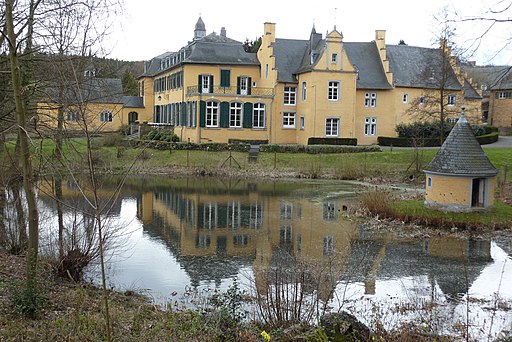
Schloss Vehn is situated in the western part of Germany, in the region historically shaped by the borders and cultural exchanges of the Rhineland. The castle lies near the city of Aachen, an area that has long been influenced by trade routes, imperial ambitions, and ecclesiastical power. Its location is not accidental; the surrounding landscape of gently rolling hills, fertile land, and access to local roads made it suitable both for defense and for managing agricultural estates. Over centuries, this region experienced repeated political shifts, and Schloss Vehn stands as a material witness to these transformations, reflecting how local nobility adapted to changing power structures while maintaining their presence in the countryside.
Origins and Early Development
The origins of Schloss Vehn can be traced back to the medieval period, when fortified residences were essential for asserting control over land and resources. Initially, the site likely began as a defensive structure, possibly a manor with fortifications, intended to protect its inhabitants from regional conflicts and feudal rivalries. As stability gradually increased, the castle evolved from a primarily defensive stronghold into a representative residence. This transformation mirrors a broader pattern in German castle history, where military necessity slowly gave way to comfort, administration, and status. Each generation of owners left its mark, expanding or modifying the structure to suit contemporary needs and tastes.
Architectural Character and Evolution
Architecturally, Schloss Vehn reflects a layered history rather than a single stylistic moment. Medieval elements such as thick walls and a compact ground plan coexist with later additions that emphasize symmetry, larger windows, and more refined interior spaces. The castle’s form illustrates how aristocratic residences evolved in response to new technologies, social expectations, and aesthetic ideals. Over time, purely defensive features became less prominent, while representative halls, living quarters, and landscaped surroundings gained importance. This gradual evolution gives Schloss Vehn its distinctive character, as it cannot be reduced to one architectural style but instead represents a dialogue between centuries.
Role in Regional Society
Beyond its physical presence, Schloss Vehn played an important role in the social and economic life of the surrounding area. As the center of an estate, it functioned as an administrative hub where agricultural production, taxation, and legal matters were managed. The castle’s owners were not only landholders but also local authorities whose influence shaped daily life for nearby villages. Through periods of peace and conflict, Schloss Vehn remained a focal point of regional identity, symbolizing continuity in a landscape often affected by political upheaval. Its presence reinforced social hierarchies while also providing employment and stability to the local population.
Modern Era and Preservation
In the modern era, Schloss Vehn has faced challenges common to many historic estates, including changing ownership structures and the high cost of maintenance. Despite these pressures, the castle has survived as a significant cultural monument. Preservation efforts have aimed to balance historical authenticity with contemporary use, ensuring that the structure remains both stable and meaningful. Today, Schloss Vehn is valued not only as an architectural relic but also as a source of historical insight, offering a tangible connection to the region’s past. Its continued existence underscores the importance of conserving such sites, as they embody centuries of human activity, adaptation, and cultural expression.
