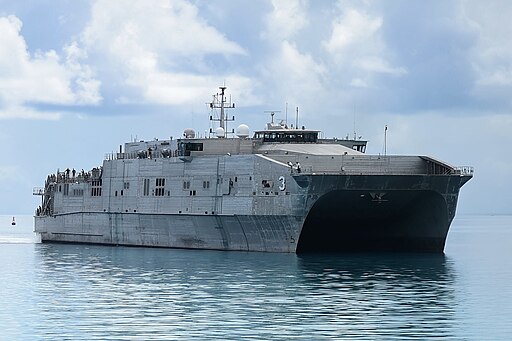
The USNS Millinocket (JHSV-3/T-EPF-3) is an expeditionary fast transport vessel of the United States Navy’s Spearhead class, designed to provide rapid, flexible intra-theater movement of troops, military vehicles, cargo, and equipment. Built by Austal USA in Mobile, Alabama, Millinocket was laid down on May 3, 2012, and launched on June 5, 2013, before entering service with the U.S. Military Sealift Command on March 21, 2014. The vessel was originally designated as JHSV-3 (Joint High Speed Vessel) and later reclassified as T-EPF-3 (Expeditionary Fast Transport) as part of the broader Navy nomenclature update for this class of support ships. Its operational profile emphasized transport flexibility, high transit speeds, and access to shallow and underdeveloped ports, making it a critical asset for logistical support, theater security cooperation exercises, and humanitarian missions throughout its service life.
Hull, Structure, and General Characteristics
Millinocket is a large, wave-piercing catamaran with an overall length of approximately 103 meters (338 feet) and a beam of 28.5 meters (93.5 feet), dimensions that derive from the Spearhead class design to balance cargo volume with high speed and stability in littoral waters. The vessel’s draft is shallow—about 3.83 meters (12 feet 7 inches)—allowing access to ports and waterways unavailable to deeper-draft combatants or traditional sealift ships. Its lightweight aluminum construction and catamaran hull form reduce hydrodynamic resistance, enabling the fast transport profile that is the hallmark of the EPF program. The hull and superstructure accommodate a large mission bay of roughly 20,000 square feet that can be rapidly reconfigured for cargo, vehicles, or personnel transport, including modular mission packages and containerized equipment.
Propulsion, Performance, and Range
The propulsion system aboard Millinocket consists of four MTU 20V8000 M71L diesel engines coupled through four ZF 60000NR2H reduction gears driving high-speed waterjets. This configuration enables the vessel to achieve a top speed of approximately 43 knots (near 80 kilometers per hour), which is considerably faster than traditional transport vessels and facilitates rapid repositioning across operational theaters. Typical operational range for the EPF class is around 1,200 nautical miles at an average cruising speed of roughly 35 knots, sufficient for most intra-theater logistics movements without underway replenishment. The ship’s hydrodynamic profile and shallow draft emphasize coastal and littoral performance, enabling access to austere ports and undeveloped quay walls where conventional cargo ships cannot operate.
Capacity and Accommodation
USNS Millinocket’s internal configuration supports a complement of around 41 personnel, typically composed of civilian mariners from the Military Sealift Command who operate the vessel. The transport capacity includes airline-style seating for up to 312 embarked forces and fixed berthing for an additional 104 personnel if needed, enabling company-sized units or specialized teams to deploy aboard the ship. The reconfigurable mission bay is designed to carry up to 600 short tons of cargo, including vehicles, tactical equipment, and supplies. The EPF design includes a robust, shallow-angle stern ramp that interfaces with roll-on/roll-off facilities or austere piers, allowing rapid loading and unloading of cargo and vehicles without the need for extensive port infrastructure.
Aviation and Auxiliary Capabilities
Although not a traditional aviation ship, Millinocket features a dedicated flight deck capable of supporting medium-class helicopters for embarked airlift, reconnaissance, or vertical replenishment operations. This aviation capability enhances flexibility, enabling helicopter operations from the open ocean or littoral zones in support of transport and logistics missions. In addition to helicopter operations, the vessel carries its own small boats and auxiliary craft that can be deployed for personnel transfers or assistance missions. The ship’s design and equipment allow it to contribute to non-combatant evacuation operations, humanitarian assistance and disaster relief scenarios, and bilateral or multinational exercises where rapid logistics throughput is critical.
Operational History and Role
Throughout its operational life, USNS Millinocket has participated in a range of missions that highlight its adaptability. These include logistic support and joint exercises in the Indo-Pacific region, such as Cooperation Afloat Readiness and Training (CARAT) engagements with partner navies in Indonesia and Bangladesh, where its high speed and shallow draft enabled frequent port visits and multinational interoperability missions. In August 2023, the vessel demonstrated auxiliary response capability by aiding a distressed civilian craft near Darwin, Australia, while en route to Exercise Talisman Sabre, underscoring its utility beyond purely military transport roles. After more than a decade of service, Millinocket was stricken from the Naval Register on May 2, 2025, and transferred to the National Defense Reserve Fleet, marking the end of its active duty but preserving the design’s legacy for future logistics solutions. (navy.mil)
.jpg)