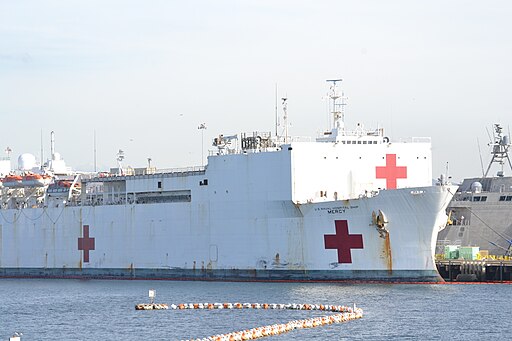
USNS Mercy (T-AH-19) is one of the United States Navy’s two hospital ships and serves as a floating medical treatment facility capable of delivering advanced healthcare in support of military operations, humanitarian assistance, and disaster response. Operated by the Military Sealift Command and crewed primarily by civilian mariners, the ship embarks large medical contingents from the U.S. Navy medical community when activated. Its mission profile is unique within the fleet, focusing not on combat or logistics, but on lifesaving care, medical diplomacy, and rapid response to crises around the world. As a symbol of humanitarian reach and medical capability, USNS Mercy has become one of the most recognizable non-combatant vessels operated by the United States.
Design Origins and Conversion
USNS Mercy was originally constructed as a San Clemente-class supertanker before being converted into a hospital ship, a transformation that shaped its distinctive size and internal volume. The conversion process replaced oil cargo spaces with extensive medical facilities while retaining the tanker hull’s exceptional endurance and stability. The resulting ship features a broad beam and deep draft that provide excellent seakeeping and the internal space necessary for large-scale medical operations. The design emphasizes redundancy, compartmentalization, and survivability, allowing the ship to function independently for extended periods while supporting thousands of patients during major contingencies.
Medical Facilities and Clinical Capabilities
The defining feature of USNS Mercy is its comprehensive medical complex, which rivals that of a major metropolitan hospital. The ship contains twelve fully equipped operating rooms, an intensive care unit, recovery wards, emergency treatment spaces, radiology facilities, laboratories, blood banks, and specialized clinics. With a capacity of approximately 1,000 hospital beds, including intensive care and intermediate care units, the ship can handle mass casualty events as well as prolonged treatment campaigns. Medical gases, sterilization systems, and pharmaceutical storage are integrated throughout the ship to support continuous operations. The layout is designed for efficient patient flow from triage to surgery, recovery, and rehabilitation, even under high patient loads.
Aviation and Patient Transfer Systems
USNS Mercy is equipped with a large flight deck capable of supporting helicopter operations for medical evacuation and logistics support. Helicopters provide a critical link between the ship and shore-based casualty collection points, especially in areas where port infrastructure is damaged or nonexistent. The ship also features side ports and internal ramps that allow patient transfer via small boats and landing craft. These multiple access points ensure flexibility in a wide range of operational environments, from contested military theaters to disaster-stricken coastal regions. Aviation fuel storage, deck handling equipment, and coordination spaces support sustained air operations in support of medical missions.
Propulsion, Power, and Engineering Systems
The ship retains a conventional steam propulsion system inherited from its tanker origins, providing steady and reliable performance rather than high speed. Twin steam turbines drive a single shaft, delivering sufficient power for global transit and station-keeping operations. While not designed for rapid maneuvering or combat escort speeds, USNS Mercy’s propulsion system emphasizes endurance and mechanical robustness. Electrical power generation is extensive, supporting not only navigation and ship services but also the massive energy demands of medical equipment, climate control, lighting, and water purification systems. Redundant generators and distribution networks ensure uninterrupted power to critical medical spaces.
Crew Composition and Medical Staffing
USNS Mercy operates with a core crew of civilian mariners responsible for navigation, engineering, and ship operations. When activated for medical missions, the ship embarks a large medical staff composed of Navy doctors, nurses, corpsmen, and support personnel. At full medical activation, the total complement can exceed 1,200 personnel, making it one of the most densely staffed ships in the U.S. inventory. Habitability spaces, galleys, and support facilities are designed to accommodate this surge in personnel while maintaining operational efficiency during long deployments.
Humanitarian Assistance and Global Engagement
Beyond its military medical role, USNS Mercy is a key instrument of U.S. humanitarian outreach and medical diplomacy. The ship frequently deploys on planned humanitarian missions, providing medical care, surgical procedures, and training in partnership with host nations. These deployments strengthen international relationships while delivering critical healthcare to underserved populations. The ship’s ability to operate independently, produce fresh water, and generate its own power allows it to serve as a self-sustaining medical hub in regions affected by natural disasters, epidemics, or infrastructure collapse.
Technical Specifications
USNS Mercy (T-AH-19) has a full-load displacement of approximately 69,000 tons, making it one of the largest ships in the U.S. Navy inventory. The vessel measures about 894 feet in length, with a beam of approximately 105 feet and a draft of roughly 33 feet. Its propulsion system delivers a maximum speed of around 17 knots, with an operational range exceeding 13,000 nautical miles. The ship’s medical capacity includes approximately 1,000 hospital beds, 12 operating rooms, and extensive diagnostic and treatment facilities. The core civilian crew numbers around 60 to 70 mariners, while full medical activation increases total personnel to over 1,200.
Strategic and Symbolic Significance
USNS Mercy occupies a unique position within U.S. naval power, serving as both a strategic medical asset and a powerful symbol of humanitarian commitment. Protected under the Geneva Conventions and clearly marked as a hospital ship, it embodies the principle of medical neutrality while providing unmatched treatment capability at sea. Whether supporting combat operations, responding to natural disasters, or conducting humanitarian missions, USNS Mercy extends the reach of American medical expertise across the globe. Its combination of scale, capability, and purpose ensures its continued relevance in both military planning and international humanitarian efforts.
