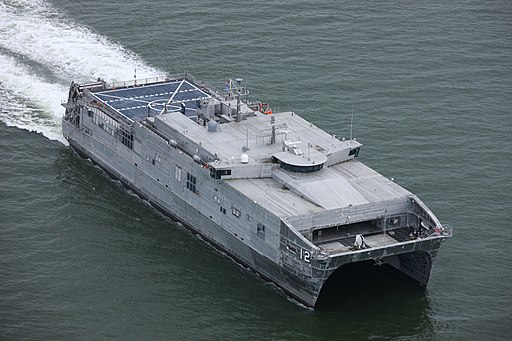
USNS Newport (T-EPF-12) is part of the United States Navy’s Expeditionary Fast Transport program, previously known as the Joint High Speed Vessel program. The EPF class was designed to provide a rapidly deployable, shallow-draft platform capable of transporting troops, vehicles, and equipment between ports or operating bases with minimal infrastructure requirements. Newport represents a later unit in the class and incorporates lessons learned from earlier hulls, particularly in terms of reliability, habitability, and mission flexibility. Operated by Military Sealift Command with a civilian mariner crew, the vessel is intended to support joint and coalition operations, humanitarian assistance, disaster relief, and theater security cooperation missions rather than direct combat roles. Its design philosophy emphasizes speed, modularity, and access to austere ports over survivability in high-threat environments.
Hull Design and Structural Characteristics
USNS Newport is a high-speed aluminum catamaran constructed by Austal USA, following a wave-piercing hull form optimized for sustained high-speed operations in moderate sea states. The twin-hull configuration provides a wide beam and excellent transverse stability, which is particularly beneficial during vehicle loading, helicopter operations, and operations alongside piers with limited infrastructure. The vessel has an overall length of approximately 103 meters, a beam of about 28.5 meters, and a shallow draft of roughly 3.8 meters, allowing access to ports and coastal areas unavailable to larger sealift ships. Aluminum construction reduces overall displacement, which is typically in the range of 2,400 to 2,600 metric tons full load, but it also requires careful structural monitoring due to fatigue considerations associated with high-speed operations.
Propulsion System and Performance Parameters
The propulsion system of USNS Newport is based on four medium-speed diesel engines driving waterjets, a configuration selected to maximize speed, maneuverability, and shallow-water capability. The engines collectively produce approximately 36,000 to 40,000 horsepower, enabling a sustained cruising speed of around 35 knots and a maximum speed exceeding 40 knots under optimal conditions. Waterjet propulsion allows rapid acceleration, excellent low-speed handling, and reduced risk of damage in shallow or debris-laden waters compared to conventional propellers. The vessel’s operational range is approximately 1,200 nautical miles at cruising speed, which supports rapid intra-theater lift rather than transoceanic deployment. Fuel efficiency is optimized for short, high-speed transits, aligning with the EPF mission profile.
Cargo Capacity and Mission Payload
A central feature of USNS Newport is its large mission bay, which spans most of the vessel’s length and is designed to accommodate a wide variety of payloads. The cargo deck offers roughly 20,000 square feet of usable space and can support loads exceeding 600 metric tons, depending on distribution and mission configuration. This space can be used to transport wheeled and tracked vehicles, containerized cargo, engineering equipment, or modular mission packages. A stern vehicle ramp enables roll-on and roll-off operations directly to a pier or floating causeway, significantly reducing offload time. The deck structure is reinforced to handle military vehicles such as armored trucks, light armored vehicles, and logistics support platforms, though it is not intended for heavy main battle tanks.
Aviation Facilities and Support Capabilities
USNS Newport is equipped with a flight deck capable of supporting the operation of rotary-wing aircraft, including medium-lift helicopters such as the MH-60 series and comparable allied platforms. The flight deck is rated for day and night operations and supports vertical replenishment, personnel transfer, and medical evacuation missions. While the vessel does not have a permanent hangar, it can support temporary aviation support equipment and maintenance containers when required. The aviation capability significantly enhances the ship’s flexibility, allowing it to operate as a forward staging platform during humanitarian assistance missions or to support distributed maritime operations in low-threat environments.
Command, Control, and Crew Accommodations
The ship’s command and control spaces are designed to support joint operations, with secure communications systems and flexible mission planning areas. USNS Newport typically operates with a core civilian mariner crew of approximately 40 personnel, supplemented by embarked military detachments and mission-specific teams that can bring total personnel capacity to more than 300. Berthing spaces are modular and configured to accommodate troops, disaster response personnel, or special mission units for short-duration deployments. Habitability standards are higher than traditional military sealift ships, reflecting the vessel’s high-speed operational tempo and the need to support embarked personnel effectively during rapid transits.
Survivability, Limitations, and Operational Considerations
As a non-combatant auxiliary vessel, USNS Newport is lightly protected and not designed to operate independently in high-threat environments. It lacks organic offensive weapon systems and relies on situational awareness, speed, and escort support for protection when operating in contested regions. Damage control systems are robust for an aluminum vessel, but survivability standards are lower than those of combatants or amphibious assault ships. Operational experience across the EPF fleet has shown that high-speed performance is best sustained in moderate sea states, with reduced speeds required in rough conditions to limit structural stress and crew fatigue. These factors define Newport’s optimal employment as a connector and rapid lift platform rather than a front-line asset.
Strategic Value and Long-Term Relevance
USNS Newport (T-EPF-12) contributes to the broader U.S. naval strategy by enhancing operational mobility and enabling rapid response across geographically dispersed theaters. Its ability to move forces, equipment, and humanitarian supplies quickly between ports supports both military and non-military missions, including disaster relief and partner-nation engagement. While the EPF class has recognized limitations in survivability and sea state performance, its speed, shallow draft, and modular payload capacity fill a critical niche between traditional sealift and airlift. In this role, USNS Newport remains a technically specialized and strategically valuable asset, particularly in regions where infrastructure is limited and rapid maritime access is essential.
_successfully_completed_integrated_sea_trials_on_30_July_2020.jpg)