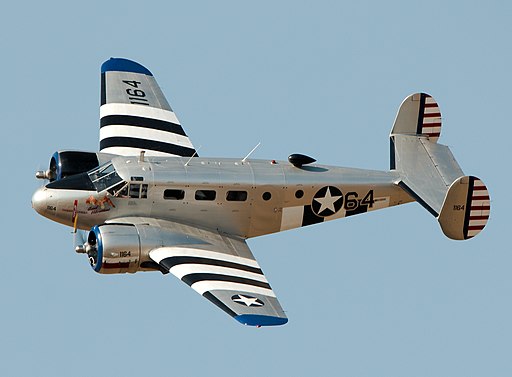
The Beechcraft Model 18, often affectionately referred to as the “Twin Beech,” is one of the most enduring and versatile aircraft in aviation history. Introduced in the mid-1930s by the Beech Aircraft Corporation, it was designed as a twin-engine, low-wing monoplane intended to serve multiple roles including passenger transport, cargo hauling, and military applications. Its rugged design, reliability, and adaptability contributed to a production run spanning more than three decades, making it one of the most prolific aircraft of its era. The Model 18’s longevity and widespread use reflect its exceptional design balance between performance, utility, and ease of maintenance. The aircraft became a workhorse for airlines, freight carriers, military operators, and even specialized roles such as aerial survey and training.
Design and Structural Features
The Beechcraft Model 18 features a low-wing cantilever monoplane configuration with twin radial engines mounted on the wings. The all-metal airframe construction, using aluminum alloy, provided both strength and corrosion resistance, which were essential for its diverse operational environments. The wings were tapered with rounded tips and incorporated flaps and ailerons, delivering good lift characteristics and control authority. The design included a conventional tail unit with a single vertical stabilizer and rudder, along with horizontal stabilizers equipped with elevators for pitch control.
The fuselage was streamlined and spacious relative to other aircraft of the time, configured to accommodate between six and eleven passengers depending on the variant and interior arrangement. It also featured large windows along the cabin, enhancing passenger comfort and visibility. The cockpit was fully enclosed with side-by-side seating for two pilots, allowing for efficient crew coordination on longer flights. The Model 18 employed retractable landing gear with tailwheel configuration, which contributed to reduced drag and improved performance compared to fixed gear designs.
The aircraft’s construction was focused on durability and ease of repair, with removable panels and standardized components facilitating maintenance and field servicing. Its robust structure allowed it to operate from a variety of airfields, including rough or unimproved strips, making it highly versatile in both civilian and military contexts.
Powerplant and Performance
The Beechcraft Model 18 was equipped with twin radial piston engines, most commonly the Pratt & Whitney R-985 Wasp Junior or the Wright R-975 Whirlwind engines. These engines generally produced between 450 and 600 horsepower each, depending on the model and engine variant. The twin-engine configuration not only improved reliability and safety but also enhanced payload and range capabilities compared to single-engine aircraft of similar size.
Performance-wise, the Model 18 was capable of cruising speeds around 200 miles per hour (320 kilometers per hour) and a maximum speed reaching approximately 230 miles per hour (370 kilometers per hour), which was impressive for its class and era. The service ceiling was typically around 20,000 feet (6,100 meters), allowing it to operate efficiently at higher altitudes. Its range varied between 700 and 1,200 miles (1,126 to 1,931 kilometers), depending on fuel load and configuration, which made it suitable for regional and medium-haul flights.
The aircraft was also noted for its good short-field performance, with takeoff and landing distances that allowed operation from smaller airports. This, combined with its payload capacity of around 3,000 pounds (1,360 kilograms), made the Model 18 a favorite for cargo and passenger services in remote areas.
Flight Controls and Handling Characteristics
The Model 18’s flight controls adhered to conventional aerodynamic principles, with ailerons providing roll control, elevators controlling pitch, and a rudder managing yaw. The control surfaces were cable-operated, connected to a dual yoke setup in the cockpit for pilot and co-pilot use. The aircraft was equipped with electrically or hydraulically actuated flaps to assist with low-speed handling during takeoff and landing.
Pilots praised the Model 18 for its stable and predictable handling characteristics, which contributed to its widespread use as a training aircraft, particularly during World War II when it served extensively in military flight schools. Its twin-engine design required pilots to develop proficiency in asymmetric thrust management, especially during engine-out scenarios, but the aircraft’s forgiving nature and robust control authority made it manageable even for less experienced aviators.
The retractable landing gear enhanced the aerodynamic profile during flight, improving speed and fuel efficiency. While the tailwheel configuration demanded careful handling on the ground, particularly during crosswind conditions, experienced pilots found the Model 18 to be a reliable and steady performer both in the air and during taxi, takeoff, and landing.
Operational History and Legacy
The Beechcraft Model 18 had an extensive operational history spanning over 30 years, with production running from 1937 to 1969. More than 9,000 units were built, including numerous military variants designated as the C-45 Expeditor, AT-7 Navigator, and AT-11 Kansan, among others. These military versions were utilized for transport, navigation training, bombardier training, and reconnaissance missions during World War II and beyond.
In the civilian world, the Model 18 served airlines, charter operators, freight companies, and private owners worldwide. Its versatility allowed it to perform tasks ranging from passenger transport to aerial survey and agricultural spraying. Even after newer aircraft entered the market, many Model 18s remained in service well into the late 20th century, valued for their ruggedness and adaptability.
The Twin Beech’s influence extends beyond its production years; it set standards for multi-engine utility aircraft and inspired numerous designs in both civil and military aviation sectors. Its combination of performance, capacity, and reliability secured its reputation as one of the most important aircraft of its generation.
Technical Specifications Summary
- Type: Twin-engine, low-wing monoplane utility aircraft
- Crew: 2 pilots
- Capacity: 6 to 11 passengers depending on variant
- Length: Approximately 34 feet 9 inches (10.59 meters)
- Wingspan: Approximately 47 feet 8 inches (14.52 meters)
- Height: Approximately 9 feet 4 inches (2.84 meters)
- Wing Area: Around 235 square feet (21.8 square meters)
- Empty Weight: Approximately 6,200 pounds (2,812 kilograms)
- Maximum Takeoff Weight: Approximately 10,200 pounds (4,627 kilograms)
- Powerplant: Two Pratt & Whitney R-985 or Wright R-975 radial engines, 450-600 horsepower each
- Maximum Speed: About 230 mph (370 km/h)
- Cruise Speed: Around 200 mph (320 km/h)
- Range: Between 700 and 1,200 miles (1,126 to 1,931 kilometers)
- Service Ceiling: Approximately 20,000 feet (6,100 meters)
- Landing Gear: Retractable tailwheel type
- Construction: All-metal aluminum alloy airframe with fabric-covered control surfaces on some models
The Beechcraft Model 18 Twin Beech’s blend of speed, utility, and durability allowed it to thrive across civil and military aviation for decades, securing a place as a legendary workhorse of mid-20th century aviation history. Its design and operational versatility continue to be celebrated by aviation enthusiasts and historians alike.
