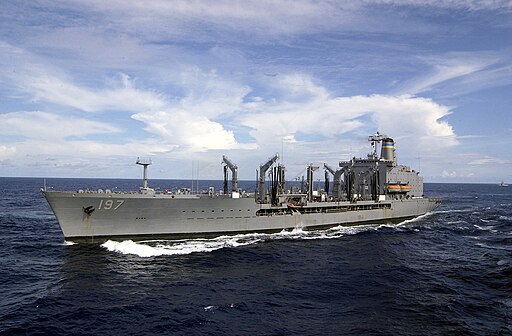
USNS Pecos (T-AO-197) was a United States Navy fleet replenishment oiler operated by Military Sealift Command and built as part of the Henry J. Kaiser class, a group of ships designed to sustain naval task forces at sea for extended periods. Named after the Pecos River, the ship represented a key element of the Navy’s late Cold War and post–Cold War logistics strategy, emphasizing endurance, high cargo capacity, and reliable underway replenishment rather than combat power. Throughout its service life, Pecos functioned as a mobile fuel and supply depot, enabling carrier strike groups, amphibious forces, and independent surface combatants to remain on station without returning to port.
Design and Construction
USNS Pecos was constructed to commercial standards with selected naval features, a design philosophy that allowed for faster construction and lower lifecycle costs while still meeting military requirements. Built by Avondale Shipyards in Louisiana, the ship was delivered to the Navy in the mid-1980s and entered service under Military Sealift Command rather than being traditionally commissioned. The Henry J. Kaiser class emphasized robust hull construction, extensive cargo tankage, and simplified machinery layouts to improve reliability and ease of maintenance during long deployments. The hull form was optimized for steady operations at replenishment speeds, providing good seakeeping and stability during connected replenishment alongside other ships.
Propulsion and Performance
Pecos was powered by a conventional steam propulsion plant consisting of two oil-fired boilers feeding a single geared steam turbine connected to one shaft. The machinery produced approximately 24,500 shaft horsepower, giving the ship a maximum speed of about 20 knots, sufficient to keep pace with most surface combatants during transit and logistics operations. The propulsion system was chosen for its proven reliability and ability to burn the same fuel carried for delivery to other ships, simplifying logistics. With large fuel reserves and efficient cruising characteristics, Pecos had an operational range measured in tens of thousands of nautical miles, allowing it to support sustained forward deployments without frequent port visits.
Dimensions and Displacement
The ship measured approximately 677.5 feet in length overall, with a beam of about 97.5 feet and a full-load draft of roughly 36 feet. At full load, displacement exceeded 40,000 tons, reflecting the massive quantities of fuel and supplies carried. These dimensions placed Pecos among the largest auxiliary ships in the U.S. Navy inventory during its era. The large hull volume was carefully subdivided to enhance survivability, with multiple cargo tanks, voids, and ballast spaces arranged to maintain stability as fuel was transferred at sea.
Cargo Capacity and Replenishment Systems
The primary mission of USNS Pecos was the transport and delivery of fuel, particularly marine diesel fuel and aviation fuel, to naval vessels underway. The ship could carry well over 180,000 barrels of fuel, equivalent to several million gallons, distributed across numerous segregated tanks to support different fuel grades. In addition to liquid cargo, Pecos carried limited quantities of dry cargo, packaged stores, and refrigerated supplies. Replenishment equipment included multiple fueling stations on each side, heavy-duty hoses, tensioned span wires, and advanced control systems that allowed simultaneous fueling of more than one ship. These systems enabled rapid, safe transfer of fuel while both ships maintained speed and course in open ocean conditions.
Aviation Facilities
To enhance flexibility and speed of resupply, Pecos was equipped with a large flight deck capable of supporting two medium naval helicopters. While the class did not include a permanent enclosed hangar, the flight deck allowed for vertical replenishment operations, personnel transfers, and medical evacuations. Helicopter support was particularly valuable when sea conditions limited connected replenishment or when ships required small quantities of high-priority supplies. The integration of aviation operations significantly expanded the ship’s ability to support dispersed naval forces.
Crew and Habitability
As a Military Sealift Command vessel, USNS Pecos was primarily crewed by civilian mariners, typically numbering around 120, supplemented by a small detachment of U.S. Navy personnel responsible for communications, supply coordination, and defensive systems. Habitability standards reflected commercial practice but were adapted for long deployments, with air-conditioned living spaces, dedicated recreational areas, and extensive galley facilities. The mixed civilian-military crew structure allowed the ship to operate efficiently while maintaining close integration with fleet command structures.
Defensive Systems
Although not designed for frontline combat, Pecos carried limited self-defense armament to counter close-range threats. This typically included crew-served heavy machine guns and, for much of its service life, Phalanx Close-In Weapon Systems mounted to provide last-ditch defense against missiles and aircraft. These systems were operated by the Navy detachment aboard the ship and were intended purely for defensive use, reflecting the auxiliary nature of the vessel and its reliance on escorted operations in higher-threat environments.
Operational Service History
USNS Pecos spent much of its operational career supporting U.S. Navy forces in the Pacific and Indian Oceans, frequently operating with the Seventh Fleet. The ship played a significant role in sustaining forward-deployed naval forces based in Japan and Guam, participating in numerous exercises and real-world operations. Pecos provided logistical support during major conflicts and contingencies, including operations in the Middle East, where long distances and high operational tempo placed heavy demands on fleet oilers. Its ability to deliver fuel reliably under austere conditions made it an indispensable asset during extended naval campaigns.
Deactivation and Legacy
After decades of service, USNS Pecos was eventually deactivated as newer, more capable replenishment oilers entered the fleet. Advances in ship design, automation, and fuel efficiency led to the gradual retirement of the Henry J. Kaiser class. Despite its deactivation, Pecos left a lasting legacy as a workhorse of U.S. naval logistics, exemplifying the critical but often overlooked role of auxiliary ships in projecting and sustaining maritime power. The ship’s long and productive service underscored the reality that naval effectiveness depends as much on reliable logistics as on combat capability.
