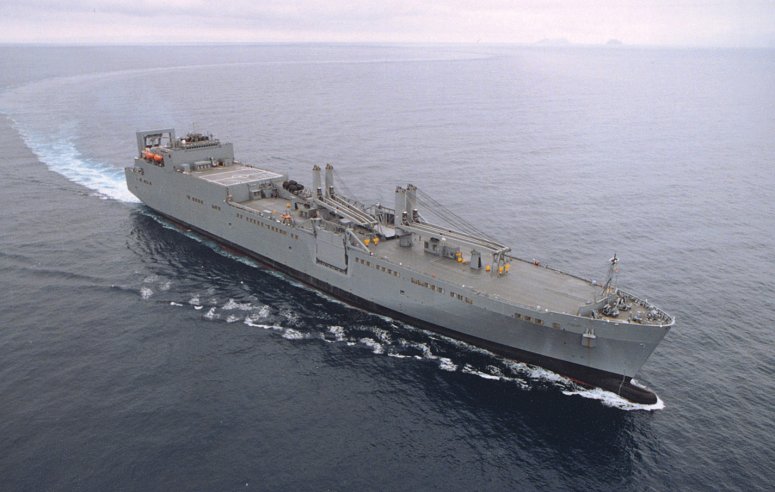
USNS Pomeroy (T-AKR-316) is a United States Navy large, medium-speed roll-on/roll-off (LMSR) cargo ship operated by the Military Sealift Command. As part of the Watson-class LMSR vessels, Pomeroy plays a critical role in the Navy’s strategic sealift capabilities by facilitating the rapid transport and deployment of military vehicles, equipment, and supplies across the globe. The ship is named in honor of Specialist Four William Earl Pomeroy, a Medal of Honor recipient recognized for his heroism during the Vietnam War. USNS Pomeroy represents a vital asset for enabling the swift projection of power, especially in support of U.S. Marine Corps and Army expeditionary operations.
Design and Construction
USNS Pomeroy was constructed during the late 1990s as part of a fleet modernization effort intended to replace older, slower cargo vessels with faster and more capable ships. The Watson-class design integrates commercial shipbuilding practices with military specifications to optimize for efficiency, durability, and operational flexibility. Built with a welded steel hull, the ship is designed to withstand the stresses of heavy military cargo transport while maintaining high speeds necessary to meet operational timelines. The vessel’s design focuses on maximizing cargo capacity and ensuring ease of loading and unloading, with specialized features that support rapid deployment in a variety of maritime environments.
Dimensions and Displacement
The ship measures approximately 950 feet in length overall, with a beam close to 105 feet, providing a wide and stable platform for cargo operations. Its fully loaded draft reaches around 32 feet, balancing between deep cargo capacity and the ability to access various ports worldwide. The displacement at full load is roughly 62,000 tons, a reflection of the large volume of military hardware and supplies the ship is capable of transporting. These dimensions enable USNS Pomeroy to carry extensive loads while maintaining the seaworthiness and speed necessary for strategic deployment missions.
Cargo Capacity and Layout
USNS Pomeroy’s cargo capacity is one of its most defining features, offering over 380,000 square feet of usable space spread across multiple vehicle decks. The ship is optimized for roll-on/roll-off operations, facilitating the transport of a wide array of military vehicles including tanks, armored personnel carriers, trucks, artillery, and other essential heavy equipment. Its internal decks are equipped with reinforced flooring and tie-down points to secure heavy tracked and wheeled vehicles during transit. The large cargo holds and open deck spaces are adaptable to accommodate containerized supplies, palletized goods, and oversized cargo, allowing for versatile mission support. The vessel’s design ensures fast loading and unloading, critical for reducing turnaround times during deployments or redeployments.
Propulsion and Performance
The propulsion system aboard USNS Pomeroy consists of multiple diesel engines connected to twin propeller shafts, delivering a combined power output sufficient to achieve cruising speeds of up to 24 knots. This speed is notably high for a ship of its size and class, enabling rapid transit across oceanic distances and integration into task force movements. The diesel engines are optimized for both reliability and fuel efficiency, essential for long-duration missions requiring extensive range without frequent refueling stops. Advanced automation within the propulsion and engineering systems reduces crew workload and increases operational availability.
Loading and Cargo Handling Systems
USNS Pomeroy features state-of-the-art cargo handling systems designed to streamline military logistics. The ship is equipped with large stern and side ramps, which provide roll-on/roll-off access to multiple cargo decks, enabling vehicles and equipment to be driven on and off the ship quickly and safely. This configuration allows the vessel to operate independently of shore-based loading infrastructure, which is crucial when deploying to austere or damaged ports. Heavy-lift cranes complement the ramps, enabling the handling of non-vehicular cargo such as containers or oversized equipment. These capabilities make Pomeroy highly adaptable to a range of operational scenarios, from prepositioning military assets to supporting combat deployments and humanitarian missions.
Aviation Capabilities
While primarily a cargo ship, USNS Pomeroy includes a helicopter landing deck capable of supporting medium-lift helicopters. This facility extends the ship’s logistical reach by allowing vertical replenishment operations, personnel transfers, and medical evacuations. The flight deck supports joint operations by enabling rapid transfer of supplies and personnel to and from the vessel when port access is limited or conditions at sea require alternate methods of resupply. Although the ship lacks a permanent hangar, the deck provides sufficient space for temporary shelter and refueling of embarked helicopters.
Crew and Operational Profile
Operated by a primarily civilian crew under the Military Sealift Command, USNS Pomeroy typically carries between 40 and 50 mariners responsible for navigation, engineering, and cargo operations. The civilian mariners bring extensive maritime expertise and maintain the ship’s continuous operational status. In addition to the civilian crew, military personnel are often embarked to oversee the handling of sensitive military cargo and to coordinate communications and security. Crew accommodations are designed for long-term deployments, with comfortable living quarters, mess facilities, and recreational areas to maintain morale and effectiveness during extended at-sea operations.
Defensive Systems and Survivability
As an auxiliary ship not designed for direct combat, USNS Pomeroy carries minimal self-defense armament. It is usually equipped with small arms and crew-served weapons intended for defense against close-range asymmetric threats such as small boats or low-flying aircraft. The ship relies heavily on escort vessels and naval air cover for protection in contested environments. Its structural design incorporates robust damage control features, including watertight compartments, fire suppression systems, and redundancy in vital systems, all of which enhance survivability in the event of attack or accidents.
Strategic Importance and Operational Role
USNS Pomeroy serves a critical function in the U.S. military’s ability to project and sustain power globally. As part of the Maritime Prepositioning Ship program and surge sealift fleet, the vessel ensures that combat-ready equipment and supplies are positioned close to potential conflict zones, significantly reducing the time required to deploy ground forces. This capability supports rapid crisis response, contingency operations, and large-scale joint exercises. The ship’s flexibility in cargo handling and high transit speed make it indispensable for transporting heavy equipment necessary to establish and maintain forward operating bases. Pomeroy’s role enhances the overall readiness and responsiveness of U.S. expeditionary forces.
Summary
USNS Pomeroy (T-AKR-316) represents a vital asset within the Navy’s strategic sealift capability, combining large cargo capacity with speed and flexible handling systems to support rapid military deployments worldwide. Its advanced design and robust construction enable it to transport a wide array of military vehicles and supplies efficiently, while its aviation facilities add an extra layer of operational versatility. Crewed by experienced civilian mariners and integrated with military operations, Pomeroy ensures that critical equipment reaches the battlefield swiftly and reliably. As part of the Watson-class LMSR fleet, the ship exemplifies modern naval logistics, playing a pivotal role in maintaining U.S. military readiness and global presence.
.jpg)