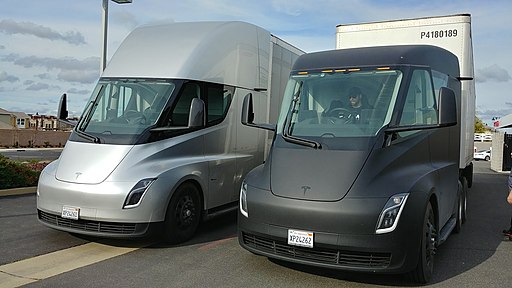
The Tesla Semi represents a transformative step in the heavy-duty trucking industry, bringing all-electric propulsion, cutting-edge technology, and sustainable design to a sector historically dominated by diesel engines. Tesla designed the Semi to reduce operating costs, increase efficiency, and improve safety while maintaining the durability and hauling capabilities required for commercial freight transport. Its aerodynamic silhouette, reinforced aluminum construction, and low-drag profile contribute not only to energy efficiency but also to stability and handling under heavy loads. Unlike conventional trucks, the Semi integrates its battery pack and electric drivetrain seamlessly into the chassis, lowering the center of gravity and enhancing overall vehicle control, even when fully loaded.
Powertrain and Performance
The Tesla Semi is powered by multiple high-efficiency electric motors, with the top configuration featuring four independent motors mounted on the rear axles. This setup provides exceptional torque delivery for hauling heavy freight, with an estimated 0-60 mph acceleration of approximately 20 seconds when fully loaded to 80,000 pounds. The electric drivetrain produces near-instant torque, enabling smoother acceleration, reduced gear shifting complexity, and lower maintenance requirements compared to diesel-powered trucks. Advanced regenerative braking recaptures energy during deceleration, reducing wear on mechanical components and increasing overall range. The Semi’s air suspension system adjusts automatically for varying loads and road conditions, providing both ride comfort for the driver and stability for the cargo.
Battery and Range
The Tesla Semi utilizes a large-format lithium-ion battery pack integrated into the vehicle’s chassis to optimize weight distribution and structural integrity. The standard configuration offers an estimated range of 300 miles on a single charge, while higher-capacity options extend this to 500 miles, addressing both regional and long-haul transport needs. Tesla’s proprietary thermal management system ensures the battery operates efficiently under heavy load conditions, maintaining consistent performance and protecting against thermal degradation. The Semi is compatible with Tesla’s Megacharger network, enabling high-speed charging to recover approximately 80% of capacity in about 30 minutes, minimizing downtime for commercial operations. The battery design emphasizes modularity and durability, ensuring long life cycles and reduced total cost of ownership.
Cabin and Driver Experience
The Tesla Semi introduces a radically modern cab design focused on driver ergonomics, visibility, and safety. The centrally positioned driver seat offers a panoramic view of the road and dashboard, while dual 17-inch touchscreens on either side provide full access to navigation, energy management, and truck monitoring systems. The cab layout reduces blind spots and optimizes driver engagement, with all critical controls within easy reach. Climate-controlled seats, adjustable steering, and advanced infotainment systems enhance comfort during long-haul trips. Tesla has also integrated autopilot capabilities, allowing semi-autonomous driving for highway conditions, lane keeping, adaptive cruise control, and collision avoidance, all aimed at reducing driver fatigue and improving safety.
Cargo and Hauling Capabilities
The Tesla Semi is engineered to handle typical commercial freight loads, with a gross vehicle weight rating (GVWR) of 80,000 pounds in the United States. The truck’s low center of gravity, adaptive suspension, and high-torque motors ensure stability and maneuverability under maximum payload. Coupling and trailer interfaces are designed to meet industry standards, allowing compatibility with a wide range of commercial trailers. The vehicle’s regenerative braking and torque-vectoring capabilities improve control during descents and in varying terrain, while aerodynamic design reduces drag to maximize efficiency over long distances.
Performance Metrics and Handling
Despite its size, the Tesla Semi delivers superior driving performance for a heavy-duty vehicle. Acceleration, while slower than passenger vehicles, is competitive within the commercial trucking sector, particularly when considering its torque delivery and handling under load. The truck’s stability is enhanced by its low center of gravity, independent rear motors, and active suspension management, providing predictable handling on highways and rural roads. Regenerative braking assists in energy recapture and reduces wear on braking systems, improving both safety and operational cost-efficiency. Tesla’s software continuously monitors performance, enabling updates to optimize power delivery, suspension settings, and energy efficiency over time.
Safety and Driver Assistance
Safety is a cornerstone of the Tesla Semi design. Its low center of gravity reduces rollover risk, while reinforced cabin structures and crumple zones protect occupants during collisions. Tesla’s Autopilot system provides semi-autonomous driving capabilities, including automatic emergency braking, lane departure warning, collision avoidance, and adaptive cruise control. Sensors and cameras create a comprehensive 360-degree awareness system, ensuring hazards are detected early. Over-the-air software updates allow Tesla to continuously improve these safety features, integrating new driver-assist technologies without the need for physical modifications.
Environmental and Efficiency Considerations
The Tesla Semi is designed to minimize environmental impact while reducing operational costs. As a fully electric vehicle, it produces zero tailpipe emissions, significantly reducing greenhouse gas output relative to traditional diesel trucks. Aerodynamic efficiency, regenerative braking, and high-efficiency motors maximize energy utilization, translating to lower electricity consumption per mile. Tesla’s emphasis on long-life battery packs, modular design, and recyclability further reduces environmental footprint. By integrating with renewable energy sources and the Megacharger network, the Semi offers fleet operators the ability to run long-haul operations sustainably and cost-effectively.
Technical Specifications
| Specification | Tesla Semi Standard | Tesla Semi Extended Range |
|---|---|---|
| Drive Type | Tri-Motor AWD | Quad-Motor AWD |
| 0-60 mph (0-97 km/h) Full Load | ~20 seconds | ~20 seconds |
| Top Speed | 65 mph (105 km/h) | 65 mph (105 km/h) |
| Range (Estimated) | 300 miles (483 km) | 500 miles (805 km) |
| Battery | High-capacity lithium-ion, integrated floor pack | High-capacity lithium-ion, integrated floor pack |
| Gross Vehicle Weight Rating (GVWR) | 80,000 lbs (36,287 kg) | 80,000 lbs (36,287 kg) |
| Cargo Compatibility | Standard trailers, 53 ft max | Standard trailers, 53 ft max |
| Suspension | Adaptive air suspension | Adaptive air suspension |
| Regenerative Braking | Yes | Yes |
| Charging Rate | Megacharger, up to 1 MW | Megacharger, up to 1 MW |
| Cab Features | Central driver seat, dual 17” touchscreens, FSD hardware, climate control | Central driver seat, dual 17” touchscreens, FSD hardware, climate control |
| Autonomous Features | Autopilot, lane keeping, collision avoidance, adaptive cruise control | Autopilot, lane keeping, collision avoidance, adaptive cruise control |
| Price (Est.) | $150,000 USD | $180,000 USD |
The Tesla Semi is a revolutionary step for the trucking industry, combining zero-emission operation, advanced electric drivetrain performance, and modern driver-focused technology. With its impressive range, low operating costs, and cutting-edge safety systems, the Semi offers fleet operators a sustainable alternative to diesel trucks without sacrificing hauling capabilities, efficiency, or driver comfort.
