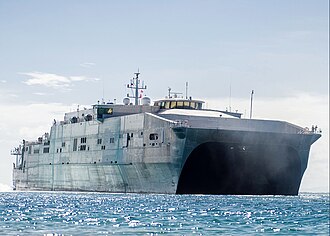
USNS Spearhead (JHSV-1 / T-EPF-1): The U.S. Navy’s High-Speed Expeditionary Transport Platform
The modern operational environment demands naval platforms capable of moving forces rapidly across vast maritime regions while remaining flexible enough to support a wide spectrum of missions. Among the vessels designed to meet this requirement is USNS Spearhead (JHSV‑1/T‑EPF‑1), the lead ship of the Spearhead-class Expeditionary Fast Transport operated by the Military Sealift Command of the United States Navy. Designed as a high-speed intra-theater transport vessel, this ship combines the speed of a fast ferry with the logistics capabilities of a military transport platform.
The Spearhead program represents a major shift in naval logistics philosophy. Instead of relying solely on heavily armed warships or slow cargo vessels, the U.S. Navy introduced a fast, lightweight catamaran capable of transporting troops, vehicles, and equipment rapidly within a theater of operations. The vessel is optimized for speed, shallow-water access, and modular mission capability, making it ideal for humanitarian operations, disaster relief, special operations support, and rapid force deployment. (navy.mil)
The ship was constructed by Austal USA, a company specializing in high-speed aluminum vessels. The result is a modern expeditionary transport capable of reaching speeds exceeding 40 knots while carrying hundreds of troops and hundreds of tons of cargo. This combination of speed and capacity has made the Spearhead design one of the most distinctive logistical platforms in the contemporary U.S. naval fleet.
This article provides a detailed technical and operational overview of the vessel, including its design philosophy, propulsion systems, operational capabilities, mission profiles, and technical specifications.
Origins of the Expeditionary Fast Transport Concept
The development of the Spearhead-class ships was driven by the U.S. military’s need for rapid intra-theater mobility. During operations in Iraq and Afghanistan, as well as humanitarian missions worldwide, military planners recognized that traditional sealift vessels were too slow for many operational requirements. At the same time, high-speed ferries demonstrated the feasibility of transporting large cargo loads quickly over moderate distances.
To address this capability gap, the U.S. Department of Defense initiated the Joint High Speed Vessel (JHSV) program. The goal was to create a platform capable of transporting troops, vehicles, and equipment at high speeds between forward bases or coastal areas within a theater of operations.
The first vessel in this program became USNS Spearhead, designated JHSV-1 during its early service. In 2015 the class designation changed to Expeditionary Fast Transport (EPF), and the ship was redesignated T-EPF-1 to reflect its role in the logistics and expeditionary support fleet.
The concept emphasized several critical characteristics:
- High operational speed
- Shallow draft for coastal operations
- Large cargo deck
- Modular mission configuration
- Low crew requirements
- Flexible mission capabilities
Unlike traditional warships, these vessels are not designed for high-intensity combat environments. Instead, they operate in lower-threat environments or under the protection of other naval forces.
Construction and Shipyard Background
USNS Spearhead was built at the Austal USA shipyard in Mobile, Alabama, a facility known for constructing advanced aluminum vessels for both commercial and military customers. Construction of the ship began with the keel laying on 22 July 2010, marking the start of the first vessel in the class.
The ship was launched on 12 September 2011 and officially christened shortly thereafter. Following extensive sea trials and system tests, the vessel was delivered to the U.S. Navy’s Military Sealift Command and entered service on 5 December 2012.
The Spearhead-class program itself represented a collaboration between naval architects, shipbuilders, and defense planners who sought to integrate commercial high-speed ferry technology with military logistics requirements. The design leveraged Austal’s experience building aluminum catamarans for ferry operators worldwide.
This hybrid approach allowed the ship to achieve exceptional speeds while maintaining substantial payload capacity. The lightweight aluminum hull and catamaran structure significantly reduce hydrodynamic resistance, enabling higher speeds than conventional monohull transport vessels.
Hull Design and Structural Characteristics
One of the most distinctive features of USNS Spearhead is its catamaran hull configuration. Unlike traditional monohull ships, the catamaran design uses two slender hulls connected by a broad deck structure.
This configuration offers several important advantages:
- Reduced hydrodynamic drag, enabling higher speeds.
- Improved stability, particularly at high speeds.
- Large deck area, providing significant cargo and mission space.
- Shallow draft, allowing access to ports and coastal regions that larger vessels cannot reach.
The vessel measures approximately 103 meters in length, with a beam of 28.5 meters, making it both long and unusually wide for its size category. The wide beam results from the spacing between the two hulls, which supports the expansive mission deck and cargo area.
Another key design feature is the extensive use of marine-grade aluminum in the hull and superstructure. Aluminum provides significant weight savings compared with steel, enabling the vessel to maintain high speeds while carrying heavy cargo loads.
However, aluminum construction also presents engineering challenges, particularly in terms of structural fatigue and damage tolerance. Naval engineers have addressed these issues through advanced hull design, reinforcement structures, and continuous maintenance procedures.
Propulsion System and Engineering
The propulsion system of USNS Spearhead reflects the ship’s primary design objective: speed. The vessel is powered by four high-performance diesel engines, specifically the MTU 20V8000 M71L model.
Each of these engines produces approximately 9.1 megawatts (12,200 horsepower) of power. The engines drive four Wartsila WLD 1400 SR waterjets via reduction gear systems.
The waterjet propulsion system offers several advantages over conventional propellers:
- Higher efficiency at high speeds
- Reduced draft
- Improved maneuverability
- Lower risk of damage in shallow waters
Because the jets are located within the hull structure rather than extending below it, the ship can operate effectively in shallow coastal environments. This capability is essential for expeditionary operations and humanitarian missions where port infrastructure may be limited.
The propulsion system allows the ship to reach maximum speeds of approximately 43 knots, making it one of the fastest large logistical vessels in the U.S. Navy’s inventory. Operational cruising speeds typically range between 35 and 40 knots.
Cargo Capacity and Mission Deck
The central mission deck of USNS Spearhead is one of its most significant features. Designed to be highly modular, the mission bay allows for rapid reconfiguration depending on operational requirements.
The cargo area provides approximately 20,000 square feet (1,900 square meters) of usable space. Within this area, the ship can carry up to 600 short tons of cargo, including vehicles, containers, and military equipment.
This flexibility enables the ship to support numerous mission types, including:
- Rapid deployment of ground forces
- Transport of armored vehicles
- Logistics resupply operations
- Disaster relief cargo transport
- Special operations support
- Medical evacuation and humanitarian aid missions
The cargo deck also includes a roll-on/roll-off ramp, allowing vehicles to drive directly on and off the vessel. This capability significantly reduces loading times compared with traditional cargo ships.
Troop Accommodation and Personnel Capacity
USNS Spearhead is capable of transporting a substantial number of personnel relative to its size. The ship has accommodations for approximately 41 crew members, although the normal operating crew is typically smaller.
In addition to the permanent crew, the ship can transport up to 312 troops in airline-style seating arrangements. These seats are located in a dedicated passenger area designed for comfort during medium-length voyages.
There are also additional berthing areas for embarked forces, allowing personnel to rest during longer transit operations. This capacity makes the ship suitable for transporting company-sized military units with their equipment.
Aviation Facilities
The ship is equipped with a flight deck capable of supporting medium and heavy helicopters, including aircraft such as the CH-53 Super Stallion or CH-53K King Stallion.
Although the vessel does not include a full hangar, it features a helicopter landing pad and parking area for smaller aircraft such as the MH-60 Seahawk.
Helicopter operations significantly expand the vessel’s operational capabilities. Aircraft can be used for:
- Rapid troop insertion
- Medical evacuation
- Reconnaissance missions
- Cargo delivery
- Search and rescue operations
The integration of aviation facilities allows the ship to function as a mobile expeditionary support platform rather than merely a transport vessel.
Armament and Defensive Systems
Unlike traditional warships, USNS Spearhead is not designed for direct combat operations. Instead, it is classified as an auxiliary vessel and typically operates in relatively secure environments.
Nevertheless, the ship is equipped with basic defensive systems to provide limited protection. These include mounts for M2 .50 caliber heavy machine guns, which can be used for self-defense against small surface threats.
In higher-threat environments, the vessel normally operates under the protection of escorting naval warships, such as destroyers or frigates.
Operational Role and Strategic Importance
The strategic role of USNS Spearhead lies in its ability to function as an intra-theater connector. This term refers to vessels that move personnel and equipment within a specific region of operations rather than across entire oceans.
For example, the ship can transport forces between islands, coastal bases, or forward operating locations within a combat theater. This capability is particularly important in regions such as:
- Southeast Asia
- The Western Pacific
- The Caribbean
- The Mediterranean
- The Persian Gulf
Because of its shallow draft and high speed, the vessel can reach ports that would otherwise be inaccessible to larger ships.
Humanitarian Assistance and Disaster Relief Missions
One of the most important uses of the Spearhead-class vessels has been humanitarian assistance and disaster relief operations. Their speed and cargo capacity allow them to deliver supplies quickly to disaster-affected regions.
The ships can transport:
- Medical teams
- Relief supplies
- Engineering equipment
- Portable hospitals
- Vehicles and generators
Because the mission bay can be rapidly reconfigured, the ship can adapt to the needs of specific disaster response missions.
Evolution of the Spearhead-Class Fleet
Following the successful introduction of USNS Spearhead, additional vessels in the class were constructed. The program eventually expanded to include multiple ships serving in different operational regions.
Later vessels incorporated design improvements and expanded mission capabilities. Some have been modified for specialized missions such as medical support or unmanned systems operations.
The class continues to evolve as naval planners explore new uses for fast expeditionary transport platforms.
Technical Specifications Table
| Parameter | Specification |
|---|---|
| Ship Name | USNS Spearhead |
| Hull Number | JHSV-1 / T-EPF-1 |
| Class | Spearhead-class Expeditionary Fast Transport |
| Builder | Austal USA |
| Laid Down | 22 July 2010 |
| Launched | 12 September 2011 |
| Entered Service | 5 December 2012 |
| Length | 103 m |
| Beam | 28.5 m |
| Draft | 3.83 m |
| Displacement | ~2,500 tons |
| Propulsion | 4 × MTU 20V8000 M71L diesel engines |
| Propulsion System | Waterjet drive |
| Maximum Speed | ~43 knots |
| Operational Speed | 35–40 knots |
| Range | ~1,200 nautical miles |
| Crew | 22–41 personnel |
| Troop Capacity | Up to 312 troops |
| Cargo Capacity | Approx. 600 short tons |
| Cargo Deck Area | ~20,000 sq ft |
| Aircraft Facilities | Helicopter landing deck |
| Armament | Mounts for M2 .50 caliber machine guns |
| Operator | U.S. Navy Military Sealift Command |
Conclusion
USNS Spearhead represents a significant evolution in naval logistics and expeditionary operations. By combining the speed of commercial high-speed ferries with the operational flexibility required by modern military forces, the ship provides a unique capability within the U.S. Navy’s fleet.
Its catamaran hull design, lightweight aluminum construction, powerful diesel engines, and waterjet propulsion system allow it to achieve exceptional speeds while maintaining significant cargo capacity. These characteristics enable the ship to perform missions ranging from troop transport and logistics support to humanitarian assistance and disaster relief.
As naval strategy increasingly emphasizes mobility, flexibility, and rapid response, vessels like USNS Spearhead will continue to play an important role in supporting global operations.
_departs_from_Puerto_Castilla,_Honduras,_Sept_140902-N-XQ474-001_(cropped).jpg)