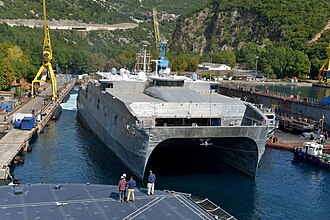
USNS Trenton (JHSV-5 / T-EPF-5): High-Speed Expeditionary Transport Vessel of the U.S. Navy
Modern naval operations depend not only on powerful warships but also on highly flexible logistical platforms capable of rapidly transporting troops, equipment, and humanitarian aid across vast maritime regions. In an era where mobility and speed are critical to military effectiveness, the United States Navy has increasingly invested in high-speed transport vessels designed to support expeditionary operations. One of the most important ships fulfilling this role is USNS Trenton (T-EPF-5), a high-speed expeditionary transport vessel that operates within the logistics fleet of the United States Navy.
The vessel is part of the Spearhead-class expeditionary fast transport, a modern class of aluminum catamaran ships developed to rapidly move troops, vehicles, and cargo within operational theaters. Originally designated as Joint High Speed Vessels (JHSV), these ships were designed to meet the evolving needs of U.S. military planners who required rapid deployment capabilities between regional bases, forward operating areas, and remote coastal locations.
Unlike traditional naval transports that focus primarily on cargo capacity, expeditionary fast transport vessels combine speed, shallow draft, and flexible mission modules. This allows them to perform a wide range of tasks, including military logistics support, humanitarian assistance, disaster relief operations, special operations support, and medical evacuation missions.
USNS Trenton represents the fifth vessel in the Spearhead-class series. Operated by the Military Sealift Command, the ship is crewed primarily by civilian mariners and serves as a critical component of the Navy’s global logistics infrastructure. Its ability to travel at extremely high speeds while carrying significant payloads makes it one of the most versatile support vessels currently operating in the U.S. fleet.
Development of the Expeditionary Fast Transport Program
The concept behind the Expeditionary Fast Transport program originated in the early twenty-first century when military planners identified a gap between large strategic sealift ships and smaller tactical transport assets. Traditional cargo ships were capable of moving enormous quantities of equipment but often required weeks to reach operational theaters. Aircraft provided rapid transportation but were limited in the amount of cargo they could carry.
To bridge this gap, the Department of Defense initiated the Joint High Speed Vessel program. The objective was to create a platform capable of transporting troops and equipment quickly between regional ports while maintaining a high level of operational flexibility.
These ships were inspired by commercial high-speed ferries already operating in various parts of the world. Naval engineers adapted these designs for military use by adding reinforced cargo decks, helicopter landing facilities, improved navigation systems, and military communications equipment.
The program eventually evolved into the Expeditionary Fast Transport designation used today. USNS Trenton became one of the key vessels in this series, demonstrating how high-speed logistics ships can transform the way naval forces operate within regional theaters.
Construction and Shipbuilding
USNS Trenton was constructed by Austal USA, a major shipbuilder located in Mobile, Alabama. Austal specializes in aluminum ship construction and high-speed vessel technology, making it an ideal contractor for the expeditionary fast transport program.
The ship was built using modular construction techniques, where large sections of the vessel were assembled separately before being joined together in the final stages of construction. This approach allowed shipbuilders to accelerate production while maintaining high standards of quality and structural integrity.
Once the hull and superstructure were completed, the ship underwent extensive outfitting that included propulsion systems, cargo handling equipment, communications systems, and aviation support facilities. After completing sea trials, the vessel was delivered to the Military Sealift Command and officially entered service as USNS Trenton.
The ship was named after the city of Trenton, New Jersey, continuing the Navy’s tradition of honoring American cities with logistical and auxiliary vessels.
Catamaran Hull Design and Structural Characteristics
One of the most distinctive features of USNS Trenton is its catamaran hull configuration. Unlike traditional monohull ships, catamarans use two parallel hulls connected by a wide deck structure.
This design offers several advantages for high-speed transport vessels. The twin-hull configuration significantly reduces hydrodynamic resistance, allowing the ship to achieve higher speeds than conventional ships of similar size. It also improves stability in rough seas and provides a large deck area for cargo and mission modules.
The hull is constructed primarily from marine-grade aluminum, which reduces overall weight while maintaining structural strength. This lightweight design is essential for achieving the high speeds required by expeditionary transport missions.
The wide beam created by the catamaran structure also allows for a spacious mission bay capable of carrying vehicles, equipment, and containerized cargo. This cargo deck is one of the most important operational features of the vessel.
Propulsion System and High-Speed Performance
USNS Trenton is designed to operate at exceptionally high speeds compared with most naval support vessels. The ship’s propulsion system consists of four high-power diesel engines that drive waterjet propulsion units.
Waterjet propulsion systems work by drawing water into the vessel and expelling it through high-velocity nozzles. This system offers several advantages over traditional propellers, particularly for high-speed ships.
First, waterjets provide greater efficiency at high speeds, allowing the vessel to travel faster while consuming less fuel. Second, they improve maneuverability by allowing the ship to rapidly change direction. Third, waterjets reduce the risk of damage when operating in shallow waters, which is particularly important for expeditionary operations near coastlines.
The propulsion system enables USNS Trenton to reach speeds exceeding 40 knots, making it one of the fastest large vessels in the U.S. Navy logistics fleet. This speed allows the ship to quickly move between ports and operational areas, significantly reducing transit times.
Mission Deck and Cargo Handling Capabilities
The central mission deck of USNS Trenton is designed to support a wide range of operational requirements. The deck provides a large open space capable of accommodating military vehicles, containerized cargo, and specialized mission equipment.
This flexible layout allows the ship to transport a wide variety of payloads depending on the mission. Vehicles can be loaded using a roll-on/roll-off ramp located at the stern, allowing them to drive directly onto the cargo deck.
The ship can carry several hundred tons of cargo, including trucks, armored vehicles, engineering equipment, and humanitarian relief supplies. This capability makes the vessel extremely valuable during both military deployments and disaster response operations.
Advanced cargo handling systems ensure that loading and unloading operations can be conducted quickly and efficiently, minimizing time spent in port.
Troop Transport and Accommodation
In addition to cargo transport, USNS Trenton is capable of carrying large numbers of personnel. The ship includes seating and accommodation areas for hundreds of embarked troops.
The passenger spaces are designed to provide reasonable comfort during transit operations. Troops are typically seated in airline-style seating arrangements that allow them to travel safely during high-speed voyages.
Additional spaces within the vessel provide berthing areas, restrooms, and support facilities necessary for extended operations. These accommodations make the ship suitable for transporting entire company-sized military units along with their equipment.
Aviation Facilities and Helicopter Operations
USNS Trenton includes aviation facilities that significantly expand its operational capabilities. The ship features a helicopter landing deck capable of supporting medium-lift naval helicopters.
Aircraft such as the Sikorsky MH-60 Seahawk can land on the deck to conduct cargo transfer, reconnaissance missions, or medical evacuation operations.
Helicopter support allows the ship to deliver supplies and personnel to locations that may not have port infrastructure capable of accommodating large vessels. This capability is especially useful during humanitarian missions and disaster response operations.
Although the ship does not include a full hangar for aircraft storage, its flight deck is designed to support frequent helicopter operations.
Operational Role in Expeditionary Warfare
USNS Trenton plays a vital role in expeditionary warfare operations. Expeditionary forces require rapid deployment capabilities to respond to crises in remote regions around the world.
The ship’s high speed allows it to transport troops and equipment quickly between regional bases and forward operating locations. Its shallow draft also allows it to access smaller ports and coastal areas that may not be accessible to larger ships.
These capabilities make expeditionary fast transport vessels valuable assets for supporting special operations forces, Marine Corps units, and humanitarian response teams.
Humanitarian Assistance and Disaster Relief Missions
Beyond military operations, USNS Trenton is frequently used in humanitarian assistance and disaster relief missions. Natural disasters often damage infrastructure, making it difficult to deliver supplies using traditional transport methods.
The ship’s ability to rapidly deliver vehicles, equipment, and relief supplies makes it an ideal platform for emergency response operations.
Medical teams, engineers, and disaster relief personnel can be transported quickly to affected areas along with the equipment needed to restore essential services.
Role within Military Sealift Command
As part of the Military Sealift Command fleet, USNS Trenton contributes to one of the world’s largest maritime logistics networks.
Military Sealift Command vessels support naval operations by transporting fuel, cargo, and personnel across global maritime regions. These ships are operated by civilian mariners who specialize in maritime logistics operations.
This operational structure allows the Navy to maintain a large support fleet without diverting active-duty sailors from combat roles.
Strategic Importance of Expeditionary Fast Transport Ships
Ships like USNS Trenton represent a new generation of naval logistics platforms designed for modern operational requirements.
The ability to move troops and equipment quickly within regional theaters is essential for responding to emerging crises. High-speed transport vessels allow military forces to reposition rapidly without relying solely on air transport.
As geopolitical challenges continue to evolve, expeditionary fast transport ships will likely remain an important component of naval logistics strategies.
Technical Specifications of USNS Trenton (JHSV-5 / T-EPF-5)
| Parameter | Specification |
|---|---|
| Ship Name | USNS Trenton |
| Hull Number | JHSV-5 / T-EPF-5 |
| Class | Spearhead-class Expeditionary Fast Transport |
| Operator | Military Sealift Command |
| Builder | Austal USA |
| Length | ~103 m |
| Beam | ~28.5 m |
| Draft | ~3.8 m |
| Displacement | ~2,400 tons |
| Propulsion | 4 × diesel engines |
| Propulsion Type | Waterjet propulsion |
| Maximum Speed | Over 40 knots |
| Range | Approx. 1,200 nautical miles |
| Crew | ~40 personnel |
| Troop Capacity | Up to 300+ troops |
| Cargo Capacity | Approx. 600 tons |
| Cargo Deck | Large mission bay |
| Aviation Facilities | Helicopter landing deck |
| Supported Aircraft | MH-60 Seahawk |
| Armament | Light defensive weapons |
| Primary Mission | High-speed troop and cargo transport |
Conclusion
USNS Trenton (T-EPF-5) represents a significant advancement in modern naval logistics and expeditionary operations. Designed to combine high speed, flexible cargo capacity, and shallow-water accessibility, the vessel fills a critical role between traditional sealift ships and air transport.
Its innovative catamaran hull design, powerful propulsion system, and large mission deck allow it to transport troops, vehicles, and supplies rapidly across regional theaters. These capabilities make the ship invaluable for both military operations and humanitarian missions.
As global naval operations increasingly emphasize rapid mobility and flexible deployment strategies, expeditionary fast transport ships like USNS Trenton will continue to play a crucial role in supporting maritime security and international humanitarian response efforts.
.jpg)