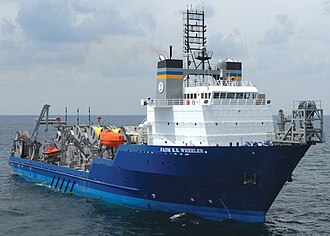
USNS VADM K. R. Wheeler (T-AG-5001): The U.S. Navy’s Next-Generation Submarine Cable Layer
Modern global communication and military command systems rely heavily on undersea cable networks. These vast underwater infrastructures carry enormous volumes of digital data, connect continents, and support both civilian and military communication systems. In recent years, the strategic importance of subsea cables has increased significantly as governments and defense organizations recognize their vulnerability and critical role in modern warfare and global connectivity.
To support the installation, repair, and maintenance of undersea cable networks, the United States Navy and the Military Sealift Command operate specialized vessels designed for cable-laying operations. Among the newest and most technologically advanced ships in this category is USNS VADM K. R. Wheeler (T-AG-5001), a modern cable-laying vessel built to strengthen the resilience and expansion of critical underwater communication infrastructure.
Unlike traditional naval combat vessels, cable layers serve a unique and highly specialized mission. Their primary function involves installing and maintaining submarine cables used for communication networks, sensor arrays, and military command systems. These operations require highly specialized equipment, precision navigation capabilities, and crews trained in complex marine engineering tasks.
USNS VADM K. R. Wheeler represents the newest generation of cable-laying ships designed for the United States Navy. With advanced positioning systems, extensive cable storage capacity, and sophisticated deployment equipment, the ship is capable of installing thousands of kilometers of subsea cable across deep ocean environments.
This vessel reflects a growing recognition that undersea infrastructure is an essential component of modern national security. By enabling secure communication networks and supporting naval sensor systems, ships like USNS VADM K. R. Wheeler play an increasingly important role in the maritime domain.
The Strategic Importance of Undersea Cable Infrastructure
Undersea cables form the backbone of global telecommunications. More than ninety percent of international internet traffic travels through submarine cable networks laid along the seabed. These cables connect continents, enable international financial transactions, and support global data exchange.
Beyond civilian uses, submarine cables are also essential to military communication systems. Secure command networks, intelligence transmission, and sensor arrays often rely on dedicated undersea cable infrastructure.
In recent years, concerns about the vulnerability of these networks have increased. Natural disasters, accidents, and potential sabotage can disrupt communications and cause widespread economic and operational consequences.
Because of these risks, maintaining and expanding submarine cable networks has become a priority for governments and military organizations worldwide. Specialized cable-laying ships provide the capability to deploy new cables, repair damaged lines, and maintain underwater communication systems.
USNS VADM K. R. Wheeler was designed to meet these challenges by providing a modern platform capable of supporting complex undersea engineering operations.
Development of the Cable Layer Replacement Program
For decades, the United States Navy relied on aging cable-laying ships to support undersea communication infrastructure. Many of these vessels were originally constructed during the Cold War and eventually reached the limits of their operational lifespan.
To replace these ships and modernize its cable-laying capabilities, the Navy initiated a program to develop a new generation of cable-layer vessels. The goal was to create ships equipped with modern technology capable of installing advanced fiber-optic communication cables and supporting naval sensor networks.
This initiative eventually led to the construction of USNS VADM K. R. Wheeler, which became the lead ship in a new class of cable-laying vessels.
The program focused on several key design priorities:
- Large cable storage capacity
- Advanced dynamic positioning systems
- High-precision navigation equipment
- Modern cable deployment machinery
- Improved crew accommodations and operational efficiency
These features ensure that the vessel can conduct complex cable installation missions in a wide variety of maritime environments.
Shipbuilding and Construction
USNS VADM K. R. Wheeler was built by Vigor Industrial, an American shipbuilding and maritime services company with extensive experience constructing specialized vessels for both government and commercial clients.
Construction took place at the company’s shipyard facilities in the United States. The ship was designed with a focus on reliability, precision engineering, and operational versatility.
Unlike combat ships that emphasize weapons systems and armor, cable-laying vessels prioritize deck space, cargo capacity, and specialized mechanical equipment. As a result, much of the ship’s internal volume is dedicated to cable storage tanks and deployment systems.
The vessel’s construction also incorporated modern environmental and efficiency standards. Fuel-efficient propulsion systems, advanced monitoring equipment, and improved automation reduce operational costs while enhancing performance.
Once completed, the ship underwent sea trials to evaluate its propulsion system, dynamic positioning capabilities, and cable-laying equipment before entering service with the Military Sealift Command.
Ship Design and Hull Characteristics
The design of USNS VADM K. R. Wheeler reflects the specialized mission of a cable-laying vessel. The hull is engineered to provide exceptional stability during slow-speed operations required for cable deployment.
Cable installation requires the vessel to maintain precise positioning while releasing cable onto the seabed. Even small movements caused by waves or currents can affect cable placement, making stability a critical design requirement.
The ship’s hull features a wide beam and deep draft to enhance stability in open ocean conditions. This design reduces rolling motion and provides a stable working platform for cable-laying operations.
Another important feature is the vessel’s large working deck. This area contains cable handling equipment, control stations, and deployment machinery used during installation missions.
Below the deck are multiple cable storage tanks capable of holding large quantities of fiber-optic cable. These tanks allow the vessel to transport and deploy extensive lengths of cable during a single mission.
Propulsion and Dynamic Positioning Systems
USNS VADM K. R. Wheeler uses a diesel-electric propulsion system designed for efficiency and precise maneuverability. Diesel-electric systems generate electrical power through diesel engines and use electric motors to drive the ship’s propellers.
This arrangement provides several advantages for cable-laying operations. Electric propulsion allows precise control over speed and direction, which is essential when deploying cables on the ocean floor.
The ship is also equipped with a sophisticated dynamic positioning system, which uses satellite navigation, sensors, and computer-controlled thrusters to maintain the vessel’s position automatically.
Dynamic positioning enables the ship to remain stationary or follow a precise course even in challenging sea conditions. This capability is essential for accurate cable installation and repair operations.
Multiple bow thrusters and stern thrusters provide additional maneuverability, allowing the vessel to maintain position with minimal drift.
Cable Storage and Deployment Systems
The core mission equipment aboard USNS VADM K. R. Wheeler consists of its cable storage tanks and deployment systems.
The ship can carry thousands of tons of submarine cable stored in large cylindrical tanks located within the hull. These tanks are designed to prevent damage to the cable while allowing it to be fed smoothly into deployment machinery.
During installation operations, the cable is guided through specialized handling equipment that controls the tension and speed of deployment. Maintaining proper tension is critical to prevent cable damage during installation.
The vessel also includes remotely operated vehicles and specialized monitoring systems used to inspect cables on the ocean floor. These tools allow engineers to verify that the cable is being laid correctly and to repair damaged sections when necessary.
Navigation and Survey Systems
Accurate navigation is essential during cable-laying operations. USNS VADM K. R. Wheeler uses advanced navigation and survey equipment to ensure precise cable placement.
Satellite-based navigation systems provide accurate positioning data, while sonar and seabed mapping equipment help engineers identify suitable routes for cable installation.
Before deploying a cable, the crew conducts detailed seabed surveys to identify potential obstacles such as underwater mountains, trenches, or existing infrastructure.
This information is used to plan the optimal route for the cable, ensuring long-term reliability and minimizing the risk of damage.
Crew and Operational Organization
USNS VADM K. R. Wheeler is operated by the Military Sealift Command and crewed primarily by civilian mariners. These professionals are responsible for navigation, engineering, and deck operations.
In addition to the civilian crew, the ship carries specialized technicians and engineers responsible for cable-laying equipment and underwater systems.
The crew works in coordinated teams during installation operations, monitoring cable deployment, controlling positioning systems, and managing navigation tasks simultaneously.
The complex nature of cable-laying missions requires extensive training and coordination among all crew members.
Role in Naval Communications and Sensor Networks
Beyond telecommunications, cable-laying ships support naval sensor systems used for maritime surveillance.
Underwater sensor networks are often connected by fiber-optic cables that transmit data from remote monitoring stations to command centers. These systems can detect submarine movements, track vessels, and monitor oceanographic conditions.
USNS VADM K. R. Wheeler supports the installation and maintenance of these networks, helping strengthen maritime security and intelligence capabilities.
Future Role in Undersea Infrastructure Protection
As global dependence on undersea infrastructure grows, protecting these networks has become a strategic priority.
Cable-laying ships like USNS VADM K. R. Wheeler will play an important role not only in installing cables but also in maintaining and repairing them after damage or disruption.
Their ability to quickly respond to cable failures ensures that communication networks remain operational even in challenging conditions.
Technical Specifications of USNS VADM K. R. Wheeler (T-AG-5001)
| Parameter | Specification |
|---|---|
| Ship Name | USNS VADM K. R. Wheeler |
| Hull Number | T-AG-5001 |
| Ship Type | Cable Layer / Auxiliary Vessel |
| Operator | Military Sealift Command |
| Builder | Vigor Industrial |
| Length | ~113 m |
| Beam | ~21 m |
| Draft | ~7 m |
| Displacement | ~10,000 tons (approx.) |
| Propulsion | Diesel-electric system |
| Positioning System | Dynamic positioning |
| Thrusters | Multiple bow and stern thrusters |
| Maximum Speed | ~14–15 knots |
| Crew | Civilian mariners and technical specialists |
| Cable Storage | Large internal cable tanks |
| Equipment | Cable deployment machinery |
| Navigation | Satellite navigation and seabed survey systems |
| Mission | Submarine cable installation and maintenance |
Conclusion
USNS VADM K. R. Wheeler (T-AG-5001) represents a major advancement in the United States Navy’s ability to support undersea communication infrastructure. As the lead ship in a new generation of cable-laying vessels, it combines modern engineering, advanced navigation systems, and specialized deployment equipment to perform complex undersea missions.
The ship’s role extends far beyond traditional naval operations. By enabling the installation and maintenance of submarine cables, it supports global communication networks, military command systems, and underwater sensor arrays.
In an era where digital connectivity and maritime security are closely linked, vessels like USNS VADM K. R. Wheeler are becoming increasingly important assets within the naval logistics and infrastructure support fleet.
Their ability to maintain the invisible networks that connect the world ensures that both civilian and military communication systems remain reliable and resilient across the global maritime environment.
