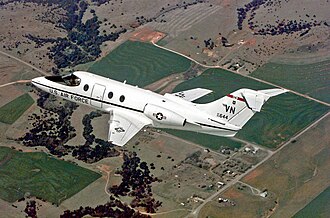
The Raytheon T-1 Jayhawk represents a crucial link in the modern pilot training pipeline of the United States Air Force, embodying a shift from purely tactical training platforms to aircraft that simulate real-world operational environments. Developed as a military adaptation of a civilian business jet, the T-1 Jayhawk was designed to prepare pilots for multi-engine, crew-based aircraft operations, particularly in transport and tanker roles. Its introduction marked a significant evolution in training philosophy, emphasizing systems management, crew coordination, and high-performance jet handling in a controlled yet realistic environment.
Unlike earlier trainers that focused heavily on stick-and-rudder skills alone, the T-1 integrates advanced avionics and operational procedures that mirror those found in frontline aircraft. This makes it an essential stepping stone for pilots transitioning to platforms such as strategic airlifters and aerial refueling tankers. The aircraft’s design, performance envelope, and cockpit environment collectively create a training ecosystem that balances complexity with accessibility.
Origins and Development Background
The origins of the T-1 Jayhawk can be traced to the civilian Beechcraft 400A Beechjet, a light business jet developed by Beech Aircraft Corporation, later part of Raytheon Company. During the late 1980s and early 1990s, the United States Air Force recognized the need to modernize its pilot training fleet, particularly for those destined for multi-engine aircraft. Existing trainers lacked the avionics sophistication and operational realism required to prepare pilots for increasingly complex missions.
To address this gap, the Air Force initiated a program to acquire a new training aircraft that could replicate the experience of flying larger, crew-operated jets. The Beechjet platform was selected due to its proven reliability, efficient twin-engine configuration, and compatibility with military training requirements. Modifications were made to adapt the aircraft for military use, including reinforced structures, specialized avionics, and provisions for instructor oversight.
The resulting aircraft was designated T-1A Jayhawk, with the “T” indicating its trainer role. The name “Jayhawk” continues the Air Force tradition of naming training aircraft after birds, symbolizing agility, awareness, and adaptability.
Design Philosophy and Structural Characteristics
The design philosophy of the T-1 Jayhawk centers on realism, reliability, and cost-effectiveness. By leveraging a civilian platform, the Air Force was able to reduce development costs while benefiting from an established production and maintenance infrastructure. The aircraft’s low-wing, swept configuration provides aerodynamic efficiency and stable high-speed performance, characteristics essential for jet training.
Structurally, the T-1 features an all-metal airframe with a pressurized cabin, enabling operations at high altitudes. The swept wings are optimized for cruise efficiency, while the T-tail configuration enhances stability and control authority. These design elements collectively contribute to an aircraft that behaves similarly to larger transport jets, making it an ideal training platform.
The landing gear system is retractable and designed for repeated training cycles, including frequent takeoffs and landings. Durability and ease of maintenance were key considerations, ensuring that the aircraft could sustain high utilization rates typical of training environments.
Cockpit Layout and Avionics Systems
One of the most significant aspects of the T-1 Jayhawk is its cockpit design, which closely mirrors that of operational multi-engine aircraft. The cockpit accommodates two pilots and an instructor, allowing for realistic crew coordination exercises. The layout emphasizes ergonomics and accessibility, with controls and displays arranged to facilitate efficient workflow.
The avionics suite includes advanced navigation and communication systems, as well as flight management systems (FMS) that enable complex flight planning and execution. These systems are critical for training pilots in modern aviation procedures, including instrument flight rules (IFR) operations, en-route navigation, and approach techniques.
In addition to standard avionics, the T-1 is equipped with systems that allow instructors to monitor and evaluate student performance in real time. This includes the ability to simulate system failures and emergency scenarios, providing a comprehensive training experience that prepares pilots for a wide range of situations.
Powerplant and Performance Engineering
The T-1 Jayhawk is powered by two turbofan engines, typically Pratt & Whitney JT15D turbofan units, which provide a balance of thrust, efficiency, and reliability. These engines are well-suited for training applications, offering predictable performance and relatively low operating costs compared to larger powerplants.
The aircraft’s performance characteristics are tailored to simulate those of larger jets while remaining manageable for student pilots. It is capable of cruising at high subsonic speeds, with a service ceiling that allows for realistic high-altitude operations. The rate of climb and acceleration profiles provide valuable experience in energy management and flight planning.
Fuel efficiency is another important consideration, as training aircraft must operate economically over long periods. The T-1 achieves this through aerodynamic efficiency and optimized engine performance, allowing for extended training missions without excessive fuel consumption.
Flight Handling and Training Dynamics
The handling characteristics of the T-1 Jayhawk are designed to be both forgiving and instructive. The aircraft exhibits stable behavior across its flight envelope, making it suitable for pilots transitioning from simpler trainers. At the same time, it introduces complexities such as higher speeds, increased inertia, and more sophisticated systems management.
One of the key training objectives of the T-1 is to teach crew resource management (CRM), a critical skill in modern aviation. The multi-crew environment requires pilots to communicate effectively, تقسیم tasks efficiently, and maintain situational awareness. These skills are essential for operating large aircraft, where coordination between crew members is paramount.
The aircraft also supports advanced training scenarios, including instrument approaches, holding patterns, and cross-country navigation. These exercises are conducted under realistic conditions, often simulating the operational environment of transport and tanker missions.
Operational Role in Pilot Training
Within the Air Force training pipeline, the T-1 Jayhawk plays a specialized role. After completing initial flight training in primary trainers, selected pilots transition to the T-1 for advanced training focused on multi-engine operations. This phase prepares them for assignments to aircraft such as the Boeing KC-135 Stratotanker and the Boeing C-17 Globemaster III.
The training syllabus includes a combination of classroom instruction, simulator sessions, and actual flight hours. Students learn to operate the aircraft in various conditions, including day and night operations, adverse weather, and high-traffic environments. The goal is to develop proficiency not only in flying but also in managing complex systems and making informed decisions.
The T-1’s role extends beyond basic training, as it also serves as a platform for instructor development and proficiency maintenance. Its versatility and reliability make it a cornerstone of the Air Force’s training infrastructure.
Maintenance, Reliability, and Operational Efficiency
Maintenance considerations are critical for any training aircraft, and the T-1 Jayhawk excels in this regard. Its design incorporates features that facilitate routine inspections and repairs, minimizing downtime and ensuring high availability. The use of a civilian-derived platform also means that parts and expertise are widely available.
Reliability is a key factor in training operations, where scheduling disruptions can have significant consequences. The T-1’s proven track record in both civilian and military contexts contributes to its reputation as a dependable aircraft. This reliability allows training programs to operate smoothly and efficiently.
Operational efficiency is further enhanced by the aircraft’s relatively low operating costs compared to larger jets. This makes it a cost-effective solution for training large numbers of pilots without compromising on quality.
Comparison with Other Training Aircraft
When compared to other training aircraft, the T-1 Jayhawk occupies a unique position. Unlike primary trainers such as the Beechcraft T-6 Texan II, which focus on basic flight skills, the T-1 emphasizes multi-engine operations and crew coordination. It bridges the gap between initial training and operational conversion.
In contrast to advanced jet trainers like the Northrop T-38 Talon, which are used to prepare pilots for fighter aircraft, the T-1 is tailored for transport and tanker roles. This specialization ensures that pilots receive training relevant to their المستقبل assignments, improving overall effectiveness.
Evolution and Future Outlook
Although the T-1 Jayhawk has been a mainstay of Air Force training for decades, changes in technology and training philosophy are shaping its future. Advances in simulation and the introduction of new training aircraft are gradually transforming the training landscape.
The Air Force has explored options to replace or supplement the T-1 with more modern platforms, incorporating digital cockpits and enhanced simulation capabilities. However, the T-1’s proven performance and established infrastructure ensure that it will remain in service for the foreseeable future.
Its legacy lies in its contribution to the development of thousands of pilots, many of whom have gone on to operate some of the most advanced aircraft in the world. The lessons learned from the T-1 program continue to influence the design of future training systems.
Broader Impact on Military Aviation Training
The introduction of the T-1 Jayhawk marked a shift toward more realistic and comprehensive training methodologies. By emphasizing systems management, crew coordination, and operational realism, it helped redefine what it means to prepare pilots for modern aviation.
This approach has influenced training programs not only within the United States but also in other देशों that have adopted similar philosophies. The integration of advanced avionics and realistic mission scenarios has become a standard in pilot training, reflecting the complexities of contemporary aviation.
The T-1’s success demonstrates the value of leveraging civilian technology for military applications, a principle that continues to shape defense procurement strategies. Its impact extends beyond its immediate role, contributing to a broader evolution in aviation training.
Conclusion
The Raytheon T-1 Jayhawk stands as a testament to innovation in pilot training, combining the reliability of a civilian platform with the sophistication required for military operations. Its design, performance, and training capabilities have made it an indispensable asset for the United States Air Force.
By preparing pilots for the challenges of multi-engine, crew-based aircraft, the T-1 has played a vital role in maintaining the effectiveness of the Air Force’s transport and tanker fleets. Its legacy is reflected in the দক্ষ and professionalism of the pilots it has trained, as well as in the continued evolution of aviation training systems.
Technical Specifications Table
| Parameter | Value |
|---|---|
| Manufacturer | Raytheon (Beechcraft) |
| Role | Advanced Trainer Aircraft |
| Crew | 2 pilots + instructor |
| Length | ~14.8 m |
| Wingspan | ~13.3 m |
| Height | ~4.2 m |
| Empty Weight | ~4,500 kg |
| Maximum Takeoff Weight | ~7,300 kg |
| Powerplant | 2 × Pratt & Whitney JT15D turbofan engines |
| Thrust (per engine) | ~13.7 kN |
| Maximum Speed | ~850 km/h |
| Cruise Speed | ~720 km/h |
| Range | ~2,400 km |
| Service Ceiling | ~12,500 m |
| Rate of Climb | ~20 m/s |
| Avionics | Advanced IFR, FMS, military comm systems |
| Landing Gear | Retractable tricycle |
