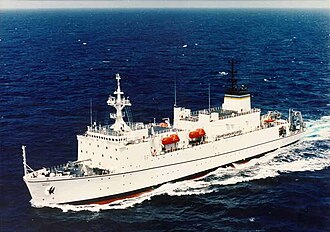
In the modern era of naval operations, the ability to understand the ocean environment is as critical as the ability to navigate or fight within it. Beneath the surface lies a dynamic and complex world of currents, temperature gradients, salinity layers, and seabed structures—all of which influence submarine operations, sonar performance, and undersea warfare. At the forefront of this scientific endeavor is the USNS Waters (T-AGS-45), a specialized vessel dedicated to hydrographic and oceanographic research in support of the United States Navy.
Unlike combat ships or logistical vessels, Waters operates in a domain where precision, patience, and data collection are paramount. Its mission is not to engage adversaries directly, but to provide the environmental intelligence that enables naval forces to operate more effectively and safely. As part of the Pathfinder-class oceanographic survey ships, Waters represents a sophisticated integration of scientific instrumentation, advanced navigation systems, and quiet propulsion technologies.
The Strategic Importance of Oceanographic Survey Ships
The oceans are not uniform environments. Variations in temperature, pressure, and salinity create layers that can refract sound waves, affecting sonar detection ranges and accuracy. Seafloor topography can influence submarine navigation and determine the placement of undersea infrastructure such as cables or sensor arrays. Understanding these variables is essential for maintaining an operational advantage.
The USNS Waters (T-AGS-45) plays a central role in gathering this information. By conducting detailed surveys of the ocean floor and water column, the ship contributes to a global database of maritime environmental data. This information supports not only military operations but also scientific research, navigation safety, and environmental monitoring.
Origins and Development of the Pathfinder-Class
The Pathfinder-class was developed to replace older survey vessels that lacked the precision and technological sophistication required for modern oceanographic missions. The design emphasizes stability, low acoustic signature, and the ability to operate a wide range of scientific equipment.
Ships in this class, including Waters, are built with a focus on minimizing self-generated noise. This is crucial for acoustic measurements, as even minor vibrations can interfere with sensitive instruments. The hull design, propulsion system, and onboard machinery are all optimized to reduce noise and enhance data quality.
Construction and Commissioning
The USNS Waters (T-AGS-45) was constructed by VT Halter Marine in Pascagoula, Mississippi, a shipyard known for producing specialized vessels for both military and commercial applications. The ship was part of a broader program to modernize the Navy’s oceanographic fleet, incorporating lessons learned from earlier vessels in the class.
Following its construction, Waters underwent extensive sea trials to validate its performance and ensure that all systems met operational requirements. Once delivered, it was assigned to the Military Sealift Command (MSC), which operates non-combatant ships with civilian crews.
Mission Capabilities and Operational Role
The primary mission of Waters is to conduct hydrographic and oceanographic surveys. This involves mapping the seafloor, measuring water properties, and collecting data that can be used to improve nautical charts and support naval operations.
The ship is equipped with a wide range of sensors and instruments, including:
- Multibeam echo sounders for detailed seafloor mapping
- Side-scan sonar systems for imaging underwater features
- Conductivity, temperature, and depth (CTD) sensors for analyzing water properties
- Acoustic Doppler current profilers for measuring ocean currents
These systems allow Waters to generate highly detailed maps and datasets, which are then analyzed and distributed to various naval and scientific organizations.
Propulsion and Acoustic Quieting
One of the defining features of the USNS Waters (T-AGS-45) is its diesel-electric propulsion system. This configuration provides several advantages, including reduced noise and improved efficiency.
Electric motors drive the ship’s propellers, while diesel generators produce the necessary electrical power. This separation of power generation and propulsion helps minimize vibrations and acoustic emissions, which is essential for maintaining the integrity of acoustic measurements.
The ship is also equipped with advanced control systems that allow for precise maneuvering, including dynamic positioning capabilities. This enables the vessel to maintain a fixed position over a survey area, even in challenging environmental conditions.
Hull Design and Stability
The hull design of Waters is optimized for stability and endurance. A stable platform is critical for accurate data collection, particularly when deploying sensitive instruments or conducting detailed surveys.
The ship’s design minimizes roll and pitch, ensuring that sensors remain properly aligned and that data is not distorted by excessive motion. This stability also enhances crew comfort, which is important during long missions that can last several weeks or even months.
Scientific Infrastructure and Data Processing
Beyond its physical sensors, Waters is equipped with advanced data processing systems that allow for real-time analysis of collected information. Onboard laboratories provide scientists and technicians with the tools needed to process and interpret data as it is gathered.
This capability significantly reduces the time required to produce usable results, enabling more efficient mission planning and execution. Data collected by Waters is often integrated into larger databases and used to support a wide range of applications, from submarine operations to environmental research.
Crew and Life Onboard
Operating under the Military Sealift Command, the USNS Waters (T-AGS-45) is crewed by civilian mariners, with additional personnel including scientists and technicians.
The crew size typically ranges from 25 to 50 personnel, depending on the mission. Life onboard is structured around continuous operations, with shifts organized to ensure that data collection can proceed around the clock.
The ship is equipped with modern accommodations and facilities designed to support long deployments, including laboratories, workspaces, and recreational areas.
Applications Beyond Military Use
While the primary mission of Waters is to support naval operations, its capabilities have broader applications. The data collected by the ship can be used for:
- Updating nautical charts and improving maritime safety
- Supporting scientific research in oceanography and marine biology
- Monitoring environmental changes and assessing the impact of human activities
- Assisting in search and rescue operations
This dual-use capability highlights the value of oceanographic survey ships as both military and scientific assets.
Technological Evolution and Future Prospects
As technology continues to advance, ships like Waters are being updated with new sensors and systems. These upgrades enhance their ability to collect and process data, ensuring that they remain relevant in a rapidly changing technological landscape.
Future developments may include greater integration with unmanned systems, such as autonomous underwater vehicles (AUVs) and remotely operated vehicles (ROVs). These systems can extend the reach of the ship’s sensors and provide additional data from areas that are difficult to access.
Strategic Significance in Undersea Warfare
In the context of undersea warfare, environmental knowledge is a force multiplier. Accurate data on ocean conditions can significantly improve the effectiveness of sonar systems and enhance the ability to detect and track submarines.
The USNS Waters (T-AGS-45) contributes directly to this capability by providing the data needed to model and predict acoustic conditions. This information is essential for planning and executing naval operations in complex underwater environments.
Conclusion: Science as a Foundation of Naval Power
The USNS Waters (T-AGS-45) exemplifies the critical role of science and technology in modern naval operations. By providing detailed and accurate information about the ocean environment, it enables naval forces to operate more effectively and with greater confidence.
Though it may not carry weapons or engage in combat, Waters plays a vital role in ensuring that those who do have the information they need to succeed. It stands as a reminder that in the complex world of maritime operations, knowledge is as important as القوة.
Technical Parameters of USNS Waters (T-AGS-45)
| Parameter | Specification |
|---|---|
| Class/Type | Pathfinder-class Oceanographic Survey Ship |
| Builder | VT Halter Marine, Pascagoula, Mississippi, USA |
| Displacement (Full Load) | ~4,200 tons |
| Length Overall | ~329 ft (100 m) |
| Beam | ~60 ft (18.3 m) |
| Draft | ~15 ft (4.6 m) |
| Propulsion | Diesel-electric system |
| Speed | ~16 knots (maximum) |
| Crew | ~25–50 personnel (civilian + scientific staff) |
| Mission Equipment | Multibeam sonar, side-scan sonar, CTD sensors |
| Dynamic Positioning | Yes |
| Operator | Military Sealift Command (MSC) |
| Primary Role | Oceanographic and hydrographic survey |
