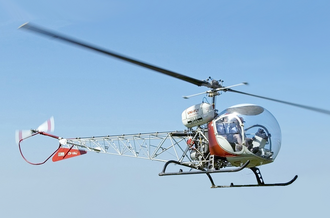
Bell 47 — The Helicopter That Taught the World to Fly Vertically
There are machines that change industries, and then there are machines that define them. The Bell 47 belongs firmly in the latter category. Instantly recognizable by its bubble canopy, exposed tail boom, and skeletal elegance, the Bell 47 was not just a helicopter—it was the helicopter for an entire generation.
Long before modern rotorcraft filled skies with sleek composite bodies and digital avionics, the Bell 47 introduced the world to practical, reliable vertical flight. It served in war zones, saved lives in medical evacuations, trained thousands of pilots, and even became a pop culture icon.
This is the full story of the Bell 47—its origins, engineering, variants, global impact, and enduring legacy—told as a deep technical and historical exploration.
The Visionary Behind the Machine
To understand the Bell 47, one must begin with its creator: Arthur M. Young.
Young was not a traditional engineer. He approached helicopter design from a conceptual and experimental perspective, focusing on stability and control—two of the biggest challenges in early rotorcraft development.
In the 1930s, Young began experimenting with model helicopters, gradually refining a design that would later form the basis of a full-scale aircraft. His work attracted the attention of Bell Aircraft, which brought him onboard to develop a practical helicopter.
The Birth of the Bell 47
The Bell 47 emerged in the mid-1940s as a direct result of Young’s experiments and Bell’s industrial capabilities.
First Flight and Certification
The prototype of the Bell 47 first flew in 1945. Shortly afterward, it achieved a historic milestone:
- In 1946, it became the first helicopter to receive civilian certification in the United States.
This certification marked a turning point—it meant helicopters were no longer experimental curiosities but viable tools for real-world applications.
Design Philosophy: Simplicity Meets Function
One of the most striking aspects of the Bell 47 is its design simplicity.
Open Framework Structure
Unlike modern helicopters with enclosed fuselages, the Bell 47 used:
- An exposed tubular tail boom
- Minimal bodywork
- Easily accessible mechanical components
This design made maintenance easier and reduced weight.
Bubble Canopy
The aircraft’s iconic bubble canopy provided:
- Exceptional visibility
- Improved situational awareness
- A futuristic aesthetic
This feature became one of the Bell 47’s defining characteristics.
Rotor System Engineering
At the heart of the Bell 47’s success was its rotor system.
Main Rotor
The helicopter used a two-blade main rotor system with a stabilizer bar—a key innovation introduced by Arthur Young.
This stabilizer bar:
- Improved flight stability
- Reduced pilot workload
- Allowed smoother control inputs
Tail Rotor
The tail rotor counteracted torque from the main rotor, enabling controlled yaw movement.
Powerplant and Performance
The Bell 47 was powered by a variety of piston engines throughout its production life.
Engine Types
Common engines included:
- Franklin piston engines
- Lycoming piston engines
These engines provided modest power, but the helicopter’s lightweight design allowed effective performance.
Flight Characteristics
Pilots often describe the Bell 47 as:
- Stable and forgiving
- Easy to learn
- Responsive but not overly sensitive
These characteristics made it ideal for training.
Military Service
The Bell 47 gained widespread recognition during the Korean War.
H-13 Sioux
In military service, it was designated as the H-13 Sioux.
The H-13 became famous for:
- Medical evacuation (MEDEVAC) missions
- Reconnaissance
- Liaison duties
Korean War Impact
The Bell 47 revolutionized battlefield medicine by enabling rapid evacuation of wounded soldiers.
The MASH Legacy
The Bell 47 achieved cultural immortality through the television series MAS*H.
Its appearance in the show cemented its image as a life-saving machine.
Civilian Applications
After the war, the Bell 47 found widespread civilian use.
Training
It became one of the most popular training helicopters in the world.
Agriculture
Used for:
- Crop dusting
- Spraying
Law Enforcement and Rescue
Its visibility and maneuverability made it ideal for:
- Police work
- Search and rescue
Variants and Evolution
The Bell 47 family includes numerous variants.
Bell 47D
- Early production model
- Fabric-covered fuselage
Bell 47G
- Introduced bubble canopy
- Most recognizable version
Bell 47J Ranger
- Enclosed cabin
- More refined design
Global Impact
The Bell 47 was used worldwide.
Countries across Europe, Asia, and the Americas operated the aircraft for both military and civilian roles.
Engineering Innovations
The Bell 47 introduced several key innovations:
Stabilizer Bar
Improved stability and control.
Modular Design
Simplified maintenance and repair.
Lightweight Construction
Enhanced efficiency and performance.
Strengths and Limitations
Strengths
- Simplicity
- Reliability
- Excellent visibility
Limitations
- Limited speed
- Low payload capacity
- Exposure to weather (in some variants)
Comparison with Later Helicopters
Compared to modern helicopters, the Bell 47 is:
- Slower
- Less powerful
- Mechanically simpler
Yet it remains one of the most important helicopters ever built.
Legacy
The Bell 47’s influence can still be seen in modern rotorcraft design.
It trained generations of pilots and proved that helicopters could be practical tools.
Conclusion
The Bell 47 is more than just a helicopter—it is a symbol of innovation, practicality, and the dawn of vertical aviation.
Its simple design, groundbreaking stability system, and versatility allowed it to succeed in roles ranging from combat to agriculture to pilot training.
Few aircraft can claim such a broad and lasting impact.
Technical Specifications — Bell 47
| Parameter | Value |
|---|---|
| Manufacturer | Bell Aircraft |
| Role | Light Utility Helicopter |
| First Flight | 1945 |
| Crew | 1–2 |
| Capacity | 1–2 passengers |
| Length | ~9.85 m |
| Rotor Diameter | ~11.32 m |
| Height | ~2.83 m |
| Empty Weight | ~770 kg |
| Maximum Takeoff Weight | ~1,340 kg |
| Powerplant | 1 × Franklin or Lycoming piston engine |
| Power Output | ~200–260 hp |
| Maximum Speed | ~140 km/h |
| Cruise Speed | ~105 km/h |
| Range | ~395 km |
| Service Ceiling | ~3,000 m |
| Rate of Climb | ~4.5 m/s |
.png)