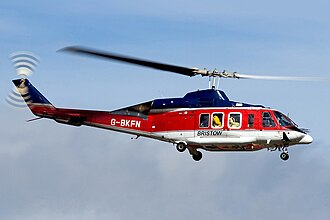
Bell 214ST — The Heavy-Lift Twin That Bridged Generations
In the long evolution of rotary-wing aviation, certain aircraft stand out not because they were the first or the most famous, but because they solved very specific, very real problems at exactly the right time. The Bell 214ST is one such machine.
Overshadowed by icons like the Bell UH-1 Iroquois and modern heavy-lift helicopters, the Bell 214ST occupies a fascinating niche in aviation history. It was designed as a powerful, reliable, and versatile transport helicopter for both military and civilian use—particularly in demanding environments where performance, payload, and endurance mattered more than cutting-edge avionics.
Developed in the 1970s and 1980s, the 214ST was Bell’s answer to a growing demand for a medium-heavy twin-engine helicopter that could operate safely over water, deserts, and remote terrain. Its story is one of adaptation, engineering pragmatism, and global service.
This article offers a comprehensive deep dive into the Bell 214ST—its origins, development, design, operational history, and technical specifications—presented in a long-form blog format.
Origins: From the Huey Legacy to Heavy Lift
To understand the Bell 214ST, one must begin with the lineage from which it emerged.
Bell had already achieved massive success with helicopters like the Bell UH-1 Iroquois (“Huey”) and its derivatives. These aircraft proved the value of turbine-powered rotorcraft in both military and civilian roles.
However, by the late 1960s and early 1970s, new operational requirements began to emerge:
- Offshore oil exploration required helicopters capable of carrying large payloads over water
- Military forces needed greater lift capacity and redundancy
- Operators demanded improved safety, particularly twin-engine reliability
Bell responded by developing a new generation of helicopters based on the proven Huey platform but significantly enlarged and enhanced.
The Predecessor: Bell 214 (Single-Engine)
Before the 214ST, Bell introduced the single-engine Bell 214 (often referred to as the 214A or “BigLifter”).
This aircraft was originally developed for Iran and featured:
- A more powerful engine than the UH-1
- Increased lifting capability
- Reinforced structure
While successful, the single-engine configuration posed limitations—particularly in safety-critical operations like offshore transport.
Birth of the Bell 214ST
What Does “ST” Mean?
“ST” stands for “Stretched Twin”, which perfectly describes the aircraft’s concept:
- Stretched fuselage for greater capacity
- Twin engines for redundancy and power
Development Timeline
Development of the 214ST began in the late 1970s. The first flight occurred in 1979, and certification followed in the early 1980s.
The helicopter was designed primarily for civilian markets, especially:
- Oil and gas transport
- Utility operations
- Passenger transport in remote areas
Design Philosophy
The Bell 214ST was not a radical departure in design—it was an evolution rooted in practicality.
Key Goals
- High payload capacity
- Excellent reliability
- Ease of maintenance
- Adaptability to harsh environments
Bell chose to build on proven technologies rather than pursue experimental designs.
Airframe and Structural Design
Fuselage
The fuselage of the 214ST is significantly larger than that of earlier Bell helicopters.
Key features include:
- Wide cabin for passenger or cargo transport
- Reinforced structure for heavy loads
- Large sliding doors for easy access
Cabin Configuration
The cabin can accommodate:
- Up to 18 passengers
- Mixed cargo and passenger configurations
- Specialized equipment for missions such as medical evacuation
Powerplant: Twin-Engine Capability
One of the defining features of the 214ST is its twin-engine configuration.
Engines
The helicopter is powered by two General Electric CT7 (T700) turboshaft engines.
These engines provide:
- High power output
- Improved reliability
- Redundancy in case of engine failure
Advantages of Twin Engines
- Enhanced safety for overwater operations
- Better performance in hot-and-high conditions
- Increased payload capability
Rotor System
Main Rotor
The Bell 214ST uses a four-blade main rotor system.
This represents a significant evolution from earlier two-blade designs.
Benefits
- Reduced vibration
- Improved lift efficiency
- Smoother flight characteristics
Tail Rotor
The tail rotor provides anti-torque control and directional stability.
Flight Performance
The Bell 214ST is designed for performance in demanding conditions.
Speed and Range
- Moderate cruising speed
- Long operational range
Lift Capability
The helicopter can carry substantial payloads internally or externally.
Hot-and-High Performance
One of its strengths is operation in:
- Desert climates
- High-altitude environments
Avionics and Systems
While not as advanced as modern helicopters, the 214ST features reliable avionics suited to its era.
Navigation Systems
- Standard flight instruments
- Optional advanced navigation systems
Safety Systems
- Redundant hydraulic systems
- Engine monitoring systems
Operational Roles
The Bell 214ST has been used in a wide range of roles.
Offshore Transport
One of its primary missions.
It transports personnel to and from offshore oil platforms.
Utility Operations
Used for:
- Cargo transport
- External load lifting
- Infrastructure support
Military Use
Although primarily civilian, some military operators have used the 214ST for:
- Troop transport
- Logistics
Global Operators
The Bell 214ST has been operated by countries and companies worldwide.
Notable Regions
- Middle East
- Asia
- Africa
These regions often require helicopters capable of operating in extreme conditions.
Strengths of the Bell 214ST
Reliability
Built on proven technology.
Payload Capacity
Can carry significant loads.
Versatility
Adaptable to many missions.
Twin-Engine Safety
Critical for offshore operations.
Limitations
Aging Design
Compared to modern helicopters, the 214ST lacks advanced avionics.
Production Numbers
Relatively limited production compared to other Bell helicopters.
Competition
Faces competition from newer designs like:
- Sikorsky S-92
- Airbus H225
Comparison with Contemporary Helicopters
The Bell 214ST occupies a middle ground between medium and heavy helicopters.
| Feature | Bell 214ST | Modern Heavy Helicopters |
|---|---|---|
| Technology | Analog | Digital |
| Payload | High | Very high |
| Cost | Lower | Higher |
Engineering Legacy
The Bell 214ST represents a transitional phase in helicopter design.
Evolutionary Design
It shows how incremental improvements can produce highly effective aircraft.
Influence
Its design influenced later medium-heavy helicopters.
Civilian Importance
In the civilian sector, the 214ST has played a crucial role.
Oil and Gas Industry
Enabled safe transport over water.
Infrastructure Development
Supported construction in remote areas.
Future Outlook
Although no longer in production, the Bell 214ST remains in service.
Continued Use
Operators value its:
- Reliability
- Simplicity
- Cost-effectiveness
Modernization
Some aircraft have been upgraded with newer avionics.
Conclusion
The Bell 214ST may not be as famous as some of its predecessors or successors, but it is a highly capable and important helicopter.
It represents a practical solution to real-world challenges—combining power, reliability, and versatility in a design that continues to serve decades after its introduction.
In many ways, the 214ST is a reminder that innovation is not always about radical change. Sometimes, it is about refining what already works—and making it better.
Technical Specifications — Bell 214ST
| Parameter | Value |
|---|---|
| Manufacturer | Bell Helicopter |
| Role | Medium/Heavy Transport Helicopter |
| First Flight | 1979 |
| Crew | 2 |
| Capacity | Up to 18 passengers |
| Length | ~18.95 m |
| Rotor Diameter | ~15.85 m |
| Height | ~5.13 m |
| Empty Weight | ~4,540 kg |
| Maximum Takeoff Weight | ~7,938 kg |
| Powerplant | 2 × General Electric CT7 (T700) turboshaft engines |
| Power Output | ~1,625 shp each |
| Maximum Speed | ~260 km/h |
| Cruise Speed | ~240 km/h |
| Range | ~640 km |
| Service Ceiling | ~4,600 m |
| Rate of Climb | ~9 m/s |
