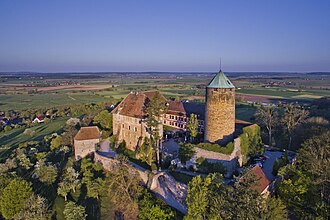
Burg Colmberg: A Journey Through Bavaria’s Timeless Castle Above the Franconian Hills
In the rolling landscape of Franconia, where forests stretch across soft hills and medieval villages appear as though preserved in amber, there stands a fortress that seems almost detached from modern time. Burg Colmberg rises high above the Bavarian countryside like a sentinel from another age, watching over valleys, farmland, and ancient trade routes that once connected kingdoms and empires. Unlike many castles that survive only as romantic ruins, Burg Colmberg remains alive. Its towers still stand firm, its walls still echo with footsteps, and its chambers continue to welcome travelers who arrive searching for history, atmosphere, and the quiet enchantment of medieval Germany.
For many visitors, the first sight of Burg Colmberg feels almost cinematic. The castle emerges above the treeline, framed by the gentle contours of the Franconian landscape. There is no need for exaggeration when describing the setting. The place naturally inspires wonder. The approach to the castle carries a peculiar emotional quality, as though one is crossing an invisible threshold between centuries. Modern roads eventually narrow into pathways that seem designed for horses rather than cars, and the surrounding scenery grows increasingly calm. By the time travelers arrive beneath the stone walls, the noise and urgency of contemporary life feel strangely distant.
Yet Burg Colmberg is more than a beautiful medieval structure. It represents layers of German history compressed into one place. The castle has witnessed dynastic struggles, religious upheaval, territorial expansion, economic transformation, and world wars. It survived eras during which countless other fortifications were destroyed, abandoned, or dismantled. Because of this continuity, Burg Colmberg offers visitors something increasingly rare in Europe: authenticity that has not been reduced to spectacle.
The castle’s enduring presence also reflects the broader story of Franconia itself. While many international travelers focus their attention on Bavaria’s Alpine south, Franconia remains one of Germany’s most fascinating cultural landscapes. It is a region defined not by dramatic mountains but by vineyards, forests, fortified towns, and deeply rooted traditions. Castles such as Burg Colmberg reveal how central this region once was to the political and military fabric of the Holy Roman Empire.
Exploring Burg Colmberg therefore becomes more than a simple sightseeing excursion. It evolves into an encounter with medieval architecture, aristocratic ambition, regional identity, and the persistence of memory. Every stone corridor and weathered tower contributes to a narrative spanning nearly a thousand years. Visitors do not merely observe history here; they move through it physically and emotionally.
The Origins of Burg Colmberg
A Strategic Position in Medieval Franconia
The story of Burg Colmberg begins in the High Middle Ages, a period during which castles emerged across Europe as instruments of authority and defense. The location chosen for Burg Colmberg was no accident. Medieval builders understood geography with remarkable precision, and the hill upon which the castle stands offered commanding views across the surrounding territory. From this elevated position, movement along important routes could be monitored, potential threats detected, and regional influence projected over the countryside.
The earliest documented references to the castle date back to the 12th century, though historians believe fortifications may have existed on the site even earlier. During this period, the political structure of the Holy Roman Empire was extraordinarily fragmented. Regional nobles competed constantly for land, alliances, and prestige. Castles were not only military installations but also symbols of legitimacy and power. To possess a fortress such as Burg Colmberg was to possess visibility and authority.
The castle eventually became associated with the powerful Hohenzollern family, one of Europe’s most significant dynasties. Long before the Hohenzollerns became kings of Prussia and German emperors, they held territories within Franconia. Burg Colmberg served as one of their important residences and administrative centers during the medieval era. This connection elevated the castle’s status considerably and ensured that it remained politically relevant for centuries.
The strategic significance of the site extended beyond warfare. Castles often functioned as centers of governance, taxation, and economic coordination. Villages surrounding Burg Colmberg were tied to the castle through obligations and protection agreements. The fortress therefore stood at the heart of a localized social order that structured everyday life throughout the region.
The Hohenzollern Legacy
The Hohenzollern association gives Burg Colmberg an especially compelling historical dimension. Few dynasties shaped Central European history as profoundly as the Hohenzollerns. Their rise from regional Franconian nobles to rulers of Prussia and eventually leaders of the German Empire remains one of Europe’s most remarkable political transformations.
Within this broader narrative, Burg Colmberg occupies an early chapter. The castle reflects the modest but ambitious beginnings of a family that would later dominate continental politics. Walking through the halls today, one can imagine medieval administrators discussing territorial disputes, military alliances, and dynastic marriages that would influence future generations.
The Hohenzollerns invested heavily in fortifications throughout Franconia, and Burg Colmberg benefited from these developments. Defensive structures were strengthened, residential quarters improved, and architectural features expanded over time. The castle gradually evolved from a simple medieval fortress into a more sophisticated aristocratic residence capable of accommodating both military and administrative functions.
This dual role shaped the castle’s identity. Unlike purely ceremonial palaces built during later centuries, Burg Colmberg retained a rugged practicality. Its walls were designed to withstand conflict, yet within them daily life unfolded with surprising complexity. Kitchens bustled with activity, servants maintained the household, scribes recorded transactions, and noble guests arrived for political discussions or hunting excursions in the surrounding forests.
Architecture That Defies Time
The Medieval Fortress Aesthetic
One of the most striking qualities of Burg Colmberg is its architectural authenticity. Many European castles were extensively reconstructed during the Romantic period of the 19th century, often resulting in idealized versions of medieval design. Burg Colmberg, however, preserves much of its genuine historical character. The fortress appears solid rather than ornamental, practical rather than theatrical.
The thick stone walls immediately communicate the realities of medieval insecurity. Every architectural decision reflects defensive necessity. Narrow windows minimized vulnerability to attack, elevated entrances increased protection, and towers provided strategic observation points. Visitors accustomed to fairy-tale castles may initially find Burg Colmberg more austere than expected, but this authenticity is precisely what makes the experience so compelling.
The castle’s layout reveals centuries of adaptation. Unlike modern buildings designed according to unified plans, medieval castles evolved organically. Additions were constructed as needs changed, resulting in a fascinating blend of architectural periods. Romanesque foundations coexist with Gothic elements and later modifications, producing a structure that feels layered rather than uniform.
Stone passageways twist unexpectedly, staircases narrow abruptly, and rooms vary dramatically in scale. This irregularity contributes enormously to the atmosphere. Exploring Burg Colmberg feels less like touring a museum and more like entering a living historical environment shaped by generations of occupants.
Towers, Walls, and Courtyards
The towers of Burg Colmberg remain among its most recognizable features. Rising above the surrounding landscape, they provide panoramic views across Franconia that are breathtaking in every season. During summer, forests and fields create a tapestry of green stretching toward the horizon. In autumn, the countryside transforms into a mosaic of gold and copper tones. Winter often cloaks the region in mist, lending the castle an almost mystical appearance.
The courtyards within the fortress possess a quieter charm. Enclosed by stone walls and historic buildings, these spaces once functioned as centers of daily activity. Horses were stabled here, supplies unloaded, and soldiers assembled. Today, visitors encounter a far more peaceful atmosphere, yet the echoes of medieval life remain palpable.
Architectural details throughout the castle reward careful observation. Ancient wooden beams reveal centuries of wear, iron fixtures retain traces of medieval craftsmanship, and weathered masonry bears witness to changing climates and historical turbulence. These details create intimacy with the past. Rather than viewing history as abstract chronology, visitors encounter it physically through texture, material, and space.
Burg Colmberg and the Landscape of Franconia
The Beauty of Rural Bavaria
To understand Burg Colmberg fully, one must appreciate its relationship with the surrounding landscape. The castle does not exist in isolation. It forms part of a broader Franconian environment defined by forests, farmland, vineyards, and historic villages. This relationship between architecture and geography gives the site much of its emotional power.
Franconia differs significantly from the stereotypical image many travelers associate with Bavaria. There are no towering Alpine peaks here. Instead, the region possesses a quieter, subtler beauty. Rolling hills create gentle horizons, rivers weave through valleys, and medieval towns preserve remarkably intact historical centers.
The countryside surrounding Burg Colmberg encourages slow travel. Roads wind through villages where timber-framed houses line narrow streets and church towers rise above red-tiled roofs. Seasonal rhythms remain visible in the agricultural landscape. During harvest months, fields glow with warm color, while winter introduces an atmosphere of stillness and introspection.
For centuries, this environment shaped life at the castle. Hunting expeditions ventured into nearby forests, local farmers supplied provisions, and trade routes connected the fortress to larger economic networks. The castle’s identity therefore cannot be separated from the rural world around it.
Seasonal Transformations
Every season alters the experience of Burg Colmberg dramatically. Spring brings renewal to the surrounding forests, with blossoms and fresh greenery softening the fortress’s imposing stone silhouette. Morning fog often drifts through the valleys, creating scenes of remarkable atmospheric beauty.
Summer introduces warmth and vibrancy. Long daylight hours illuminate the castle walls late into the evening, while outdoor terraces provide spectacular views across the countryside. The region becomes particularly inviting for hikers and cyclists exploring Franconia’s network of scenic routes.
Autumn may be the most visually captivating season of all. Franconian forests erupt into intense shades of amber, crimson, and gold. The contrast between colorful foliage and ancient stone creates imagery that seems almost painterly. Cooler temperatures also enhance the contemplative quality of the castle experience.
Winter transforms Burg Colmberg into something almost mythic. Snow occasionally blankets the fortress and surrounding hills, while mist and frost intensify the medieval atmosphere. During this season, the castle feels especially detached from modernity, as though suspended in another century entirely.
Life Inside the Castle Through the Centuries
Medieval Daily Life
Imagining daily life inside Burg Colmberg during the medieval period reveals how complex castle society truly was. Contrary to romanticized depictions, castles were not exclusively inhabited by nobles enjoying luxurious lifestyles. They functioned as dynamic communities containing soldiers, servants, craftsmen, clergy, administrators, and laborers.
The rhythm of life within the fortress was structured by necessity. Food preparation required enormous effort, heating was inconsistent, sanitation was primitive, and security remained a constant concern. Yet despite these hardships, castles also served as centers of culture and social interaction.
Meals represented important communal events. Large halls echoed with conversation, political discussion, and ceremonial rituals. Hunting parties returned with game from surrounding forests, while musicians and entertainers occasionally performed for noble audiences. Religious observances structured the calendar, reinforcing the spiritual dimension of medieval society.
Women within the castle played essential roles often overlooked in traditional historical narratives. Noblewomen managed households, supervised servants, coordinated supplies, and occasionally governed estates during their husbands’ absences. Their influence extended beyond domestic concerns into broader economic and political matters.
War and Survival
Like many medieval fortresses, Burg Colmberg endured periods of conflict and uncertainty. The Holy Roman Empire experienced frequent territorial disputes, feuds, and larger military confrontations. Castles were expected to withstand sieges, shelter local populations, and project military strength.
The castle’s survival through centuries of upheaval remains remarkable. Numerous fortifications across Germany were destroyed during wars, particularly during the devastating Thirty Years’ War in the 17th century. Burg Colmberg avoided complete ruin, allowing modern visitors to encounter a structure that retains genuine continuity with the medieval world.
This continuity deepens the emotional impact of visiting the castle. The walls visible today are not replicas or reconstructions detached from historical reality. They are the same walls that endured political instability, military tension, and social transformation across nearly a millennium.
Legends, Myths, and Ghost Stories
The Supernatural Aura of Medieval Castles
No medieval castle is complete without legends, and Burg Colmberg possesses its own atmosphere of mystery. Castles naturally inspire stories because they occupy liminal spaces between history and imagination. Their age, architecture, and isolation encourage speculation about hidden chambers, forgotten secrets, and lingering spirits.
Throughout Europe, ghost stories associated with castles often reflect deeper cultural anxieties and historical memories. Tales of wandering apparitions, tragic romances, and cursed figures emerge repeatedly in medieval folklore. Burg Colmberg is no exception. Visitors and locals alike have long shared stories suggesting that the castle contains echoes of its turbulent past.
Whether one believes such tales literally is almost irrelevant. The psychological effect of the castle environment itself is undeniable. Walking through dim corridors illuminated by soft light, hearing footsteps reverberate against stone walls, and gazing from towers into fog-covered forests naturally stimulates imagination.
The White Lady and Other Stories
Among the legends connected to Burg Colmberg is the recurring European motif of the “White Lady,” a spectral female figure associated with aristocratic tragedy. Variations of this story appear in many German castles, often involving betrayal, forbidden love, or unresolved grief.
At Burg Colmberg, stories persist about mysterious presences and unexplained occurrences experienced by guests and staff over the years. Some describe unusual sounds during quiet nights, while others speak of fleeting figures glimpsed in historic corridors. Such accounts contribute to the castle’s enduring mystique.
Even skeptical visitors often acknowledge the unusual emotional atmosphere created by ancient spaces. Medieval architecture possesses a sensory intensity difficult to replicate in modern environments. Shadows behave differently within thick stone walls, silence feels heavier, and the passage of time becomes strangely tangible.
Burg Colmberg as a Modern Destination
From Fortress to Historic Hotel
One of the most fascinating aspects of Burg Colmberg today is its transformation into a historic hotel while preserving its medieval identity. Many castles converted into hospitality venues lose authenticity through excessive modernization. Burg Colmberg avoids this trap remarkably well.
Guests staying overnight experience a rare blend of historical immersion and contemporary comfort. Rooms maintain architectural character while accommodating modern expectations. Ancient beams, stone walls, and antique furnishings create a setting fundamentally different from conventional hotels.
Sleeping inside a genuine medieval fortress carries undeniable emotional appeal. Evening transforms the castle entirely. After daytime visitors depart, silence settles across the courtyards and corridors. Candlelight and subdued illumination intensify the atmosphere, making overnight stays particularly memorable.
Dining within the castle further enhances the experience. Franconian cuisine emphasizes hearty regional traditions, often featuring local meats, seasonal vegetables, and wines produced in nearby vineyards. Meals served within historic halls connect visitors to culinary practices deeply rooted in regional identity.
Tourism and Preservation
The continued preservation of Burg Colmberg reflects broader efforts to protect Germany’s architectural heritage. Maintaining medieval structures requires immense financial and technical commitment. Stonework deteriorates, timber ages, and historical authenticity must be balanced carefully with safety and accessibility requirements.
Tourism plays a vital role in sustaining such sites. Visitors contribute not only economically but also culturally by demonstrating continued interest in historical preservation. Burg Colmberg therefore functions simultaneously as a historical monument, hospitality destination, and educational resource.
Importantly, the castle has avoided becoming overly commercialized. While tourism inevitably shapes visitor experiences, Burg Colmberg retains a sense of dignity and restraint. The focus remains on authenticity rather than spectacle.
Exploring the Surrounding Region
The Romantic Road and Franconian Towns
Burg Colmberg occupies an advantageous position near some of southern Germany’s most picturesque destinations. The famous Romantic Road, one of Germany’s best-known scenic routes, passes through nearby regions filled with medieval towns and historic landmarks.
Among the most celebrated nearby destinations is Rothenburg ob der Tauber, whose remarkably preserved medieval architecture attracts visitors from around the world. Walking through Rothenburg’s fortified streets complements the experience of Burg Colmberg beautifully, offering insight into urban life during the Middle Ages.
Other Franconian towns nearby possess quieter but equally compelling charm. Small market squares, ancient churches, and timber-framed buildings create an atmosphere of historical continuity rarely encountered elsewhere in Europe. Exploring these communities reveals how deeply medieval patterns continue to shape regional identity.
Nature, Hiking, and Slow Travel
The landscape surrounding Burg Colmberg is ideal for travelers seeking slower, more reflective forms of tourism. Hiking trails weave through forests and hills, connecting villages, castles, and scenic viewpoints. Cyclists also find the region especially rewarding due to relatively gentle terrain and well-maintained routes.
Unlike heavily urbanized tourist destinations, Franconia encourages immersion rather than consumption. Experiences unfold gradually here. Conversations in village inns, walks through quiet forests, and evenings overlooking rolling countryside become as meaningful as major landmarks themselves.
This slower pace aligns naturally with the atmosphere of Burg Colmberg. The castle invites contemplation rather than hurried sightseeing. Visitors who spend time wandering the grounds, observing architectural details, and absorbing the surrounding landscape often discover the most rewarding aspects of the experience.
The Emotional Power of Historic Places
Why Castles Continue to Fascinate Us
Human fascination with castles remains remarkably strong despite the immense historical distance separating modern life from the medieval world. Part of this fascination stems from visual drama. Towers, battlements, and fortified walls possess immediate symbolic power. Yet the deeper attraction lies elsewhere.
Castles embody continuity. In societies increasingly defined by rapid technological change and cultural acceleration, ancient structures offer tangible connection to long historical timelines. They remind us that generations before us confronted uncertainty, ambition, conflict, and mortality within these same spaces.
Burg Colmberg exemplifies this emotional resonance particularly well because it remains so physically intact. Visitors do not merely view fragments or archaeological traces. They enter rooms where people once lived, governed, feared, celebrated, and dreamed.
The castle therefore becomes a bridge between personal imagination and historical reality. Every visitor inevitably projects narratives onto the environment. Some imagine knights and battles; others reflect on dynastic politics or architectural craftsmanship. Still others simply experience a profound sense of stillness rarely encountered in contemporary life.
Memory Embedded in Stone
Historic structures possess a unique ability to preserve emotional atmosphere. While buildings cannot literally remember, human perception often treats them as repositories of accumulated experience. This phenomenon becomes especially powerful in places as old as Burg Colmberg.
Stone absorbs weather, smoke, touch, and time itself. Surfaces become worn through centuries of human contact. Floors bear the marks of countless footsteps. Such details create subtle awareness of continuity extending beyond individual lifetimes.
At Burg Colmberg, this awareness emerges constantly. A staircase polished by generations of use, a narrow window framing the same landscape viewed by medieval inhabitants, or a courtyard that once hosted soldiers and nobles alike—all contribute to an experience difficult to describe yet deeply affecting.
The Culinary Traditions of Franconia
Regional Food and Wine
No exploration of Burg Colmberg would be complete without acknowledging the culinary traditions of Franconia. The region possesses one of Germany’s richest food cultures, shaped by agricultural abundance and centuries of local refinement.
Franconian cuisine emphasizes hearty simplicity executed with care. Roasted meats, sausages, dumplings, fresh bread, and seasonal vegetables dominate many traditional meals. Yet beneath this apparent rusticity lies considerable sophistication rooted in regional identity.
Wine occupies a particularly important role in Franconian culture. Vineyards throughout the region produce distinctive white wines, especially Silvaner, often bottled in the uniquely shaped Bocksbeutel bottles associated with Franconia. Dining at Burg Colmberg frequently includes opportunities to sample these regional specialties.
Food within historic environments acquires additional emotional significance. Meals served inside medieval halls connect visitors physically to long traditions of hospitality and communal gathering. Such experiences transform dining from routine necessity into cultural immersion.
The Atmosphere of Castle Dining
Eating within Burg Colmberg is not merely about cuisine; it is about atmosphere. Candlelit rooms, wooden beams, and ancient stone walls create a sensory environment impossible to replicate in modern restaurants. Even simple meals feel elevated by the historical context.
The contrast between medieval architecture and contemporary culinary comfort produces an especially memorable experience. Visitors simultaneously encounter the harsh realities of historical castle life and the pleasures of modern hospitality. This balance contributes greatly to the castle’s enduring appeal.
Photography and Visual Impressions
Capturing the Castle
Burg Colmberg offers extraordinary opportunities for photography, though the challenge lies less in finding beautiful compositions than in conveying atmosphere accurately. The castle changes dramatically according to weather, season, and time of day.
Morning often produces soft mist rising through surrounding valleys, lending the fortress an ethereal quality. Afternoon sunlight reveals architectural textures and panoramic views with striking clarity. Evening introduces warm illumination and deep shadows that intensify the medieval ambiance.
Photographers frequently struggle to capture the emotional scale of the experience. Wide shots communicate grandeur but may lose intimacy, while close details reveal texture yet omit landscape context. The most successful images often combine both elements, emphasizing the relationship between fortress and countryside.
Beyond Social Media Aesthetics
In an era dominated by digital tourism and curated online imagery, Burg Colmberg offers something refreshingly resistant to superficial consumption. The castle certainly photographs beautifully, yet its true impact emerges through physical presence rather than visual documentation alone.
Modern tourism sometimes encourages rapid movement from one iconic image to another. Burg Colmberg rewards the opposite approach. Time spent quietly observing the environment, listening to silence within stone corridors, or watching weather shift across the landscape reveals dimensions inaccessible through photography alone.
Why Burg Colmberg Matters Today
Preserving Cultural Continuity
Historic places such as Burg Colmberg matter because they preserve cultural continuity in tangible form. They remind societies that identity emerges through accumulated history rather than instantaneous creation. In a rapidly globalizing world, regional heritage acquires renewed importance.
Franconia’s castles, villages, and traditions contribute to Europe’s cultural diversity. Protecting such places ensures that future generations can encounter history directly rather than solely through digital representation or academic description.
Burg Colmberg also demonstrates how preservation and contemporary use can coexist successfully. The castle remains economically viable without sacrificing authenticity, proving that historical heritage need not become frozen or inaccessible.
A Refuge from Modern Acceleration
Perhaps the castle’s deepest contemporary significance lies in its capacity to slow perception. Modern life often fragments attention through constant connectivity and rapid information exchange. Burg Colmberg offers the opposite experience.
Stone walls mute external noise. The surrounding landscape encourages contemplation. Historical scale relativizes contemporary anxieties. Visitors frequently describe feeling calmer, more reflective, and strangely detached from everyday urgency after spending time at the castle.
This psychological effect may explain why medieval sites continue attracting modern travelers so powerfully. Beyond historical curiosity, they satisfy emotional needs insufficiently addressed by contemporary environments.
Conclusion: The Enduring Spell of Burg Colmberg
Burg Colmberg endures because it embodies far more than architectural survival. The castle represents continuity across centuries of transformation. It connects medieval power structures with modern tourism, aristocratic history with regional identity, and historical reality with enduring imagination.
To visit Burg Colmberg is to encounter a place where time feels layered rather than linear. The castle does not belong exclusively to the past. It remains alive through preservation, hospitality, storytelling, and human curiosity. Its towers still overlook Franconian forests as they have for centuries, while visitors continue arriving in search of beauty, history, and emotional resonance.
What ultimately distinguishes Burg Colmberg from countless other historic sites is its atmosphere of authenticity. The fortress has not been reduced to decorative nostalgia. Its walls still communicate strength, endurance, and memory. Walking through its corridors, one senses not only medieval history but also the persistence of human experience itself.
In the quiet of evening, when shadows lengthen across the courtyards and the surrounding hills fade into darkness, Burg Colmberg reveals its deepest quality. It becomes a reminder that history is not merely something recorded in books. It exists physically in landscapes, buildings, traditions, and stories carried forward through generations.
For travelers willing to move slowly, observe carefully, and engage imaginatively, Burg Colmberg offers something increasingly rare in the modern world: a genuine encounter with the enduring spirit of place.
