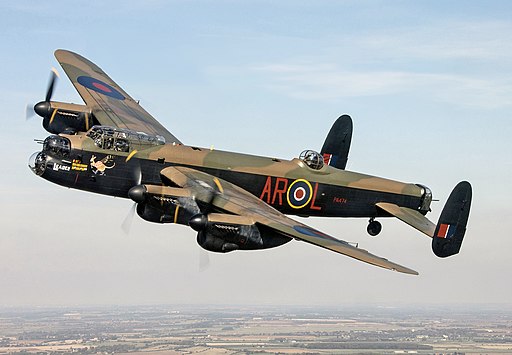
The Avro Lancaster is one of the most iconic heavy bombers of World War II, renowned for its significant role in the Allied strategic bombing campaign over Europe. Developed from the earlier Avro Manchester, the Lancaster combined a robust airframe with powerful engines and a large bomb-carrying capacity. It was a symbol of British industrial and military might, demonstrating remarkable adaptability and effectiveness throughout the war. Its reputation for reliability, range, and payload capacity made it a cornerstone of the Royal Air Force’s Bomber Command and a key factor in the eventual Allied victory.
Design and Development
The Lancaster’s development was a direct response to the shortcomings of the Avro Manchester, which suffered from unreliable Rolls-Royce Vulture engines. Avro’s chief designer, Roy Chadwick, re-engineered the airframe to accommodate four Rolls-Royce Merlin engines, each delivering increased power and reliability. This change fundamentally transformed the aircraft’s performance and operational capabilities.
The Lancaster features a mid-wing monoplane configuration with a streamlined fuselage, optimized for long-range missions. Its large wingspan supported the heavy payloads required for strategic bombing, and the airframe was designed with ruggedness to withstand battle damage and extended missions. The aircraft was constructed primarily from aluminum alloys, offering a balance between strength and weight savings.
The internal bomb bay was among the most significant design features, capable of carrying an unprecedented variety and weight of ordnance. Defensive armament was concentrated in multiple turrets to provide all-around protection from enemy fighters. The cockpit design incorporated dual pilot controls and advanced (for the time) navigation and bombing aids, facilitating operations in difficult conditions.
Technical Specifications and Performance
The Avro Lancaster had a wingspan of 102 feet 0 inches (31.09 meters), which allowed for substantial lift and stability during long missions. Its overall length was 69 feet 6 inches (21.16 meters), with a height of approximately 20 feet 6 inches (6.25 meters). These dimensions contributed to its impressive payload capacity and operational range.
Power came from four Rolls-Royce Merlin XX engines, each capable of producing about 1,280 to 1,620 horsepower, depending on the variant. The combination of four engines gave the Lancaster a maximum speed of approximately 287 miles per hour (462 kilometers per hour) at 15,000 feet (4,570 meters), a service ceiling of 24,500 feet (7,470 meters), and a range of around 2,530 miles (4,070 kilometers) with a typical bomb load.
The aircraft’s maximum takeoff weight was roughly 68,000 pounds (30,844 kilograms), allowing it to carry up to 14,000 pounds (6,350 kilograms) of bombs in its spacious internal bay. In special configurations, the Lancaster could carry up to 22,000 pounds (10,000 kilograms), particularly when equipped to deliver the massive “Grand Slam” or “Tallboy” bombs. Fuel capacity was approximately 2,154 gallons (8,160 liters), distributed in integral wing tanks, providing the endurance necessary for deep penetration raids into enemy territory.
Bomb Load and Armament
The Lancaster’s bomb bay was a pioneering design feature that could accommodate a wide range of payload configurations. The main bomb bay was split into two large compartments, which allowed for flexible loadouts of various bomb types, including general-purpose bombs, incendiaries, mines, and specialized weapons like the bouncing bomb used in the famous Dambusters raid.
Standard bomb loads were typically around 8,000 to 14,000 pounds for most missions, but the Lancaster’s versatility allowed it to carry the heaviest bombs in the British arsenal. This capability gave the RAF an unprecedented ability to strike strategic targets such as industrial complexes, rail networks, and dams with devastating effect.
Defensive armament consisted of up to eight .303 inch (7.7 mm) Browning machine guns mounted in four power-operated turrets. The nose turret, dorsal turret, tail turret, and a ventral turret offered overlapping fields of fire to protect the aircraft from enemy fighters. The tail turret, in particular, was heavily fortified and often regarded as one of the most effective defensive positions on any bomber of the era.
Operational History
The Avro Lancaster entered service in early 1942 and quickly became the backbone of the RAF’s Bomber Command. Its effectiveness in night bombing campaigns over Germany was unparalleled, contributing significantly to the disruption of German war production and infrastructure. The Lancaster played a central role in some of the most famous operations of the war, including the precision attacks on the Ruhr industrial region and the iconic Operation Chastise, known as the Dambusters raid, which employed specially modified Lancasters to deploy bouncing bombs against dams in the Ruhr Valley.
The aircraft was used extensively throughout the war, with more than 7,000 units built. It was operated not only by the RAF but also by other Allied air forces, including those of Canada, Australia, and New Zealand. The Lancaster’s reliability, range, and payload made it adaptable to a variety of roles beyond strategic bombing, such as maritime reconnaissance, electronic warfare, and aerial mine-laying.
Despite suffering losses due to enemy fighters and anti-aircraft fire, the Lancaster was highly regarded by its crews for its robust construction and relatively forgiving flight characteristics. Its ability to return to base even when heavily damaged was a testament to its rugged design.
Variants and Modifications
Numerous variants of the Lancaster were produced throughout its service life, each incorporating improvements in engines, armament, and avionics. Early versions used Merlin XX engines, while later models utilized more powerful Merlin 24 or 28 engines to enhance performance. Some variants featured enhanced radar and electronic countermeasure equipment to improve survivability against increasingly sophisticated German defenses.
Specialized modifications allowed the Lancaster to carry larger bombs or unique payloads. For example, the Lancaster B.III Special was configured to carry the Grand Slam bomb, the largest conventional bomb dropped during the war. Other adaptations enabled the aircraft to serve as photographic reconnaissance platforms, electronic intelligence gatherers, and air-sea rescue vehicles.
The bomber also saw postwar service in transport and reconnaissance roles, with several aircraft converted to civilian use for cargo and passenger transport in the immediate postwar years.
Legacy and Impact
The Avro Lancaster is widely regarded as one of the most effective heavy bombers ever built. Its design influenced postwar bomber development and set standards for payload capacity, range, and multi-engine reliability that echoed into the jet age. The aircraft’s contribution to the Allied war effort was immense, both in terms of material destruction inflicted on enemy targets and the psychological impact of sustained strategic bombing.
Beyond its wartime service, the Lancaster became a symbol of British ingenuity, resilience, and industrial capability. Its enduring legacy is reflected in numerous surviving aircraft preserved in museums and by heritage flight organizations, continuing to educate and inspire new generations about the challenges and achievements of World War II aviation.
Conclusion
The Avro Lancaster represents a pinnacle of piston-engine bomber design, combining power, payload, and precision in a versatile and rugged platform. Its technical specifications underscore an aircraft built for the demanding realities of strategic bombing, with a large wingspan, four powerful Merlin engines, extensive defensive armament, and an unprecedented bomb load. Operationally, it was a linchpin in the RAF’s efforts to disrupt and degrade enemy capabilities through relentless bombing campaigns. The Lancaster’s impact on the course of World War II and its lasting place in aviation history highlight its importance as a masterpiece of aeronautical engineering and wartime innovation.
.jpg)