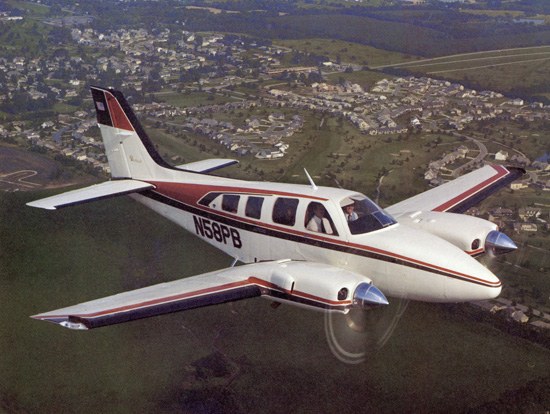
The Beechcraft Baron is a highly regarded light twin-engine piston aircraft that has served pilots and operators around the world since its introduction in the early 1960s. Designed and manufactured by Beechcraft, the Baron was developed to provide a combination of speed, reliability, and comfort in a compact twin-engine platform. It was intended to fill the niche between slower, less powerful twins and the larger, more complex multi-engine aircraft used for commercial and business travel. Over the decades, the Baron has undergone several upgrades and refinements, which have enhanced its performance, handling, and avionics, making it one of the most enduring and popular aircraft in the general aviation market. Its versatility has made it suitable for various roles, including personal transportation, flight training, and commercial operations.
Airframe and Structural Design
The Beechcraft Baron features a low-wing, all-metal monoplane design with retractable tricycle landing gear. Its sleek aerodynamic profile reduces drag and optimizes performance, contributing to its reputation as a fast and efficient light twin. The airframe construction employs aluminum alloys with stressed skin techniques that provide durability and strength while keeping weight manageable. The cabin is pressurized in later models, notably in the Baron 58P, enhancing passenger comfort at higher altitudes. The aircraft’s interior is designed to accommodate four to six occupants, including the pilot, with spacious seating and good visibility. The control surfaces—ailerons, rudder, and elevators—are conventional and balanced for responsive handling. The landing gear retracts fully into the wing and fuselage to reduce drag during cruise, and the wheel wells are designed to minimize aerodynamic penalties.
Dimensions and Weight Specifications
The Baron varies slightly in size and weight depending on the model, but the general dimensions reflect its design as a light twin. The wingspan is approximately 11 meters (36 feet), providing a wing area that balances lift generation with aerodynamic efficiency. The overall length ranges from about 8.6 to 9 meters (28 to 29.5 feet), and height typically hovers around 3 meters (10 feet), dimensions that facilitate hangar storage and ground handling. The maximum takeoff weight (MTOW) for most Baron models is in the range of 5,100 to 5,500 pounds (2,300 to 2,500 kilograms), while empty weight is generally between 3,200 to 3,600 pounds (1,450 to 1,630 kilograms), allowing for a useful load of approximately 1,500 to 2,000 pounds depending on configuration and fuel load. The fuel capacity typically ranges from 84 to 110 gallons (318 to 416 liters), enabling a balance between range and payload capacity.
Powerplant and Propulsion Systems
The Beechcraft Baron has been equipped with various engines over its production history, most notably the Continental IO-520 and IO-550 series engines. These are horizontally opposed, six-cylinder, fuel-injected piston engines renowned for their reliability and performance. Each engine typically delivers between 285 and 310 horsepower, providing the Baron with robust power for climb, cruise, and maneuvering. The aircraft uses constant-speed, full-feathering propellers, which enhance efficiency and safety, particularly in the event of an engine failure. These propellers allow pilots to adjust blade pitch for optimal performance across different phases of flight, improving fuel economy and control. Some variants of the Baron are fitted with turbocharged engines, which allow higher altitude flight with improved performance, especially useful for operations in mountainous terrain or regions where higher cruising altitudes reduce fuel consumption and increase speed.
Performance and Flight Characteristics
The Beechcraft Baron is known for its impressive performance metrics within the light twin category. Cruise speeds typically range from 180 to 200 knots (207 to 230 mph or 333 to 370 km/h), with maximum speeds reaching up to approximately 202 knots in some high-performance models. Its rate of climb generally exceeds 1,200 feet per minute, enabling rapid ascent and operational flexibility. The aircraft is capable of operating at service ceilings up to 20,000 to 25,000 feet depending on engine configuration and model variant, with turbocharged versions typically able to maintain performance at the upper end of this range. Takeoff and landing distances are relatively short for a twin, with ground rolls around 1,200 feet and total distances over a 50-foot obstacle near 2,300 feet, making the Baron well-suited for operations at smaller airports and airfields. The aircraft’s handling is often praised for being predictable and forgiving, with responsive controls and stable flight characteristics, which have made it a favorite for multi-engine training as well as private ownership.
Avionics and Systems
Over the years, the Baron has incorporated progressively advanced avionics suites, transitioning from analog gauges to modern glass cockpit systems. Early models featured conventional round-dial instruments and basic navigation aids, while later versions were equipped with integrated GPS navigation, digital autopilots, weather radar, traffic advisory systems, and advanced communication radios. These enhancements have significantly improved situational awareness, safety, and ease of operation, allowing the Baron to compete in increasingly sophisticated airspace environments. Electrical and fuel systems are designed for redundancy and reliability, with dual alternators and independent fuel tanks feeding each engine. Environmental controls include heating and ventilation, with pressurization in certain high-end models for improved cabin comfort at altitude.
Operational Use and Legacy
The Beechcraft Baron remains a cornerstone of the light twin market, with its long production run reflecting both its versatility and enduring appeal. Its ability to deliver twin-engine safety, respectable speed, and payload capacity in a relatively compact package has made it popular for private owners, flight schools, and charter operators alike. The Baron has been widely used for multi-engine training due to its manageable complexity and forgiving flight characteristics, helping countless pilots transition to multi-engine flying. Its legacy is bolstered by continuous upgrades in avionics and engine technology, ensuring that even older airframes remain viable in modern operations. The combination of performance, comfort, and operational economy has cemented the Baron’s status as one of the most successful and respected light twin aircraft ever produced.
