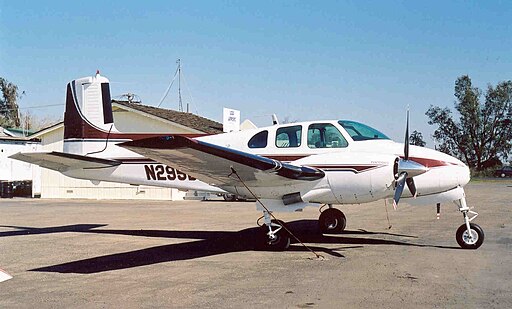
The Beechcraft Twin Bonanza emerged in the early 1950s as a rugged, versatile light twin-engine aircraft designed to meet the needs of corporate operators, private owners, and military services seeking greater performance and utility than available from single-engine aircraft of the era. Designed and built by the Beech Aircraft Corporation in the United States, the Twin Bonanza was produced from 1951 until the early 1960s, with nearly a thousand airframes completed before the company shifted focus toward larger and more advanced designs like the Queen Air and King Air series. Its evolution through multiple engine upgrades and structural refinements reflected Beechcraft’s commitment to improving power, payload, and altitude performance while maintaining operational simplicity and durability. Civilian models typically served in business transport and utility roles, while various military versions, notably the L-23 Seminole and U-8 designations, fulfilled liaison, staff transport, and light utility missions for several air forces around the world. (pilotjohn.com)
Airframe Architecture and Structural Features
At its core, the Twin Bonanza is an all-metal, low-wing monoplane featuring a cantilever wing with flaps and a retractable tricycle landing gear system that was state-of-the-art for its time. The aerodynamically clean wing and fuselage provided efficient lift and stability, which translated into capable climb performance and predictable handling characteristics in both single-engine and multi-engine flight regimes. A distinctive characteristic of the landing gear is the semi-exposed wheel design on the main gear; when retracted the tires remain partially visible, a deliberate feature intended to reduce damage in the event of gear-up landings and provide additional friction and directional control on the runway. The cabin structure allowed flexibility in configuration, accommodating one or two pilots and between five and seven passengers depending on seating layout and mission requirements, with some later production models featuring a rear airstair door for easier access.
Dimensions and Weight Characteristics
The dimensional footprint of the Twin Bonanza situates it squarely in the light twin category, with a wingspan of approximately 13.79 meters (45 feet 3 inches), an overall length near 9.60 meters (31 feet 6 inches), and an overall height around 3.45 to 3.51 meters (11 feet 4 inches to 11 feet 6 inches). Its wing area is about 25.7 square meters (277 square feet), producing an aspect ratio near 7.5:1 that balances lift, drag, and structural efficiency. Empty weights vary by variant and equipment, typically centered around 3,980 to 4,100 pounds (about 1,805 to 1,860 kilograms), while maximum takeoff weights span roughly from 6,000 to 6,300 pounds (2,722 to 2,858 kilograms) in stock GO-480 powered versions, with higher limits on certain supercharged models or aftermarket conversions. Typical useful loads are influenced by fuel, passengers, and baggage, with standard fuel capacities often near 180 US gallons (680 liters) that provide both extended range and reasonable payload capability when managed carefully.
Powerplant and Propulsion Options
The propulsion architecture of the Twin Bonanza reflects a clear progression through Lycoming’s geared piston engine families. Early examples were fitted with Lycoming GO-435 engines rated around 260 horsepower each. From the mid-1950s onward, the aircraft predominantly used Lycoming GO-480 series engines producing around 275 to 295 horsepower each, with fuel injection and supercharging introduced in later builds to maintain power at altitude and increase service ceilings. Some production sub-variants, notably H50 and J50 models, incorporated supercharged GSO or GTSO-480 engines rated near 340 horsepower to address higher gross weights and altitude performance demands. Beyond factory engines, the Twin Bonanza has been the subject of significant aftermarket modification, including conversions such as the Excalibur 800 program that replaced the original gear-driven engines with normally aspirated Lycoming IO-720 eight-cylinder powerplants producing roughly 400 horsepower apiece, enhancing climb and cruise performance but altering the aircraft’s characteristic handling and maintenance requirements.
Performance and Flight Capabilities
Performance metrics for the Twin Bonanza vary by specific variant, engine installation, and environmental conditions, but common industry figures provide a clear picture of its capabilities. Standard mid-series models with Lycoming GO-480 engines can achieve maximum level speeds near 186 knots (214 mph / 344 km/h) and cruise effectively around 170–175 knots (about 200–205 mph) at moderate altitudes, while service ceilings typically range up to approximately 20,000 feet for standard aircraft. Rates of climb on two engines often exceed 1,400 feet per minute, with single-engine climb figures reduced but sufficient for maintaining controlled flight after an engine failure. Takeoff distances to a 50-foot obstacle hover in the vicinity of 1,200 to 1,300 feet, with landing rolls and distances over 50-foot barriers reflecting the aircraft’s balance of wing loading and power. Long-range performance on standard fuel loads can exceed 800 nautical miles, and extended tanks or efficient cruise settings can push mission range closer to 900–1,000 nautical miles under optimal conditions. Supercharged or higher power variants and modifications further extend service ceilings into the 25,000 to 30,000-foot class while offering improved climb and cruise performance.
Operational Use, Legacy, and Modern Context
In operational practice, the Twin Bonanza has been appreciated for its robust airframe, versatile cabin arrangements, and dependable multi-engine performance that suited a wide spectrum of missions from business travel to utility support. Its adoption by military services under various designations attests to its adaptability and reliability in challenging environments. Over time, as general aviation advanced and turboprop technology matured, the Twin Bonanza was succeeded by larger and more capable aircraft within Beechcraft’s lineup, but it endures as a classic light twin cherished by enthusiasts and operators who value its combination of performance, payload flexibility, and mechanical character. Even today, well-maintained examples remain active in both private and commercial roles, often with modern avionics and powerplant upgrades that keep the design relevant nearly a century after its initial conception.
.jpg)