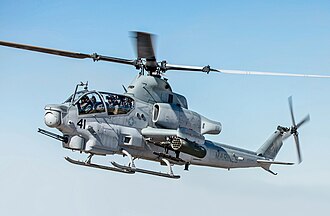
Bell AH-1Z Viper – The Ultimate Evolution of the Legendary Cobra Attack Helicopter
Few military aircraft have achieved the iconic status of the Bell AH-1 Cobra family. Since the late 1960s, the slender silhouette of the Cobra has represented one of the purest expressions of the attack helicopter concept—a fast, heavily armed, and highly maneuverable machine designed specifically to dominate the battlefield from the air. Over decades of combat experience, technological progress, and changing operational requirements, this famous lineage evolved into what many aviation enthusiasts and military analysts consider its most refined form: the Bell AH-1Z Viper.
The AH-1Z Viper is not merely an upgraded Cobra. It is the culmination of over half a century of combat lessons learned, engineering innovation, and continuous adaptation to modern warfare. Developed primarily for the United States Marine Corps, the helicopter combines exceptional firepower, advanced avionics, cutting-edge sensors, and impressive survivability into a single platform capable of operating in some of the world’s most demanding environments.
Unlike many modern military aircraft that rely heavily on stealth or overwhelming size, the Viper follows a different philosophy. It remains relatively compact, agile, and expeditionary, perfectly suited for amphibious operations and rapid deployments from naval vessels. Whether providing close air support to Marines on the ground, escorting transport helicopters, engaging armored vehicles, or conducting armed reconnaissance missions, the AH-1Z has proven itself as a versatile and formidable weapon system.
Today, the Viper serves not only as the backbone of Marine Corps attack aviation but also attracts increasing interest from international customers seeking a reliable and battle-proven attack helicopter. Its combination of mature technology and modern capabilities places it among the elite rotorcraft currently flying.
The Origins of the Cobra Legacy
To fully appreciate the AH-1Z Viper, one must first understand the remarkable history of its ancestors.
The story begins during the Vietnam War, when the United States military recognized the growing importance of helicopter warfare. Transport helicopters like the UH-1 Iroquois, universally known as the “Huey,” had transformed battlefield mobility, but they were vulnerable when carrying troops into hostile landing zones.
Bell Helicopter responded by creating a dedicated gunship based on the Huey’s mechanical components but with a much narrower fuselage and tandem seating arrangement. The result was the AH-1G Cobra, which entered combat in 1967 and quickly demonstrated the effectiveness of a purpose-built attack helicopter.
Over the following decades, the Cobra family evolved through numerous variants. Improved engines, enhanced weapons systems, night-fighting capabilities, and advanced targeting equipment continually expanded the aircraft’s combat effectiveness.
For the United States Marine Corps, the twin-engine AH-1W Super Cobra became particularly important. Marine aviation demanded an attack helicopter capable of operating safely over water and from amphibious assault ships, where engine redundancy significantly increased survivability.
However, by the 1990s, the rapidly changing nature of warfare required another leap forward. Digital battlefields, precision-guided weapons, and network-centric operations demanded a completely modernized helicopter.
This requirement eventually gave birth to the AH-1Z Viper.
Development of the AH-1Z Program
The AH-1Z originated from the H-1 Upgrade Program, an ambitious initiative designed to modernize both the Marine Corps’ attack and utility helicopter fleets simultaneously.
Rather than developing an entirely new aircraft from scratch, Bell engineers focused on creating a highly advanced evolution of the existing AH-1W and UH-1N platforms. The resulting AH-1Z Viper and UH-1Y Venom share approximately 85 percent of their components, dramatically simplifying maintenance, logistics, and pilot training.
Development was not without challenges. The program encountered delays related to integrating sophisticated avionics, testing new rotor systems, and validating the helicopter’s expanded capabilities.
One of the most significant improvements was the introduction of a completely redesigned four-bladed composite rotor system, replacing the older two-bladed design. This innovation reduced vibration, increased lift capacity, improved maneuverability, and enhanced survivability by making the rotor blades more resistant to battle damage.
After extensive testing and evaluation, the AH-1Z achieved initial operational capability with the United States Marine Corps in 2010. Since then, it has steadily replaced older Super Cobra variants.
Design Philosophy: Built for Expeditionary Warfare
Unlike many land-based attack helicopters, the AH-1Z was specifically optimized for Marine Corps doctrine.
Marine aviation places enormous emphasis on flexibility. Aircraft must be capable of deploying aboard amphibious assault ships, operating from improvised forward bases, and supporting rapidly moving expeditionary forces.
As a result, the Viper was designed to function effectively in harsh maritime environments. Corrosion-resistant materials, compact dimensions, and folding rotor blades make it ideal for shipboard operations where hangar space is limited.
Its tandem cockpit arrangement provides excellent visibility for both crew members. The front seat is occupied by the gunner or co-pilot, while the rear seat houses the pilot. Both cockpits feature nearly identical digital displays, allowing either crew member to fly or operate weapons if necessary.
The narrow fuselage presents a smaller target to enemy defenses while improving aerodynamic efficiency. Combined with its powerful engines and advanced rotor system, the helicopter exhibits remarkable agility during low-altitude combat maneuvers.
Advanced Avionics and Digital Cockpit
One of the defining features of the AH-1Z Viper is its fully integrated glass cockpit.
Older attack helicopters relied heavily on analog gauges and separate control systems. In contrast, the Viper employs large multifunction liquid crystal displays that consolidate flight information, navigation data, sensor imagery, weapons status, and tactical communications.
The helicopter incorporates an advanced mission computer that manages vast amounts of battlefield information in real time. This enables the crew to identify threats, coordinate with friendly forces, and engage targets with exceptional speed.
Night operations are equally impressive. Compatibility with night vision devices, coupled with sophisticated infrared sensors, allows the Viper to conduct missions in complete darkness or adverse weather conditions.
The Target Sight System combines forward-looking infrared imaging, television cameras, laser designation, and range-finding capabilities into a single sensor package. This enables highly accurate target detection and engagement over long distances.
Data sharing capabilities further enhance combat effectiveness by allowing the Viper to exchange tactical information with other aircraft, ground units, and command centers.
Powerplant and Flight Performance
The AH-1Z is powered by two General Electric T700-GE-401C turboshaft engines.
Each engine produces approximately 1,800 shaft horsepower, providing the helicopter with excellent power reserves even under demanding environmental conditions such as high temperatures or mountainous terrain.
The transition from a two-bladed to a four-bladed rotor system represented one of the most important engineering advances in the helicopter’s development.
Composite rotor blades offer numerous advantages:
- Greater lift capacity.
- Lower vibration levels.
- Increased structural durability.
- Improved maneuverability.
- Enhanced resistance to ballistic damage.
Pilots frequently praise the aircraft’s handling characteristics. The Viper is capable of rapid directional changes, aggressive banking maneuvers, and stable hovering, all of which are critical during close air support missions.
Its maximum speed exceeds 400 kilometers per hour, placing it among the faster dedicated attack helicopters currently in service.
Weapons Systems and Firepower
The AH-1Z Viper is fundamentally a weapons platform, and its arsenal reflects decades of combat experience.
Its primary fixed weapon is the M197 three-barrel 20 mm rotary cannon mounted beneath the nose. Capable of firing hundreds of rounds per minute, it provides devastating firepower against infantry, light vehicles, and fortified positions.
The helicopter’s stub wings feature six external hardpoints capable of carrying a wide variety of ordnance.
Air-to-Ground Missiles
The AGM-114 Hellfire missile remains one of the Viper’s most potent weapons. Using laser guidance, the missile can accurately destroy tanks, bunkers, and other hardened targets at considerable distances.
Future integration of newer precision-guided munitions ensures that the platform remains relevant against evolving threats.
Rockets
The Viper can employ 70 mm Hydra rocket pods in both unguided and precision-guided configurations.
The introduction of the Advanced Precision Kill Weapon System (APKWS) transformed traditional rockets into highly accurate, low-cost guided weapons suitable for engaging lightly armored vehicles and small targets.
Air-to-Air Capability
Although primarily designed for attacking ground targets, the AH-1Z can also carry AIM-9 Sidewinder missiles.
This capability provides a valuable self-defense option against enemy helicopters, drones, and certain low-flying aircraft.
Survivability on the Modern Battlefield
Attack helicopters often operate at extremely low altitudes, placing them within range of small arms fire, heavy machine guns, and portable surface-to-air missiles.
Consequently, survivability was a major design priority.
The AH-1Z incorporates ballistic-tolerant composite rotor blades, crashworthy landing gear, armored crew seating, and redundant flight systems.
Its twin-engine configuration significantly improves safety during combat damage scenarios, particularly during overwater operations.
Electronic warfare systems further enhance protection by detecting incoming missile threats and automatically deploying flares or chaff countermeasures.
The aircraft’s infrared signature reduction measures also make it more difficult for heat-seeking missiles to acquire a lock.
Operational Role Within the United States Marine Corps
The AH-1Z serves as the principal attack helicopter of Marine Light Attack Helicopter Squadrons.
Typically, Vipers operate alongside UH-1Y Venom utility helicopters, forming highly integrated aviation teams capable of conducting a wide range of missions.
Primary operational roles include:
- Close air support.
- Armed reconnaissance.
- Escort missions.
- Anti-armor warfare.
- Urban combat support.
- Convoy protection.
- Maritime strike operations.
The Marine Corps places exceptional value on rapid response capability, and the Viper excels in delivering immediate fire support to troops engaged in combat.
Its ability to launch from amphibious assault ships extends the reach of Marine expeditionary forces far beyond conventional land bases.
International Interest and Export Success
The AH-1Z has attracted growing international attention due to its mature design and proven reliability.
Several nations have selected the Viper as part of broader efforts to modernize their rotary-wing combat capabilities.
Countries such as Bahrain and the Czech Republic have acquired the platform, recognizing its combination of advanced technology and relatively straightforward maintenance requirements.
For smaller air forces, the commonality between the AH-1Z and UH-1Y offers additional logistical advantages, reducing operational costs while increasing fleet flexibility.
As geopolitical tensions continue to emphasize the importance of rapid-response expeditionary forces, the Viper’s market appeal is likely to remain strong.
Comparison With Other Modern Attack Helicopters
The AH-1Z often finds itself compared with helicopters such as the AH-64 Apache, Ka-52 Alligator, and Eurocopter Tiger.
While the Apache typically carries a heavier sensor suite and larger payload, the Viper offers outstanding agility, lower operating complexity, and exceptional compatibility with naval operations.
Compared with the Russian Ka-52, the Viper benefits from extensive Western digital networking capabilities and long-term logistical support infrastructure.
Against the Tiger, it provides a highly balanced combination of firepower, durability, and expeditionary flexibility.
Rather than attempting to outperform every competitor in a single category, the AH-1Z succeeds through versatility and operational practicality.
The Future of the Viper
Military aviation is evolving rapidly with the emergence of unmanned systems, artificial intelligence, and increasingly sophisticated battlefield networks.
The AH-1Z is well positioned to adapt to these changes.
Future upgrades may include enhanced sensor packages, improved electronic warfare systems, integration with unmanned aerial vehicles, and expanded use of precision-guided weapons.
The helicopter’s digital architecture allows many new capabilities to be added through software modernization rather than costly structural redesigns.
As a result, the Viper is expected to remain an important component of Marine Corps aviation for decades to come.
Conclusion
The Bell AH-1Z Viper represents the ultimate evolution of one of military aviation’s most legendary helicopter families. It successfully combines the proven combat heritage of the original Cobra with the advanced technologies demanded by twenty-first-century warfare.
Its four-bladed composite rotor system, digital cockpit, precision-guided weapons, advanced survivability features, and expeditionary design philosophy make it one of the most capable attack helicopters currently in operation.
Perhaps the Viper’s greatest strength lies in its balance. It is powerful without being excessively large, technologically advanced without becoming prohibitively complex, and versatile enough to perform an extraordinary range of missions.
For the United States Marine Corps and its international operators, the AH-1Z is far more than an aircraft. It is a symbol of adaptability, precision, and battlefield effectiveness—a modern predator that carries the spirit of the original Cobra into a new era of aerial warfare.
Technical Specifications
| Parameter | Value |
|---|---|
| Manufacturer | Bell Textron |
| Designation | AH-1Z Viper |
| Type | Twin-engine attack helicopter |
| Crew | 2 (pilot and co-pilot/gunner) |
| Length | 17.8 m |
| Rotor Diameter | 14.6 m |
| Height | 4.4 m |
| Empty Weight | Approx. 5,600 kg |
| Maximum Takeoff Weight | Approx. 8,390 kg |
| Engines | 2 × General Electric T700-GE-401C turboshafts |
| Engine Power | Approx. 1,800 shp each |
| Main Rotor | Four-blade composite rotor |
| Maximum Speed | Approx. 411 km/h |
| Cruise Speed | Approx. 296 km/h |
| Combat Radius | Approx. 230 km |
| Ferry Range | Up to 685 km |
| Service Ceiling | Approx. 6,100 m |
| Rate of Climb | Approx. 14 m/s |
| Fixed Gun | 1 × M197 20 mm three-barrel rotary cannon |
| Cannon Ammunition | Up to 750 rounds |
| Hardpoints | 6 external weapon stations |
| Typical Missile Armament | AGM-114 Hellfire, AIM-9 Sidewinder |
| Rocket Armament | 70 mm Hydra / APKWS guided rockets |
| Primary Operators | United States Marine Corps, Bahrain, Czech Republic |
| First Flight | 8 December 2000 |
| Operational Service Entry | 2010 |
.jpg)