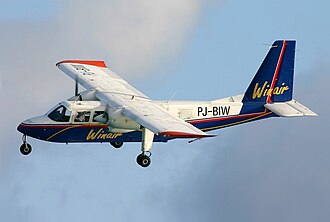
Britten-Norman BN-2 Islander: The Remarkable Story of Britain’s Rugged Island Hopper
The Britten-Norman BN-2 Islander is one of those rare aircraft whose importance cannot be measured simply by speed, size, or technological sophistication. Instead, its reputation comes from usefulness. Since its first flight in 1965, the Islander has become a familiar sight in some of the world’s most remote communities, carrying passengers, freight, medical teams, survey crews, and specialist equipment into places where larger aircraft would struggle to operate. Its distinctive twin-engine layout, high wing, fixed landing gear, boxy fuselage, and remarkably practical cabin have made it instantly recognizable. More than six decades after its introduction, the Islander remains an active aircraft rather than merely a piece of aviation history. Britten-Norman says the type has been built in more than 1,250 examples and operated by customers in more than 100 countries.
The secret to the Islander’s success is that it was designed around a very specific problem: how to connect isolated places with minimal infrastructure. Its creators, John Britten and Desmond Norman, identified a need for a high-payload, short-sector aircraft capable of operating from short and rough airstrips. Instead of trying to create a miniature airliner with the characteristics of a conventional airport aircraft, they produced something much more specialized. The result was a rugged utility aircraft that could combine short takeoff and landing performance with twin-engine safety, a large cabin, simple systems, and exceptional flexibility. That philosophy has allowed the BN-2 family to remain relevant through generations of aviation technology.
The Origins of the BN-2 Islander
A Different Kind of Regional Aircraft
Britten-Norman was founded in 1954 by John Britten and Desmond Norman, who had completed apprenticeships at de Havilland. The company initially focused on aircraft modification and related engineering work, but its founders eventually identified an opportunity for a new kind of utility aircraft. They wanted something capable of carrying substantial loads over short distances while operating from airfields that might have little infrastructure or relatively primitive surfaces.
The concept was particularly relevant to Britain’s offshore islands and other remote regions. Conventional airliners were often too large and demanding for small airstrips, while single-engine light aircraft could lack the payload, cabin capacity, or redundancy needed for regular commercial operations. The proposed aircraft therefore needed to sit somewhere between the traditional light aircraft and the regional airliner.
The solution was the BN-2 Islander. From the beginning, the design emphasized practicality over glamour. The aircraft was not intended to be exceptionally fast, sleek, or luxurious. Instead, it needed to carry people and equipment repeatedly, reliably, and economically. This approach would eventually prove extraordinarily successful.
First Flight in 1965
The first Islander prototype flew on 13 June 1965 from Bembridge Airport on the Isle of Wight. That first flight began a career that would eventually span more than 60 years. Britten-Norman marked the 60th anniversary of the event in 2025, emphasizing that the original aircraft had evolved continuously while retaining its fundamental design philosophy.
The Islander quickly demonstrated that there was a genuine market for its unusual combination of characteristics. By 1967, only two years after its maiden flight, Britten-Norman had delivered its 100th Islander. The aircraft’s popularity was not based on a single role. Instead, operators could configure it for passenger transportation, cargo, air ambulance work, aerial survey, parachuting, surveillance, and numerous other specialist missions.
The Islander’s Distinctive Design
A High-Wing Utility Aircraft
The BN-2 Islander’s appearance is immediately recognizable. Its high wing, twin engines mounted on the wings, fixed landing gear, and rectangular fuselage give it a utilitarian appearance that reflects its mission. Nearly every visible feature serves a practical purpose.
The high-wing configuration provides excellent ground clearance for the propellers and engines while giving passengers and crew useful downward visibility. It also makes loading and unloading the cabin relatively straightforward. Beneath the wing, the engines are positioned far enough above the ground to allow the aircraft to operate from surfaces that might be unsuitable for many conventional aircraft.
The fixed landing gear is another expression of the Islander’s philosophy. Retractable landing gear can reduce aerodynamic drag and potentially improve cruise performance, but it also introduces additional mechanical complexity, weight, and maintenance requirements. The Islander accepts some aerodynamic penalty in exchange for simplicity and durability. For an aircraft spending much of its life flying short sectors between small airfields, this is a sensible trade-off.
The twin-engine configuration is equally important. The aircraft can provide the reassurance of two engines while retaining the relatively compact dimensions of a light utility aircraft. This has been particularly valuable for operators flying over water, mountainous terrain, forests, or other areas where an engine failure could have serious consequences.
A Cabin Designed for Flexibility
Inside, the Islander is almost the opposite of a conventional narrow-body airliner. Its cabin is relatively compact but remarkably adaptable. Seating can be installed for commuter operations, while the same basic airframe can be converted for cargo, medical evacuation, parachuting, or specialist missions.
This flexibility is one of the strongest arguments for the aircraft. An operator does not necessarily need a different aircraft for every task. Instead, the Islander’s cabin and equipment can be configured around the mission.
Britten-Norman describes the Islander as a high-capacity, multi-role, high-frequency aircraft and emphasizes its ability to operate in rough terrain and from short runways. The company also highlights applications including passenger transport, freight, air ambulance work, aerial survey, search and rescue, and specialist government missions.
Short Takeoff and Landing Performance
Built for Difficult Airfields
One of the Islander’s defining characteristics is its STOL, or short takeoff and landing, capability. The aircraft was created for environments where runways could be short, narrow, rough, or otherwise unsuitable for conventional regional aircraft. This makes it particularly useful for remote communities that may have no practical access to large airports.
The importance of this capability becomes obvious when considering the locations in which Islanders operate. A conventional regional aircraft might require a long paved runway, sophisticated navigation facilities, fueling infrastructure, and substantial ground equipment. The Islander can operate with considerably less.
Britten-Norman has highlighted takeoff distances as low as approximately 189 meters for certain configurations, although actual performance depends on aircraft weight, weather, runway surface, elevation, and other operational conditions.
This performance has allowed the Islander to serve locations ranging from remote Scottish islands to tropical regions and isolated settlements in South America. It has also contributed to its popularity in areas where roads may be unreliable or nonexistent.
The Importance of Reliability
Short-field performance alone would not have made the Islander successful. An aircraft operating frequent services to remote communities also needs to be dependable and economical. This is particularly important when the aircraft is effectively part of a region’s transportation infrastructure.
The Islander’s relatively straightforward design contributes to this role. Its systems can be maintained without the enormous infrastructure required by larger commercial aircraft, and its rugged airframe was designed around frequent operation rather than occasional use.
Britten-Norman notes that some Islanders built during the 1960s and 1970s remain in daily service, illustrating the longevity of the basic airframe.
Engines and Evolution
From Piston Power to Turboprops
The original Islander was powered by piston engines, with later versions receiving increasingly capable powerplants. Among the best-known piston configurations is the BN-2B Islander, while later developments included the BN-2T Turbine Islander, powered by Rolls-Royce 250-series turboprop engines.
The transition to turboprop power gave operators higher performance and improved payload capabilities while preserving the basic airframe concept. The BN-2T is equipped with two Rolls-Royce 250-B17 engines and three-bladed Hartzell propellers. Britten-Norman has also developed modern avionics and interior options for the turbine aircraft.
This ability to accept newer engines without abandoning the fundamental airframe is an important part of the Islander’s longevity. Rather than becoming obsolete when technology changed, the aircraft could be updated.
The BN-2T and Modern Islander
The BN-2T represents a significant step forward from the original piston-powered aircraft. Turboprop engines provide more power and are particularly well suited to demanding operations. Modern avionics can also replace many of the instruments and systems found in early Islanders.
Despite these changes, the underlying aircraft remains recognizable. This is an important testament to the original design. A successful aircraft does not necessarily need to be redesigned every decade; sometimes a strong basic structure can be upgraded repeatedly.
Britten-Norman continues to offer the Islander with modern systems, and the company’s current strategy includes further development of the aircraft rather than abandoning the original concept.
A Global Working Aircraft
Connecting Remote Communities
Perhaps the most important role of the BN-2 Islander is its contribution to remote transportation. In isolated regions, a regular Islander service can represent much more than a convenient flight. It can provide access to healthcare, education, supplies, employment, tourism, and connections to larger population centers.
The aircraft has operated in locations where roads are limited or seasonal, and where geography makes conventional transportation difficult. In such environments, a small aircraft that can land close to the community can be vastly more useful than a larger aircraft requiring a distant airport.
Britten-Norman has described Islanders operating from environments including remote Scottish islands, the Ecuadorian Amazon, snow-covered strips, sandy surfaces, and other challenging locations.
Cargo, Medical and Specialist Missions
Passenger transportation is only one part of the Islander’s story. The aircraft can be configured as a freighter, allowing operators to carry supplies and equipment into remote areas. Its relatively accessible cabin makes loading practical, while the aircraft’s short-field capability expands the number of locations it can serve.
The same flexibility has made the Islander valuable as an air ambulance. A cabin that can accommodate medical equipment and stretchers can transform the aircraft into a vital emergency transportation platform.
Other operators have used Islanders for aerial survey, environmental monitoring, search and rescue, law-enforcement activities, oil-pollution detection, and other specialist work. The aircraft’s ability to carry mission equipment while operating at relatively low speeds makes it particularly useful for observation and survey missions.
Military and Government Applications
From Transport to Surveillance
Although the BN-2 was conceived primarily as a civilian aircraft, its ruggedness and flexibility naturally attracted government and military operators. Different versions have been adapted for surveillance, communications, reconnaissance, transport, and other specialist roles.
The BN-2T and military-oriented derivatives demonstrate how the basic Islander platform can support sophisticated equipment. The related Defender family, for example, builds on the Islander’s basic pedigree and is designed for special missions including surveillance and intelligence operations.
The aircraft’s relatively small size can actually be advantageous for surveillance work. It can operate from smaller airfields, remain airborne at useful speeds for observation, and carry sensors or communications equipment without requiring a large transport aircraft.
This is another example of the Islander’s core strength: it is not optimized for one spectacular mission but can be adapted to many practical ones.
The Trislander and the Expansion of the Family
Adding a Third Engine
The success of the Islander led Britten-Norman to explore additional aircraft concepts. The best-known derivative was the BN-2A Mk III Trislander, which added a third engine to the basic configuration.
The Trislander was designed to increase capacity and provide additional performance while retaining many of the Islander’s operating characteristics. Its distinctive central engine mounted in the rear fuselage made it visually unusual, but the aircraft continued the basic philosophy of a rugged, short-haul utility aircraft.
Although the Trislander never achieved the same longevity or production success as the Islander, it demonstrated how flexible the original concept was.
The Islander in the Modern Era
A 60-Year-Old Design That Refuses to Disappear
The most remarkable thing about the BN-2 Islander may be its longevity. Many aircraft from the 1960s disappeared from commercial service decades ago, replaced by newer designs with better avionics, improved aerodynamics, and more sophisticated systems. Yet the Islander remains useful because its fundamental mission has not disappeared.
There are still places where a long runway is unavailable. There are still communities separated by mountains, oceans, forests, and difficult terrain. There are still operators who need an aircraft capable of carrying people and cargo economically over short distances. In these circumstances, the Islander’s age becomes less important.
Its endurance is also supported by the manufacturer’s continued involvement. Britten-Norman maintains design authority and provides technical support, modifications, upgrades, and other services for the worldwide Islander fleet.
Returning Production to Britain
The aircraft has even entered a new phase of its industrial history. In 2023, Britten-Norman announced the return of Islander production to its Bembridge facility on the Isle of Wight, reversing decades in which major airframe production had taken place overseas. The company described the move as a return of full aircraft manufacturing to Britain and said the first new aircraft from the reshored production line was intended for delivery to the Falkland Islands Government Air Service.
The story has continued into 2026. Britten-Norman reports that aircraft serial number 2317 became the first Islander whose airframe was assembled in the United Kingdom from individual components at Bembridge, with the aircraft completing its first flight from the same airport associated with the original prototype’s maiden flight. The aircraft is destined for the Falkland Islands Government Air Service.
This is a remarkable chapter for an aircraft that first flew in 1965. Instead of ending its story in museums, the Islander is once again being built in Britain.
Why the Britten-Norman Islander Remains Special
The BN-2 Islander is an excellent example of how good engineering can outlast technological fashion. It is not the fastest aircraft, it does not have the largest cabin, and it does not possess the sophisticated systems of a modern regional airliner. Yet those comparisons miss the point.
The Islander succeeds because it does a specific job exceptionally well. It carries useful loads over short distances, operates from difficult airfields, provides twin-engine redundancy, can be adapted to many roles, and can be maintained and operated without the infrastructure required by larger aircraft. Its simplicity is not a weakness; it is one of its greatest strengths.
The aircraft has also become deeply connected with the communities it serves. In places where an Islander flight may be the most practical link with the outside world, the aircraft is more than transportation. It becomes part of everyday life.
Conclusion
The Britten-Norman BN-2 Islander is one of Britain’s great aviation success stories, not because it revolutionized high-speed flight but because it solved a difficult and enduring transportation problem. From its first flight at Bembridge in 1965, the Islander was designed to connect places that conventional aircraft could not easily reach. Its high-wing configuration, twin engines, fixed landing gear, adaptable cabin, rugged construction, and short-field capability created a remarkably practical aircraft.
Over the decades, Islanders have carried passengers and cargo, transported medical teams, supported emergency services, conducted surveys, performed surveillance missions, and connected isolated communities. The design has survived changing engines, avionics, regulations, and aviation markets because the fundamental requirement it addresses has remained unchanged.
More than sixty years after its first flight, the Islander is still flying and, remarkably, is once again being produced in Britain. That longevity is perhaps the strongest possible endorsement of John Britten and Desmond Norman’s original concept. The BN-2 Islander is not simply an old aircraft that has survived; it is a working aircraft whose basic design continues to make sense in the modern world.
Britten-Norman BN-2 Islander Technical Specifications
Specifications vary considerably between Islander variants, so the table below uses representative figures for the piston-powered BN-2B Islander and notes where later variants differ. The manufacturer’s documentation confirms that individual aircraft and variants can have different engines, fuel capacities, equipment, and configurations.
| Technical specification | BN-2 Islander |
|---|---|
| Manufacturer | Britten-Norman |
| Country of origin | United Kingdom |
| Aircraft type | Twin-engine STOL utility / regional aircraft |
| First flight | 13 June 1965 |
| Crew | 1–2, depending on operation |
| Passenger capacity | Up to approximately 9 passengers in typical commuter configuration |
| Configuration | High-wing twin-engine monoplane |
| Landing gear | Fixed tricycle landing gear |
| Typical engines | 2 × Lycoming O-540-series piston engines |
| Typical engine power | Approximately 260 hp each, depending on variant |
| Turboprop variant | BN-2T with 2 × Rolls-Royce 250-B17 engines |
| BN-2T engine power | Approximately 320 shp each |
| Propellers | Two- or three-bladed, depending on engine/variant |
| Length | Approximately 10.9 m / 35 ft 9 in |
| Wingspan | Approximately 14.9 m / 48 ft 10 in |
| Height | Approximately 4.2 m / 13 ft 9 in |
| Primary roles | Passenger transport, cargo, air ambulance, survey, parachuting, special missions |
| Maximum takeoff weight | Approximately 2,994 kg / 6,600 lb for representative BN-2T configuration |
| Typical maximum cruise speed | Approximately 140–150 kt, depending on variant |
| Short-field capability | Designed for STOL operations from short and rough strips |
| Typical fuel capacity | Variant-dependent; approximately 130 US gal for representative piston versions |
| Turbine Islander fuel capacity | Approximately 215 US gal / 814 L for the BN-2T |
| Approximate production | More than 1,250 aircraft |
| Countries served | More than 100 countries |
| Production status | Continued development and new production |
Note: Because the Islander has been produced in numerous versions—including piston-powered BN-2 variants, the BN-2T Turbine Islander and enlarged derivatives—the figures above should be regarded as representative rather than universal. For example, Britten-Norman lists the BN-2T at a maximum takeoff weight of 7,200 lb (3,266 kg), while the newer enlarged BN-2T-4S has a maximum takeoff weight of 8,925 lb (4,048 kg). (Britten-Norman)
