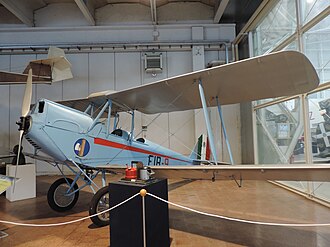
The Caproni Ca.100, affectionately known as the Caproncino, or “little Caproni,” was an Italian biplane that played an important role in the development of elementary flight training and recreational aviation during the interwar period. Designed in the late 1920s, it combined a relatively simple structure, two open cockpits, a single piston engine and the traditional biplane arrangement that was still widely used for training aircraft at the time. The Ca.100 was not intended to be a fast combat aircraft or a sophisticated long-distance transport machine. Its purpose was more practical: to help new pilots develop the skills needed to handle an aircraft, to support aviation schools and flying clubs, and to provide a versatile light aircraft that could operate from suitable airfields with comparatively modest demands. Its sturdy construction, approachable flying characteristics and adaptability allowed it to remain useful long after more advanced aircraft had entered service. The Italian Air Force’s historical account describes the Ca.100 as a touring and training aircraft that was robust, versatile, easy to fly and economical in fuel consumption.
The Ca.100 emerged from the Italian aircraft industry’s efforts to develop practical aircraft for an expanding aviation community. Its design was based on the British de Havilland DH.60 Moth, for which Caproni held production rights, but the Italian aircraft incorporated changes to the wing arrangement and tail surfaces. The result was a recognisable member of the Moth-style family with its own design identity and a range of Italian engine installations. The Ca.100 eventually became a familiar trainer of the Regia Aeronautica during the 1930s, and production involved more than one Italian manufacturer. Its variants extended beyond land-based training aircraft to include float-equipped seaplanes, while licence-built derivatives reached other countries. This combination of practical service, international production and multiple configurations makes the Ca.100 an interesting example of how a relatively modest aircraft could achieve lasting significance without relying on spectacular speed or heavy armament.
The story of the Caproni Ca.100 also illustrates the transition between early aviation’s wood-and-fabric construction methods and the more advanced aircraft that would emerge as the Second World War approached. Its wooden structure and fabric-covered surfaces reflected established techniques that could be maintained by skilled workshops, while its simple layout made it suitable for repeated instructional flights. Yet the Ca.100 was not a single, uniform design in every respect: engine types, operational roles and the distinction between landplane and seaplane versions affected its specifications. For that reason, the technical figures presented later in this article describe a representative Ca.100 configuration and identify the principal areas where published data differ.
Origins and Development of the Caproni Ca.100
The Italian aviation industry in the 1920s
During the 1920s, Italy continued to expand its aviation industry, building on experience gained during the First World War and developing aircraft for military, commercial and recreational purposes. The years after the war brought a need for reliable training aircraft, as military aviation organisations required new pilots and civilian flying clubs sought affordable ways to introduce people to powered flight. These demands favoured aircraft that were straightforward to operate, sufficiently robust for frequent training sorties and relatively economical to maintain. While large multi-engine aircraft and high-performance military machines attracted considerable attention, basic trainers were equally important to the long-term development of aviation because every operational pilot needed to acquire fundamental skills before progressing to more complex aircraft.
Caproni was already an established name in Italian aircraft manufacturing. The company’s earlier history was associated with larger aircraft and military aviation, but its wider product range also included smaller machines intended for training and general aviation. The Ca.100 reflected this practical direction: rather than attempting to introduce an entirely new aerodynamic concept, Caproni adapted a successful light-aircraft design to suit its own manufacturing and operational environment. The decision to build on the DH.60 Moth concept offered a useful foundation, since the Moth family had already demonstrated the appeal of a two-seat, single-engine biplane for elementary flying instruction. Caproni’s changes created a version suited to Italian requirements and established the basis for a type that would be produced in substantial numbers.
The influence of the de Havilland DH.60 Moth
The de Havilland DH.60 Moth was one of the best-known light aircraft designs of the 1920s, recognised for its two-seat arrangement, biplane wings and suitability for private flying and pilot training. Caproni had a production licence for the aircraft, allowing the Italian manufacturer to draw on an existing design rather than starting from a completely new project. The Ca.100 therefore shared the Moth’s broad concept: a single piston engine at the front, two open cockpits arranged in tandem, a braced biplane wing system and a conventional fixed landing gear. These features were particularly well suited to elementary instruction, because the aircraft could accommodate a student and instructor while retaining a relatively uncomplicated layout.
However, the Ca.100 was not merely a Moth assembled in Italy without changes. Its upper wing had a shorter span than its lower wing, and the tailplane was redesigned. These alterations gave the aircraft a distinctive configuration while retaining the familiar structural principles of a light biplane. The development is a useful example of licensed aircraft production during the interwar period: manufacturers often adapted imported designs to their own engineering practices, engine availability and local requirements. In the Ca.100’s case, the resulting aircraft became an established Italian type in its own right, with a range of engine installations and operational variants that distinguished it from the original British design.
First flight and entry into service
The Ca.100 first flew in 1928, with accounts placing the initial flight at Milan-Taliedo and identifying Domenico Antonini as the pilot. Some secondary specification references give 1929 as the first-flight year, illustrating a small but recurring discrepancy in historical summaries. The late-1928 date is commonly associated with the prototype, while 1929 is sometimes used in general accounts of the aircraft’s introduction or production. The distinction matters because the first flight of a prototype, the beginning of series production and the commencement of operational service are separate events. The Ca.100’s subsequent production and widespread training use during the 1930s are more firmly established than every detail of its early chronology.
The aircraft did not immediately become an overwhelming commercial success, despite the qualities that later made it well known. The Italian Air Force’s historical description notes that the Ca.100 was destined for widespread use and popularity but did not achieve immediate success at the outset. Its eventual adoption was supported by its practical qualities and its suitability for the needs of training organisations. As the type became established, it was used by the Regia Aeronautica and built by multiple companies, demonstrating that demand had grown beyond the output of Caproni alone. This progression from a licensed-design derivative to a widely used Italian trainer is one of the central features of the Ca.100’s history.
Airframe Design and Construction
Biplane configuration
The Ca.100 used a conventional biplane layout, with one wing mounted above the fuselage and another below it. In the 1920s, biplanes remained common because their two-wing arrangement could provide useful lift and structural stiffness within a compact span. The wings were connected by struts and bracing, creating a structure designed to handle the loads encountered during routine flight and training. Although biplanes generally create more aerodynamic interference and drag than comparable monoplane designs, those disadvantages were acceptable in a basic trainer whose principal goals were manageable handling, low-speed capability and operational practicality rather than maximum speed.
The Ca.100’s upper wing was shorter than its lower wing, a visible difference from the most familiar Moth configuration. This feature contributed to the aircraft’s individual appearance while preserving the overall layout of a traditional light biplane. The wings were designed for the demands of elementary flying, where predictable behaviour at relatively low speeds was more important than advanced high-speed performance. The broad wing area helped the aircraft generate lift at modest speeds, supporting the take-off, landing and manoeuvring conditions commonly encountered during instruction. The biplane configuration also reflected the engineering priorities of its era, when wood, fabric, metal fittings and external bracing offered established methods for producing light but serviceable aircraft.
Wooden structure and fabric covering
The Ca.100 is described as having a wooden-framed structure with fabric-covered flying surfaces, while the Italian Air Force’s historical summary highlights its wooden fuselage and plywood skinning. The precise construction details could vary by component and production batch, but the aircraft broadly belonged to the wood-and-fabric tradition of light aviation. Wooden structural members could be shaped and assembled using workshop techniques that were well understood by aircraft manufacturers of the period, while fabric covering provided a relatively light external surface. Plywood skinning added rigidity and formed part of the fuselage’s external structure. This approach was appropriate for an aircraft intended to be manufactured and maintained without the complexity associated with large all-metal airframes.
Such construction also placed particular importance on inspection and environmental protection. Wooden components and fabric coverings require attention to moisture, deterioration, damage and the quality of previous repairs. The condition of a historic Ca.100 therefore depends not only on its design but also on the way it has been stored, maintained and restored over time. During its operational life, the aircraft’s practical reputation rested partly on its straightforward construction and serviceability, but a surviving example requires specialist conservation to preserve its original materials safely. The use of traditional construction is one reason the Ca.100 remains of interest to aviation museums and historic-aircraft enthusiasts: it provides a tangible connection with the manufacturing techniques that characterised much of early light aviation.
Fuselage and tandem cockpits
The fuselage was arranged around two open cockpits, one behind the other. This tandem seating arrangement was well suited to flight instruction because it allowed the student and instructor to occupy separate positions along the aircraft’s centreline. The instructor could observe the student’s actions and provide guidance while the aircraft remained compact and relatively narrow. Open cockpits were typical of many light aircraft of the period and gave occupants direct exposure to the airflow, making the flying experience very different from that of a modern enclosed training aircraft. They also reinforced the Ca.100’s traditional appearance, with occupants seated in the open air behind the engine and forward fuselage.
The aircraft’s cockpit layout was functional rather than luxurious. The priority was to provide the controls and instruments needed for safe elementary flight, not to offer the extensive instrumentation or passenger amenities found in more advanced aircraft. A tandem layout also made it possible to use the same basic aircraft for solo flying after the pilot had reached the required level of competence. For flying clubs, this flexibility could help make the Ca.100 a useful investment, as it could serve both instructional and recreational roles. Its fuselage and cockpit design therefore reflected the practical requirements of a training aircraft: space for two occupants, a relatively simple control environment and an arrangement that could support repeated flights with a range of student abilities.
Tail surfaces and landing gear
The Ca.100 used a conventional tail assembly, with horizontal and vertical surfaces providing pitch and directional stability and control. The tailplane was redesigned in comparison with the DH.60 Moth, forming one of the differences between the British aircraft and its Italian derivative. The tail surfaces worked with the wings and control system to produce predictable responses to pilot input, an essential quality in a trainer. Students needed to learn how pitch, roll and yaw interacted, and an aircraft with understandable handling characteristics could make the transition from ground instruction to practical flying more manageable.
The standard landplane version had fixed conventional landing gear, with two main wheels and a tailwheel. Fixed gear was common on aircraft of this class because it avoided the weight, mechanical complexity and maintenance requirements associated with retractable systems. The arrangement was well suited to the moderate speeds and training roles for which the Ca.100 was designed. Although a tailwheel aircraft requires the pilot to develop specific ground-handling skills, the configuration was established in early aviation and remained common among trainers and light aircraft. In combination with the biplane wing and open cockpit, the landing gear gave the Ca.100 a distinctly traditional layout that remained recognisable throughout its long service life.
Engine Options and Performance
A family of different engines
One of the most distinctive aspects of the Caproni Ca.100 was its ability to accommodate a variety of engines. Rather than being tied to a single powerplant throughout its production life, the aircraft appeared with several Italian and foreign engines, reflecting the availability of components, the needs of different operators and the production arrangements of the companies involved. The Ca.100 family included aircraft powered by inline engines as well as radial engines, with outputs generally ranging from approximately 80 to 145 horsepower in commonly documented installations. Among the engines associated with the type were the Isotta Fraschini Asso 80R, Colombo S.63, Fiat A.50 and Fiat A.54, along with several other Italian and foreign designs. This diversity means that a technical description of the Ca.100 should identify its engine configuration whenever possible instead of treating every aircraft as mechanically identical.
The Colombo S.63, a six-cylinder, air-cooled inline engine, was one of the more powerful engines associated with the Ca.100, with reference material commonly listing an output of approximately 130–145 horsepower depending on the description and rating used. The Isotta Fraschini Asso 80R was another notable installation, while radial engines such as the Fiat A.50 and A.54 offered a different arrangement of cylinders around the crankshaft. Inline engines and radial engines each had their own packaging, cooling and maintenance characteristics, and their installation affected the aircraft’s weight distribution, appearance and performance. Because the Ca.100 was built in different configurations, published maximum speeds, ranges and weights can vary considerably from one reference to another.
Air-cooled piston-engine operation
The Ca.100’s engines were piston powerplants suited to relatively modest operating speeds and the repeated take-offs, climbs and landings associated with flight training. Air cooling was a common choice for light aircraft during this period because it avoided the need for a liquid-cooling system with radiators, pumps and associated plumbing. The resulting arrangement could be mechanically straightforward, although proper engine operation still depended on careful inspection, lubrication and maintenance. The range of engines installed on the Ca.100 also reflects the fact that early aviation manufacturers often had to work within a changing supply environment, making adaptable airframe designs particularly useful.
For a training aircraft, engine reliability and manageable power delivery were especially important. Students were learning how to coordinate throttle inputs with pitch, airspeed and climb performance, and they needed to understand how the aircraft responded when power was added or reduced. The Ca.100’s relatively uncomplicated single-engine layout made it appropriate for this work. Its performance was sufficient for elementary flying and recreational touring, while its operating characteristics were shaped by the engine fitted to each airframe. Modern readers should therefore be cautious about quoting one speed or range as the definitive performance of every Ca.100: the aircraft’s multiple powerplants and configurations make a single universal figure misleading.
Speed, range and practical flight characteristics
The Ca.100 was not designed to compete with high-speed military monoplanes. Its biplane structure, external bracing, fixed landing gear and generally modest engine output made it better suited to low-speed handling and elementary training than to fast cross-country travel. Reference sources list different maximum speeds, with figures around 165–200 km/h appearing for particular configurations, while the Italian Air Force’s museum entry gives a maximum speed of 180 km/h and a maximum range of 600 km. These differences should not be interpreted as proof that one source must be wrong; they may reflect different engine installations, aircraft weights, measurement conventions or versions of the type.
For a basic trainer, speed was only one measure of usefulness. The aircraft needed to take off and land at suitable airfields, remain controllable at training speeds, respond predictably to control inputs and withstand the repetitive cycles of student instruction. Its biplane wings and substantial lifting area supported a role in which moderate-speed handling was more important than aerodynamic efficiency at high speed. The Ca.100 could also be used for recreational touring, demonstrating that an aircraft designed for instruction could serve a wider community once pilots had acquired the necessary experience. Its practical value was therefore rooted in versatility, rather than in any single headline performance number.
Operational History with the Regia Aeronautica
A standard trainer of the 1930s
The Caproni Ca.100 became one of the familiar elementary trainers of the Regia Aeronautica, the Italian Royal Air Force, during the 1930s. Its two-seat configuration made it suitable for the early stages of pilot training, when students needed to learn basic aircraft control, turns, climbs, descents, take-offs and landings before moving on to more demanding aircraft. The tandem arrangement allowed an instructor to accompany a student, while the single-engine design kept the aircraft relatively straightforward compared with multi-engine training platforms. These characteristics helped make the Ca.100 an appropriate component of the training system that prepared pilots for later military service.
The importance of such aircraft can be easy to underestimate when compared with famous fighters and bombers. Military aviation depended on a steady supply of pilots who had first mastered elementary flying, and a reliable primary trainer was essential to that process. The Ca.100 helped provide this foundation during a period when military aircraft were undergoing rapid changes in speed, power and construction. A student who learned to handle a simple biplane gained experience in aircraft control and airmanship before progressing to more complex machines. The Ca.100’s service with the Regia Aeronautica therefore placed it at the beginning of a broader training pathway, rather than at the centre of front-line combat operations.
Production by several Italian manufacturers
The Ca.100 was produced not only by Caproni but also by other Italian manufacturers, including Bergamasche, Breda, C.N.A. and Macchi. The involvement of multiple companies reflected the scale of demand for training aircraft and the way production could be distributed across an industrial network. Historical summaries commonly cite approximately 675 production aircraft for the Regia Aeronautica, in addition to two prototypes, while broader estimates often place total production at around 700 aircraft. Exact totals differ depending on whether prototypes, civil aircraft, floatplane versions and foreign-built derivatives are counted together. It is therefore more accurate to describe the Ca.100 as a type produced in the high hundreds than to suggest that every source agrees on one definitive total.
Multi-company production also meant that individual aircraft could differ in engine installation, equipment and construction details. Although manufacturers worked to a common type design, production arrangements and subsequent service modifications could affect the details of a particular airframe. For modern historians, this creates a need to distinguish between the general Ca.100 specification and the history of an individual aircraft. It also helps explain why surviving aircraft and museum records may list different engine models or dimensions. The type’s broad identity remained consistent, but the Ca.100 should be understood as a family of related aircraft rather than as a completely uniform fleet.
Liaison and other secondary duties
Although the Ca.100’s best-known role was elementary training, some aircraft were also used for liaison and other light duties. Its ability to carry two people and operate as a relatively simple single-engine aircraft made it useful for tasks that did not require a larger or more powerful platform. Liaison flying generally involved transporting personnel or information between locations, and an aircraft of the Ca.100’s size could perform such work when suitable airfields and operating conditions were available. These secondary duties demonstrate how a basic trainer could be useful beyond the classroom environment.
The Ca.100’s service life extended beyond the period when it was the principal trainer of its early years. Some examples remained in use after the Second World War, including civilian aircraft and former military machines that moved into recreational aviation. This continued use reflected the aircraft’s versatility and the fact that its fundamental design remained useful for relatively modest flying tasks. It also contributed to the type’s long historical footprint: the Ca.100 was not limited to a short military career but became part of the wider story of Italian light aviation.
The Ca.100 Idro: A Floatplane Adaptation
From landplane to seaplane
One of the most interesting developments of the Ca.100 was the Ca.100 Idro, a float-equipped version intended for operations from water rather than conventional runways. The Italian word idro refers to a hydroplane or seaplane, and the designation identified the aircraft’s adaptation to a different operating environment. Instead of relying on the standard wheeled landing gear, the floatplane version used floats that supported the aircraft on the water and allowed it to take off and land on suitable lakes or other bodies of water. This conversion expanded the Ca.100’s potential uses and showed how a relatively simple airframe could be adapted to meet different operational requirements.
Floatplane conversion introduced substantial changes to the aircraft’s ground and water handling, even if the basic wing, fuselage and cockpit arrangement remained familiar. Floats added weight and aerodynamic drag, and water operations required pilots to understand wind, waves, surface conditions and the behaviour of the aircraft while moving across the water. Take-off performance could differ from that of the landplane because the aircraft needed to overcome water resistance before becoming airborne. These demands meant that the Ca.100 Idro was not simply an interchangeable landplane with wheels replaced by floats; it was a distinct operational configuration requiring appropriate training and maintenance. Nevertheless, the ability to use water as an operating surface gave the Ca.100 access to locations where conventional runways were unavailable or inconvenient.
Production and operational use of the Idro
Historical accounts report that approximately 30 Macchi-built Ca.100 aircraft were fitted with floats and designated Ca.100 Idro. The figure is a commonly cited production detail rather than a universal count of every float-equipped airframe that may have existed over the type’s entire history. The Idro variant retained the Ca.100’s general role as a light trainer, while its water-based configuration made it suitable for training or other aviation activities where seaplane experience was required. Float-equipped aircraft were especially relevant in an era when aviation schools and clubs sometimes used lakes and coastal areas as operating locations.
The Idro version is also associated with one of the most remarkable achievements in the Ca.100’s history. In 1931, a Ca.100 seaplane established a world altitude record for seaplanes, reaching 5,324 metres. The achievement demonstrated that a relatively modest training aircraft could be used for a performance feat far removed from its ordinary instructional mission. Although the Ca.100 was not designed primarily as a record-breaking machine, the event helped highlight the capabilities of the airframe and the potential of its engine and configuration under specialised conditions. It remains an important milestone in the aircraft’s history and adds an unusual chapter to the story of the “little Caproni.”
International Production and Export Versions
The Ca.100 beyond Italy
The Caproni Ca.100 was not confined to Italian service. Historical accounts record exports to countries including Peru and Portugal, while licence production and local derivatives further extended its reach. International use was a natural outcome of the aircraft’s training role: air forces and aviation schools in other countries also needed basic trainers that could accommodate an instructor and student and operate with comparatively straightforward equipment. The Ca.100’s adaptable design and variety of engine options made it relevant to different markets, although individual versions could differ considerably from the Italian-built aircraft.
The aircraft’s overseas history is a reminder that the interwar aviation industry was interconnected. Designs, licences, engines and manufacturing expertise crossed national borders, and manufacturers often sought to establish local subsidiaries or production agreements in foreign markets. A light trainer was particularly suitable for this kind of international activity because it did not require the industrial infrastructure associated with large combat aircraft. At the same time, overseas production could lead to changes in materials and powerplants, meaning that the name Ca.100 could refer to aircraft whose technical details were not identical to those of the original Italian examples.
The Peruvian Ca.100PR
One notable derivative was the Ca.100PR, produced under licence in Peru by Fábrica Nacional de Aviones Caproni Perú, a subsidiary associated with the Italian manufacturer. Historical summaries report that twelve examples were built from 1937. The Peruvian version differed from the original Ca.100 in important respects, including the use of an all-metal structure and a 125-horsepower Kinner B-5 radial engine. These changes show that licensed production could involve substantial engineering differences rather than a simple reproduction of the original wooden aircraft.
The Ca.100PR served with the Peruvian Air Force, and the remaining four aircraft were transferred to the Peruvian Civil Aviation School in 1946, according to published historical accounts. They reportedly remained in use until 1956, giving the derivative a service life that extended well beyond the original Italian aircraft’s first years of operation. The Peruvian example is significant because it demonstrates the Ca.100 concept’s adaptability to different industrial environments and national requirements. It also underlines why technical specifications must be linked to a particular variant: the Ca.100PR’s engine and structure differed from the standard Italian landplane, so its specifications should not be substituted for those of the original model.
The Bulgarian KB-1 Peperuda
The Ca.100 design was also produced in Bulgaria under the designation KB-1 Peperuda, a name translated as “butterfly.” The Bulgarian derivative was associated with Caproni’s local subsidiary and included examples powered by Walter radial engines. Historical summaries commonly report seven aircraft built in 1932 with Walter NZ 120 engines, followed by two Bulgarian-built floatplanes that were donated to the Bulgarian government. The small number of aircraft illustrates the more limited scale of this production compared with the Italian fleet.
The Bulgarian experience also shows that adopting a successful design did not guarantee identical results in every operating environment. Published accounts indicate that the Peperuda aircraft were withdrawn from Bulgarian service within a relatively short period, with problems associated with their wooden structures cited as a factor. This episode highlights the importance of materials, climate, maintenance practices and local manufacturing quality in the long-term success of an aircraft. A design that worked effectively in one environment could face different challenges when built or operated under different conditions. The Ca.100 family’s international history therefore includes both successful long-term use and examples of the difficulties that could accompany overseas production.
Civil Aviation and Postwar Service
Use by flying clubs and private pilots
Although military training accounted for much of the Ca.100’s historical importance, the aircraft also found a place in civilian aviation. Its two-seat arrangement, straightforward layout and relatively modest operating requirements made it suitable for flying clubs, private owners and recreational pilots. Civilian operators could use the aircraft to introduce beginners to flying, provide local sightseeing trips or allow qualified pilots to continue practising their skills. In this environment, the Ca.100’s usefulness depended less on advanced equipment than on its ability to deliver dependable service and an accessible flying experience.
At least several aircraft were built specifically for civilian touring, and former military examples later entered civilian registers as they became available for surplus or private use. The transition from military trainer to civil aircraft was not unusual in the years surrounding the Second World War, when many countries reassessed their aviation fleets and older trainers remained useful for non-military purposes. For an aircraft such as the Ca.100, this change of role could extend its operational life and introduce it to a new generation of pilots. Its continued use also helped preserve examples that might otherwise have disappeared after their original military service ended.
Service after the Second World War
The Ca.100 remained in use well beyond the Second World War, according to the Italian Air Force’s historical account. This longevity reflected the fact that the aircraft’s basic role did not become obsolete simply because newer designs offered greater speed or more modern construction. Elementary flying still required aircraft capable of teaching fundamental skills, and a well-maintained Ca.100 could continue to fulfil that purpose in a civil flying club or other suitable environment. Its traditional wood-and-fabric construction also meant that maintenance and restoration depended heavily on specialist knowledge, but this did not prevent some examples from surviving into the postwar period.
As aviation technology advanced, however, the Ca.100 increasingly belonged to an earlier generation. Newer trainers benefited from more modern cockpit layouts, improved engines, enclosed cabins in some designs and increasingly common metal construction. These developments changed the expectations of both students and operators. The Ca.100’s continuing use is therefore best understood as evidence of its practical durability and historical adaptability, not as proof that it remained technically equivalent to postwar trainers. It survived because it continued to serve a useful role, while gradually becoming a historic aircraft associated with the origins of modern Italian flight training.
Surviving Aircraft and Museum Preservation
The Italian Air Force Museum at Vigna di Valle
The Ca.100 remains part of Italy’s aviation heritage through surviving examples preserved in museums. The Italian Air Force Museum, known as MUSAM, at Vigna di Valle displays a Caproni Ca.100, allowing visitors to examine an aircraft associated with the development of elementary flight training in the interwar years. The museum’s historical description emphasises the aircraft’s versatility, ease of handling and modest fuel consumption, as well as its wooden construction and long service life. Such collections help preserve not only the physical aircraft but also the engineering practices and operational history that shaped early Italian aviation.
A preserved Ca.100 can reveal details that are difficult to appreciate through written specifications alone. The relationship between its upper and lower wings, the structure of the open cockpits, the bracing and the scale of its fuselage all illustrate how early trainers were designed around the practical needs of flight instruction. The aircraft’s traditional construction is also a reminder that preservation involves more than displaying a recognisable silhouette: wood, fabric, metal fittings and engine components each require appropriate care. Museum conservation therefore plays an important role in ensuring that the Ca.100 remains available for future research and public education.
The Gianni Caproni Museum of Aeronautics
Another important collection is the Gianni Caproni Museum of Aeronautics in Trento, which has a preserved Ca.100 Idro in its collection. The aircraft’s history is particularly interesting because it was originally built as a landplane and later converted to floatplane configuration. The example is reported to have flown from 1936, been converted to a floatplane in 1960 and operated by Aero Club Como until 1964 before eventually entering museum preservation. This individual history illustrates how a single airframe can experience multiple roles and modifications during a long operational life.
Surviving examples are especially valuable because the Ca.100 existed in numerous engine and configuration variants, and its historical record is not identical for every airframe. Individual aircraft histories can help researchers establish which engine was fitted, where the aircraft operated, whether it was converted to floats and how its construction changed during restoration. They also provide a tangible link between the aircraft’s early military and civilian use and the preservation work carried out by later generations. Although the Ca.100 was produced in substantial numbers, only a small proportion of the original fleet survives today, making preserved examples important resources for aviation historians.
Why the Caproni Ca.100 Matters in Aviation History
The Caproni Ca.100 was not a revolutionary high-speed aircraft, and it did not become famous for combat achievements. Its importance came from a more fundamental contribution: it helped train pilots and support the expansion of aviation during a period when flying skills were becoming increasingly important to both military and civilian organisations. By providing a two-seat platform with a relatively simple structure and adaptable engine arrangements, it filled a practical requirement that more advanced aircraft could not necessarily meet as economically or conveniently. Its widespread use with the Regia Aeronautica and its continued service in civilian aviation demonstrate that basic trainers were an essential part of aviation infrastructure.
The aircraft also represents an important stage in the development of the Italian aircraft industry. Based on a successful British design but modified for Italian production and use, the Ca.100 illustrates how licensed designs could become the foundation for nationally distinctive aircraft. Its production by several manufacturers, the development of the Idro floatplane, and the overseas Ca.100PR and KB-1 Peperuda variants all show how a relatively simple design could evolve into a family of related aircraft. The differences between these versions also reveal the engineering and industrial decisions that shaped aircraft production during the interwar period.
Finally, the Ca.100’s history reminds us that an aircraft’s significance cannot be measured only by maximum speed, armament or technological novelty. The ability to train pilots safely and economically, serve more than one role and remain useful over many years can be just as important to aviation history. The Caproncino achieved that kind of lasting relevance. Its combination of practical design, military training service, civilian use and international derivatives makes it a valuable subject for anyone interested in early twentieth-century aircraft and the evolution of pilot training.
Caproni Ca.100 Technical Specifications
The following table summarises representative specifications for the land-based Caproni Ca.100. The aircraft was built with several engines, so the figures should not be interpreted as a single definitive specification that applies to every example. The Italian Air Force museum gives a wingspan of 10 metres, a length of 7.30 metres, an empty weight of 500 kg, a total weight of 760 kg, a maximum speed of 180 km/h and a maximum range of 600 km. Other technical references give different weights and performance figures for particular engine configurations.
| Specification | Caproni Ca.100 |
|---|---|
| Country of origin | Italy |
| Manufacturer | Caproni, with production by other Italian companies |
| Aircraft type | Light training and touring aircraft |
| First flight | 1928, commonly reported |
| Primary military operator | Regia Aeronautica |
| Crew | 2 |
| Seating arrangement | Tandem, with two open cockpits |
| Configuration | Single-engine biplane |
| Structure | Primarily wooden structure with fabric-covered surfaces; plywood skinning on the fuselage |
| Landing gear | Fixed conventional tailwheel undercarriage |
| Length | 7.30 m |
| Wingspan | 10.00 m, as listed by the Italian Air Force museum |
| Height | 2.73 m |
| Wing area | 24.44 m² |
| Empty weight | 500 kg, museum reference figure |
| Maximum or total weight | 760 kg, museum reference figure |
| Engine | Varied by version; inline and radial piston engines were used |
| Representative engine types | Isotta Fraschini Asso 80R, Colombo S.63, Fiat A.50 and Fiat A.54, among others |
| Representative engine power | Approximately 80–145 hp, depending on engine and version |
| Maximum speed | Approximately 180 km/h in the Italian Air Force museum data |
| Maximum range | Approximately 600 km in the Italian Air Force museum data |
| Main role | Elementary pilot training |
| Secondary roles | Touring, recreational flying and liaison |
| Floatplane variant | Ca.100 Idro |
| Foreign derivatives | Ca.100PR in Peru; KB-1 Peperuda in Bulgaria |
| Common nickname | Caproncino, meaning “little Caproni” |
| Approximate production | Around 700 aircraft commonly cited; exact totals vary by source and variant-counting method |
Specification note: Some references list a wingspan of approximately 8.35 metres for the upper wing and 10.00 metres for the lower wing, rather than presenting only the lower-wing span. Other published figures differ in engine power, weight, speed and range because the Ca.100 was produced in multiple configurations. The table above uses the Italian Air Force museum’s principal dimensions and performance figures where available; other entries are general descriptions of the aircraft family, not guaranteed values for every airframe.
Conclusion
The Caproni Ca.100 was a practical and adaptable Italian biplane that became an important part of interwar flight training. Developed from the de Havilland DH.60 Moth concept, it combined a two-seat tandem cockpit, a conventional biplane wing system, fixed landing gear and a variety of piston engines to serve the needs of military and civilian aviation. Its reputation grew through service with the Regia Aeronautica, production by several manufacturers and continued use by flying clubs and private operators. The float-equipped Ca.100 Idro expanded its role further, while the Peruvian Ca.100PR and Bulgarian KB-1 Peperuda demonstrated how the design could be adapted for overseas production.
The Ca.100’s enduring appeal comes from its usefulness rather than from extraordinary speed or combat performance. It helped prepare pilots for more advanced aircraft, supported recreational flying and remained in service long after its original introduction. Its wooden structure and fabric-covered surfaces also preserve a connection to the construction methods that shaped much of early light aviation. Today, surviving examples in museums provide an opportunity to understand the aircraft’s design and appreciate the role that relatively simple trainers played in the growth of aviation.
For enthusiasts, the Caproncino is a reminder that aviation history depends on many kinds of aircraft. Fighters and bombers may dominate popular narratives, but basic trainers such as the Ca.100 formed the foundation on which military and civilian flying communities were built. Its long service life, multiple variants and international history make it a noteworthy chapter in the story of Italian aircraft manufacturing.
.jpg)