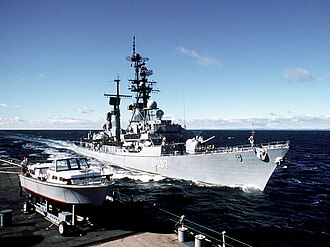
The D187 Rommel was one of the most capable warships operated by the West German Navy during the Cold War. Built in the United States but designed to meet the requirements of the newly established Bundesmarine, she belonged to the Lütjens class, a German variant of the American Charles F. Adams-class guided-missile destroyers. Entering service in 1970, Rommel spent nearly three decades operating with the West German and later unified German Navy, taking part in NATO exercises, multinational deployments and the constant training that characterized naval life during the Cold War. She never fought the large European naval war for which she was designed, but that was precisely the point: ships such as Rommel existed to make such a conflict less likely by providing credible military strength and demonstrating that NATO countries could operate together.
Rommel was also a fascinating combination of older and newer technology. Beneath her superstructure were conventional steam boilers and turbines, while above deck were radar systems, guided missiles and sophisticated fire-control equipment. Her main role was fleet air defense, but she could also attack surface ships, engage submarines and bombard targets with her two 127 mm guns. During her career, these capabilities were repeatedly upgraded to keep the ship relevant as naval warfare changed. Her eventual retirement in 1998 marked the end of an important chapter in the history of the Bundesmarine, and the ship was subsequently scrapped in Turkey. (Wikipedia)
The Origins of D187 Rommel
Building a New West German Navy
The origins of Rommel can be traced to the decision to rebuild West Germany’s naval forces during the 1950s. The new Bundesmarine was very different from the German naval forces of the Second World War. It was created as part of the NATO alliance and was intended primarily to help defend Western Europe rather than conduct an independent global naval strategy. Its ships needed to be able to operate alongside American, British, Dutch and other allied vessels, and they needed modern weapons capable of dealing with the aircraft and submarines that represented major threats to NATO fleets.
By the 1960s, guided missiles were transforming naval warfare. Traditional guns remained useful, but radar-controlled missiles could engage aircraft at considerably greater distances and offered a way for relatively small warships to protect themselves and other ships. West Germany therefore ordered three advanced destroyers from Bath Iron Works in Maine. These became Lütjens, Mölders and Rommel, the three ships of the Lütjens class. They were based on the American Charles F. Adams design but incorporated several modifications for German service, including different communications equipment, mast and funnel arrangements, accommodation and sonar installation. (Wikipedia)
Rommel was the third and final ship of the class. Her keel was laid down at Bath Iron Works on August 22, 1967, under the American hull designation DDG-30. She was launched on February 1, 1969, and was christened by Lucie Maria Rommel, the widow of Field Marshal Erwin Rommel, after whom the ship was named. Following completion and handover, the destroyer entered West German naval service on May 2, 1970, joining the 1st Destroyer Squadron at Kiel. (Námořní encyklopedie)
The choice of name reflected the complicated historical environment in which the Bundesmarine operated. West Germany’s armed forces were attempting to establish a new democratic military tradition while still dealing with the legacy of the Second World War. Erwin Rommel was a particularly recognizable military figure, and naming a major warship after him was inevitably connected to debates about how Germany should remember its military past. Regardless of the controversy surrounding the name, D187 Rommel became a working NATO warship whose daily mission was defined by the Cold War rather than by the Second World War.
A Destroyer Built for the Missile Age
Speed, Power and Size
Rommel was an impressive ship by the standards of the period. She measured approximately 134 meters in length and about 14.4 meters across the beam, with a full-load displacement generally given at around 4,700 tons. Four high-pressure boilers produced steam for two geared turbines, which drove two propeller shafts. The machinery could generate roughly 70,000 horsepower, giving the ship a top speed of around 33 knots in German service. (Unvis)
For a layman, it is useful to imagine what that meant in practical terms. Rommel was a ship weighing several thousand tons that could move at more than 60 kilometers per hour through open water. That speed allowed her to keep up with major fleet formations, maneuver rapidly during exercises and respond quickly to developing situations. It did, however, come at a cost. Steam-powered warships required large engineering departments, substantial quantities of fuel and continuous maintenance. High-speed operation consumed fuel particularly quickly, so the ship’s maximum speed was normally reserved for situations in which it was actually necessary.
Her machinery was also a reminder that Rommel belonged to a transitional generation of warships. Modern naval vessels increasingly use gas turbines or other propulsion systems, but Rommel relied on the traditional combination of boilers and steam turbines. For the sailors responsible for propulsion, the engine room was a complicated industrial environment of pipes, valves, pumps, turbines and machinery that had to function reliably far from the ship’s home port.
Weapons for Several Kinds of Threat
Rommel was designed primarily as an air-defense destroyer, but she carried a surprisingly broad collection of weapons. Her principal missile system was the American Tartar surface-to-air missile, launched from a single-arm Mk 13 launcher. The ship could carry approximately 40 missiles, giving her a significant ability to defend a naval formation against approaching aircraft. Radar and fire-control systems were essential to this capability because the missiles depended on the ship being able to detect, track and engage targets accurately. (Unvis)
The destroyer also carried two 127 mm/54-caliber Mk 42 guns, one toward the forward part of the ship and one farther aft. These were versatile weapons rather than simple naval artillery. They could fire against surface targets and shore positions and could also contribute to air defense. To a modern observer accustomed to precision-guided weapons, the idea of using large guns against aircraft may seem unusual, but rapid-fire naval artillery remained an important part of warship armament during the Cold War.
For submarine warfare, Rommel had an ASROC launcher and two triple banks of 324 mm torpedo tubes. ASROC was particularly valuable because it allowed a ship to attack a suspected submarine without having to maneuver directly over the target. The system combined a rocket with a lightweight antisubmarine torpedo, effectively extending the destroyer’s reach against underwater threats. (Navypedia)
Life Aboard D187 Rommel
A Floating Workplace
The technical specifications of Rommel tell only part of the story. A warship is ultimately operated by people, and the destroyer normally carried approximately 330 to 340 officers and sailors. Every person aboard had a role. Engineers kept the propulsion plant functioning, weapons crews maintained guns and missiles, radar operators watched for contacts, sonar operators searched beneath the waves, navigators determined the ship’s position and course, while cooks, medical personnel and other specialists ensured that the crew could continue working for long periods at sea.
Living aboard such a ship was demanding. Unlike a modern passenger vessel, Rommel was designed around military efficiency rather than comfort. Crew members worked watches around the clock, meaning that someone was always operating the bridge, monitoring machinery or standing ready at a weapons or sensor station. During exercises, the pace could become intense as the crew practiced responses to aircraft attacks, submarine contacts and surface threats.
The destroyer’s relatively compact size also meant that hundreds of people lived and worked in close proximity. Machinery spaces were noisy and hot, particularly when the boilers were operating at high power. Elsewhere, sailors might spend long hours in operations rooms watching radar displays or maintaining equipment. The ship was effectively a small community, but one in which virtually every activity ultimately supported the mission of keeping the vessel ready for combat.
Modernization During the Cold War
From Type 103 to Type 103A and 103B
Rommel’s original technology was advanced when she entered service, but naval electronics developed extremely quickly. Radar, computers, communications and missile technology were all improving, meaning that a warship could become obsolete even when its hull and machinery remained perfectly usable. The German Navy therefore invested in modernization programs designed to extend the lives of the Lütjens-class ships.
Rommel underwent modernization to the 103A standard between August 1979 and April 1980. A second major modernization followed between April 1985 and March 1986, producing the 103B configuration. These upgrades improved the ship’s combat systems and allowed her to remain an effective NATO unit as the Cold War entered its later decades. (Wikipedia)
One of the most important developments was the gradual introduction of newer missiles and electronic equipment. Later in her career, the destroyer also received Harpoon antiship missiles, giving her a substantially improved ability to threaten surface vessels. Close-range defense was enhanced in the 1990s with Rolling Airframe Missile (RAM) launchers. This was an important change because modern anti-ship missiles could travel at high speed and attack from relatively low altitude, leaving warships much less time to respond than they had against older aircraft. (Wikipedia)
These changes demonstrate why Cold War warships cannot always be described accurately by their original specifications. Rommel entered service with one combination of sensors and weapons and ended her career with another. The hull remained recognizable, but much of the technology that made the ship a fighting system had changed.
Rommel and NATO Operations
Training for a War That Never Came
During her career, Rommel regularly participated in NATO exercises and multinational naval operations. She served with formations such as STANAVFORLANT, the Standing Naval Force Atlantic, and also operated with NATO’s Mediterranean naval forces. These deployments were important because the strength of NATO depended not only on having modern ships but also on the ability of those ships to work together. (Námořní encyklopedie)
For the crew, multinational exercises meant practicing communications, formation maneuvering, air-defense procedures and antisubmarine operations alongside sailors from other countries. A German destroyer might operate with American, British, Dutch, Canadian or other NATO ships, learning how to respond to a rapidly changing tactical situation while following common procedures.
The strategic objective was deterrence. Rommel was not expected to spend her career fighting pirates or conducting humanitarian patrols. Her principal purpose was to make NATO’s maritime forces sufficiently capable that a potential enemy would understand the enormous risks involved in starting a conflict. The fact that the Cold War never became a direct war between NATO and the Soviet Union means that Rommel never had to demonstrate her combat capabilities under real wartime conditions.
The Final Years of D187 Rommel
Retirement and Scrapping
By the 1990s, the strategic environment had changed dramatically. The Berlin Wall had fallen, Germany had been reunified and the Soviet Union had disappeared. The immediate threat that had justified large NATO naval forces was gone, while newer warships offered more modern technology and more efficient propulsion.
Rommel nevertheless continued operating into the late 1990s. Her final years were increasingly affected by the practical problem of maintaining an aging steam-powered warship. In particular, the operating license for her boilers expired, and refurbishing the propulsion system was considered uneconomical. As a result, the ship was decommissioned on September 30, 1998, and was later formally stricken from the naval register. (Unvis)
Unlike her sister Mölders, which survives today as a museum ship, Rommel was not preserved. After retirement she was moved to Wilhelmshaven and used as a source of spare parts to support the remaining Lütjens-class destroyers. Eventually, the hull was taken to Turkey and scrapped in 2004. (Unvis)
The Legacy of Rommel
D187 Rommel is significant because she represents a period when West Germany was rebuilding its armed forces within a democratic and multinational alliance. Her career illustrates the close military relationship between West Germany and the United States, since her basic design originated in an American shipbuilding program. At the same time, German modifications and later upgrades transformed her into a warship specifically adapted to the needs of the Bundesmarine.
She also illustrates the technological transition that occurred at sea during the second half of the twentieth century. Guns remained important, but radar, computers, guided missiles, sonar and electronic warfare became central to naval combat. A destroyer’s effectiveness increasingly depended on its ability to detect an enemy and process information before deciding which weapon to use.
Perhaps most importantly, Rommel represents the thousands of sailors who spent their careers preparing for a conflict that fortunately never occurred. Her crew trained for aircraft attacks, submarine threats and missile warfare because NATO required its forces to be ready at all times. The absence of a major war does not mean those preparations were meaningless. On the contrary, the enormous military effort of the Cold War was partly intended to prevent that war from ever happening.
Although D187 Rommel no longer exists physically, her career remains an interesting part of German naval history. She was fast, heavily armed and technologically sophisticated for her time, yet she was also dependent on a large crew and an increasingly expensive propulsion system. Her eventual retirement was therefore not simply the end of an individual ship but part of the broader transition from Cold War destroyers to newer generations of German frigates and multinational naval forces.
D187 Rommel Technical Specifications
| Specification | Details |
|---|---|
| Ship type | Guided-missile destroyer |
| Class | Lütjens class, Type 103 |
| Pennant number | D187 |
| Builder | Bath Iron Works, Bath, Maine, USA |
| Original U.S. designation | DDG-30 |
| Keel laid | August 22, 1967 |
| Launched | February 1, 1969 |
| Commissioned | May 2, 1970 |
| Decommissioned | September 30, 1998 |
| Stricken | June 30, 1999 |
| Final fate | Scrapped in Turkey in 2004 |
| Length | Approximately 134.4 m |
| Beam | Approximately 14.4 m |
| Draft | Approximately 4.5 m in original design references; later sources give greater operational draft figures |
| Full-load displacement | Approximately 4,500–4,700 tonnes, depending on source and configuration |
| Propulsion | 4 high-pressure water-tube boilers and 2 geared steam turbines |
| Shafts | 2 |
| Power | Approximately 70,000 hp |
| Maximum speed | Approximately 33–36 knots, depending on specification |
| Range | Approximately 4,500 nautical miles at 20 knots |
| Crew | Approximately 330–340 |
| Main guns | 2 × 127 mm/54 Mk 42 |
| Original surface-to-air system | Mk 13 launcher with Tartar missiles |
| Tartar missile capacity | Approximately 40 missiles |
| Antisubmarine weapon | 8-cell ASROC launcher |
| Torpedoes | 6 × 324 mm torpedo tubes |
| Later antiship weapons | Harpoon missiles |
| Later close-in defense | RAM missile launchers |
| Primary mission | Fleet air defense, escort and general destroyer duties |
| Home port | Kiel |
| NATO role | Multinational fleet exercises and standing naval formations |
Technical figures vary somewhat among historical references because different sources use different displacement and draft measurements, while Rommel’s weapons and electronics changed substantially during her 28-year operational career. The table therefore combines commonly cited class and ship-specific figures rather than presenting every measurement as though it applied unchanged throughout the ship’s life. (Unvis)
Conclusion
The D187 Rommel was a product of the Cold War in almost every respect. She was ordered by West Germany, built in an American shipyard, armed with American-designed missiles and guns, modified for German requirements and operated for decades as part of NATO’s multinational naval structure. Her purpose was to defend the alliance against threats that, fortunately, never developed into the major war for which she had been designed.
Her story is also a useful reminder that a warship is more than its weapons. Rommel’s speed came from powerful but demanding steam machinery; her air-defense capability depended on radar operators, computers and missile crews; her antisubmarine role required sonar operators and weapons specialists; and every one of those systems depended on hundreds of sailors working together. The result was a complex floating machine whose effectiveness came from the combination of technology, training and teamwork.
When Rommel was finally retired in 1998, the world for which she had been built was already disappearing. The Soviet Union was gone, Germany was reunified and a new generation of naval technology was emerging. Her scrapping in 2004 brought a physical end to the ship, but the career of D187 Rommel remains an illuminating example of how Germany, the United States and their NATO partners prepared for—and ultimately helped deter—the naval conflict of the Cold War.
_passing_USS_Iowa_(BB-61)_in_the_Atlantic_Ocean_on_1_September_1986_(6423053).jpg)