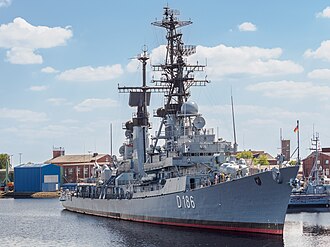
The Mölders (D186) was one of the most important warships operated by the West German Navy during the Cold War. Built in the United States but designed around the needs of the newly established Federal German Navy, she combined the proven hull of an American destroyer with modern guided missiles, radar and antisubmarine weapons. For more than three decades, Mölders served as a fast and heavily armed escort, training ship and NATO fleet unit, operating in an era when a naval confrontation between NATO and the Soviet Union was considered a genuine possibility. Today, rather than being remembered only as a Cold War weapon, Mölders can be appreciated as a remarkably well-preserved example of the technology, strategy and everyday working environment of a large destroyer from the second half of the twentieth century. She is preserved at the German Naval Museum in Wilhelmshaven, where visitors can see the ship as a physical reminder of the period when West Germany’s navy was being rebuilt and integrated into the Western alliance.
The Origins of Mölders
A German Navy Rebuilt for the Cold War
The story of Mölders begins with the creation of the Bundesmarine, the navy of West Germany, in the 1950s. Unlike the pre-war German navy, the new force was being built specifically within the framework of NATO. Its purpose was not to operate independently across the world’s oceans, but to contribute to the collective defense of Western Europe, particularly in the strategically important North Atlantic and North Sea. This meant that West Germany needed modern ships capable of operating alongside American, British, Dutch and other allied naval forces. Guided-missile destroyers were particularly valuable because they could protect larger formations from aircraft, search for submarines and contribute their own guns and missiles to a fleet’s defensive and offensive capabilities.
Mölders was one of three ships ordered by West Germany from Bath Iron Works in Maine. The vessels became known in German service as the Lütjens class, while being closely related to the American Charles F. Adams class of guided-missile destroyers. The German ships were not simply American vessels painted in German colors, however. They incorporated changes to communications equipment, electronics, internal arrangements and the distinctive mast-and-funnel arrangement required by the Bundesmarine. Mölders was ordered in 1965 and her keel was laid down on April 12, 1966. She was launched in 1968 and entered West German service on September 20, 1969, carrying the hull number D186.
The ship was named after Werner Mölders, a Luftwaffe colonel and fighter ace of the Second World War. Her naming reflected a practice that was politically and historically sensitive in postwar West Germany, where the new military was attempting to establish traditions for a democratic armed force while dealing with the legacy of the Second World War. The vessel was christened by Werner Mölders’ mother, Anna Maria Mölders, and entered service with the 1st Destroyer Squadron based at Kiel. From the beginning, therefore, the ship represented both a practical military requirement and the complicated process through which the Federal Republic was rebuilding its armed forces after 1945.
A Destroyer Designed for Modern Naval Warfare
What Made Mölders Different?
To someone accustomed to modern warships, Mölders might look relatively modest, but for the 1960s she was an impressive fighting ship. She measured roughly 134 meters in length, had a beam of about 14.4 meters and displaced roughly 4,500 to 4,800 tons depending on how displacement was measured and the ship’s configuration. Four high-pressure boilers supplied steam to two geared turbines, which drove two propeller shafts. The machinery could produce approximately 70,000 horsepower and propel the destroyer at more than 30 knots. In practical terms, this meant Mölders could travel at highway speeds across the ocean while carrying hundreds of sailors and a substantial weapons and electronics suite.
The reason for such speed was not simply to make the ship impressive. Naval warfare depends heavily on the ability to move quickly between different parts of a fleet. A destroyer might need to keep pace with a carrier, intercept another ship, maneuver to defend a convoy or move away from a dangerous area. Speed also gave the captain more options during combat. Mölders’ steam propulsion was powerful but mechanically complex, requiring a large engineering department to operate and maintain the boilers, turbines, generators and associated systems. For the sailors below decks, keeping the ship moving was itself a major undertaking.
The ship’s weapons reflected the changing nature of naval warfare. Two 127 mm/54-caliber Mark 42 guns, one forward and one aft, provided conventional artillery. These guns could engage surface targets, shore positions and aircraft, making them useful in situations where missiles were either unnecessary or unsuitable. Mölders also carried a Tartar/Standard surface-to-air missile system, which gave the ship a much greater ability to defend itself and other vessels against aircraft. An eight-cell ASROC launcher provided a means of attacking submarines at considerable distance, while two triple 324 mm torpedo mounts provided another antisubmarine weapon.
Life Aboard the Mölders
More Than 300 People on a 134-Meter Ship
One of the easiest things to overlook when discussing warships is that they are also living and working environments. Mölders normally carried approximately 334 personnel, including officers, non-commissioned officers and enlisted sailors. Every one of those people had a specific job, whether operating weapons, maintaining machinery, monitoring radar screens, preparing food, managing communications or keeping the ship supplied and functioning. The destroyer was effectively a small floating community that had to remain operational for long periods away from home.
For the crew, the ship’s enormous technological complexity meant that training was essential. A sailor did not simply learn how to fire a weapon; he needed to understand the equipment, procedures and communication systems associated with it. Engineers had to keep the boilers and turbines working, radar operators had to interpret contacts, weapons crews had to prepare missiles and ammunition, and bridge personnel had to navigate safely in all kinds of weather. During exercises, these separate departments had to work together as one organization. A destroyer’s combat effectiveness depended just as much on coordination as on the quality of its weapons.
The ship’s home port was Kiel, an important naval center on Germany’s Baltic coast. From there Mölders could operate into the North Sea and the wider Atlantic, areas that were central to NATO’s maritime defense plans. Her location also placed her close to the Baltic approaches, an area of considerable strategic importance during the Cold War. Mölders therefore spent much of her career practicing the kind of missions that might have been required during a major NATO-Warsaw Pact confrontation.
Modernization During the Cold War
Keeping an Aging Destroyer Relevant
Mölders did not remain unchanged throughout her 34-year career. Like most successful Cold War warships, she underwent repeated modernization as technology developed. During the late 1970s she received improvements associated with the 103A configuration, including changes to her weapons and fire-control systems. In the early 1980s, a further modernization created the 103B configuration. These changes were important because electronic technology was developing rapidly, and a ship that was considered advanced in 1969 could quickly become outdated without upgrades.
The modernization process affected much more than weapons. Radar systems, computers, communications equipment and fire-control systems all had to be improved as new technology became available. Mölders eventually received equipment including newer surveillance and targeting radars, improved fire-control arrangements and other electronic systems. In the early 1990s, her defensive capabilities were further enhanced with Harpoon antiship missiles, Rolling Airframe Missile (RAM) launchers and other equipment.
These upgrades demonstrate an important point about Cold War warships: their usefulness depended heavily on electronics. A destroyer could have excellent engines and guns, but detecting an enemy, identifying it and directing a weapon toward it required increasingly sophisticated sensors and computers. By the later years of Mölders’ career, the ship was considerably more technologically capable than the vessel that had entered service in 1969.
Mölders and NATO
A Ship Built for Alliance Warfare
Mölders’ career was closely connected with NATO. She regularly participated in multinational exercises and served with permanent NATO naval formations, including STANAVFORLANT in the Atlantic and STANAVFORMED in the Mediterranean. These deployments were more than routine training cruises. They allowed sailors from different countries to practice operating together, learn common procedures and develop the habits required for a genuine multinational fleet.
For the average sailor, these missions could mean long periods away from Germany. A deployment involved navigation, engineering work, maintenance, drills, weapons exercises and repeated training scenarios. A destroyer could spend days or weeks at sea without entering port, requiring the crew to maintain watches around the clock. The ship’s speed and weapons were important, but endurance and discipline were equally essential.
During the Cold War, exercises also served a political purpose. Sending NATO warships into the Atlantic or Mediterranean demonstrated that the alliance could move forces over great distances and operate them together. Mölders was therefore not merely a German warship; she was part of a much larger military system intended to deter the Soviet Union and reassure NATO members that an attack on one country would meet a collective response.
The End of an Era
Retirement in 2003
By the beginning of the twenty-first century, Mölders had become one of the oldest major destroyers still serving in the German Navy. Despite her modernization programs, the basic design dated from the 1960s, and maintaining a complex steam-powered warship was becoming increasingly difficult and expensive. The ship also suffered from recurring boiler problems. As newer German frigates and other vessels entered service, there was less reason to keep an aging destroyer in the fleet.
Mölders was finally decommissioned on May 28, 2003, ending a career of more than three decades. During her service, approximately 14,000 sailors served aboard her under 16 commanders, and the ship reportedly covered more than 675,000 nautical miles. Those figures help illustrate how heavily the destroyer was used over the course of her operational life.
Unlike her sister ships Lütjens and Rommel, which eventually disappeared from active naval service and were ultimately scrapped, Mölders was selected for preservation. She was transferred to the German Naval Museum in Wilhelmshaven, where she became a museum ship and one of the museum’s most important exhibits. She provides visitors with something that photographs and written descriptions cannot fully convey: the opportunity to understand the scale of a Cold War destroyer by physically walking through its decks, machinery spaces, weapons areas and living quarters.
Why Mölders Still Matters
The Mölders is significant because she tells several stories at once. She represents the rebuilding of West Germany’s armed forces after the Second World War, the close military relationship between West Germany and the United States, the technological competition of the Cold War and the development of guided-missile naval warfare. She also tells the much more personal story of thousands of sailors who spent years living and working aboard a fast, complicated warship.
Her design shows how dramatically naval warfare changed after 1945. Traditional artillery remained important, but radar, computers, guided missiles and antisubmarine weapons had become central to a destroyer’s purpose. Mölders was designed to fight as part of a networked fleet rather than as an isolated gunship. Her job was to detect threats, share information, defend other ships and attack targets using whichever weapon was appropriate.
Today, preserved warships such as Mölders are valuable precisely because they allow people to see this technological transition for themselves. The ship is large enough to demonstrate the complexity of a major naval combatant, yet understandable enough for visitors to imagine the sailors who operated her. From the bridge and radar systems to the engineering spaces and weapon stations, almost every part of Mölders illustrates the demands of Cold War naval service.
Mölders (D186) Technical Specifications
| Specification | Details |
|---|---|
| Ship type | Guided-missile destroyer |
| German class | Lütjens class / Type 103, later 103A and 103B |
| Related design | Modified Charles F. Adams-class destroyer |
| Builder | Bath Iron Works, Bath, Maine, USA |
| Order | 1965 |
| Keel laid | April 12, 1966 |
| Launched | 1968 |
| Commissioned | September 20, 1969 |
| Decommissioned | May 28, 2003 |
| Hull number | D186 |
| Length | Approximately 134.4 m (441 ft) |
| Beam | Approximately 14.4 m (47 ft) |
| Draft | Approximately 6 m; figures vary by configuration and source |
| Displacement | Approximately 4,500–4,800 tonnes, depending on measurement/configuration |
| Propulsion | 2 geared steam turbines |
| Boilers | 4 high-pressure steam boilers |
| Shafts | 2 |
| Power | Approximately 70,000 hp |
| Maximum speed | More than 30 knots; commonly listed around 33 knots |
| Crew | Approximately 334 |
| Main guns | 2 × 127 mm/54 Mk 42 |
| Surface-to-air missiles | Tartar/Standard missile system |
| Antiship missiles | Harpoon, added during later modernization |
| Antisubmarine weapon | 1 × ASROC launcher |
| Torpedoes | 2 × triple 324 mm torpedo tubes |
| Close-range air defense | 2 × RIM-116 RAM launchers on the later configuration |
| Aircraft | None |
| Home port | Kiel |
| Current status | Preserved as a museum ship in Wilhelmshaven |
Specifications can vary between sources because Mölders was repeatedly modernized during her long career. In particular, displacement, draft, electronics and weapons changed as the ship progressed from its original Type 103 configuration through the 103A and 103B upgrades. The figures above therefore describe the ship broadly rather than representing one precise moment in her service life.
Conclusion
The story of Mölders (D186) is ultimately the story of a navy adapting to a new age. Built in an American shipyard for West Germany, she entered service when the Cold War was already shaping European military strategy and remained in uniform until the early twenty-first century. During those years, she evolved from a conventional guided-missile destroyer into a heavily modernized warship equipped with increasingly sophisticated radar, missiles and defensive systems. Her long service demonstrates the durability of her basic design and the ability of the German Navy to keep an aging platform useful through successive upgrades.
Mölders never had to fight the major naval war for which she was designed. That is one of the defining characteristics of the Cold War: enormous military forces prepared for a conflict that fortunately never occurred. Instead, Mölders spent her career training, exercising and demonstrating NATO’s ability to operate a modern fleet. Her preservation in Wilhelmshaven gives today’s visitors a chance to understand that world in a tangible way. More than simply an old destroyer, Mölders is a surviving piece of Cold War history and a striking example of how sailors, machinery and technology came together aboard one of West Germany’s most capable warships.
.jpg)