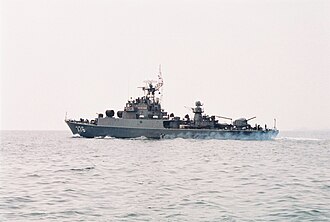
The KRI Sultan Thaha Syaifuddin (376) had an unusually international career. Built in East Germany during the Cold War, she was originally commissioned as Bad Doberan (222) in the Volksmarine before being acquired by Indonesia after German reunification. Renamed after an important figure in the history of Jambi, the ship became one of the Indonesian Navy’s Kapitan Patimura-class corvettes and spent more than three decades operating under the Indonesian flag. Her career illustrates how a warship designed for the tense waters of Cold War Europe could be given a second life in the very different maritime environment of Southeast Asia.
Sultan Thaha Syaifuddin belonged to the Parchim class, a family of relatively small antisubmarine corvettes developed in East Germany during the late 1970s. These ships were not intended to challenge large aircraft carriers or battleships. Instead, they were specialists: fast coastal warships equipped to detect and attack submarines while also possessing enough gunfire and air-defense capability to defend themselves. Indonesia acquired a large group of former East German Parchim-class ships in the 1990s, and Sultan Thaha Syaifuddin became one of them. She remained an operational Indonesian Navy vessel for many years, including missions in the 2020s, before her reported decommissioning in January 2026.
From the Baltic Sea to Southeast Asia
The Birth of Bad Doberan
Sultan Thaha Syaifuddin began life as Bad Doberan, a name taken from a town in the German state of Mecklenburg-Vorpommern. She was constructed by Peene-Werft at Wolgast, one of East Germany’s important naval shipyards, and entered service with the Volksmarine on June 30, 1982. She carried the East German pennant number 222 and was one of a series of Parchim-class vessels built to strengthen East Germany’s ability to conduct coastal antisubmarine warfare.
The Parchim class was a product of the Cold War’s particular geography. The Baltic Sea was a relatively enclosed body of water where NATO and Warsaw Pact naval forces could operate close to one another. Submarines were an important concern, and East Germany needed ships capable of locating and attacking them without the expense of building large ocean-going destroyers. The Parchims were therefore compact, heavily equipped for their size and optimized for operations relatively close to shore. Their main target in a hypothetical conflict would have been NATO submarines, including West German Type 206 boats.
For the sailors who operated these vessels, however, the ship was not simply a collection of weapons. A corvette of this type was a small floating workplace where navigation, engineering, radar, sonar and weapons operations had to function together. The ship’s mission depended upon detecting an underwater target that might never be visible from the surface, determining its position and then selecting the appropriate weapon. This made antisubmarine warfare as much a contest of sensors and crew training as it was of explosives.
The End of the Cold War Changes Everything
Bad Doberan had been in service for only a few years when the political system that created her began to collapse. The Berlin Wall fell in 1989, Germany was reunified in 1990 and the East German Volksmarine ceased to exist. The newly unified German Navy had little need for the entire former East German fleet, particularly because many of its ships were built around Soviet-designed equipment and a strategic doctrine that no longer applied.
Indonesia saw an opportunity in these surplus vessels. In the early 1990s, Indonesia purchased a large group of former East German naval ships, including 16 Parchim-class corvettes, along with other vessels. The acquisition gave Indonesia a relatively large number of warships at a much lower cost than buying an entirely new fleet. The Parchims subsequently became known in Indonesian service as the Kapitan Patimura class.
Bad Doberan was among those ships. She was transferred to Indonesia, renamed KRI Sultan Thaha Syaifuddin, and received the pennant number 376. She was commissioned into the Indonesian Navy on February 25, 1995. The change was more significant than a simple change of flag: a ship designed for Baltic coastal warfare was now expected to operate in the vastly different maritime environment of the Indonesian archipelago.
A Small Warship with a Specialized Role
Understanding the Corvette
The easiest way to understand Sultan Thaha Syaifuddin is to think of her as a specialist rather than a miniature destroyer. At approximately 75.2 meters long, she was considerably smaller than the major destroyers and frigates operated by larger naval powers. Her standard displacement is commonly given as about 865 tonnes, increasing to approximately 935 tonnes fully loaded. She had a beam of about 9.78 meters and a relatively shallow draft.
Those dimensions offered practical advantages. A smaller warship can generally operate closer to coastlines and in areas where a larger vessel may be less convenient. For Indonesia, this was particularly useful. The country consists of thousands of islands and has an enormous area of territorial and surrounding waters. A navy operating in such an environment needs ships of many different sizes rather than relying exclusively on large ocean-going combatants.
Sultan Thaha Syaifuddin’s compact hull also helped keep the crew relatively small. Sources commonly list a complement of approximately 62 personnel, although some later technical references give higher figures depending on configuration and operational requirements. A crew of this size still had to operate the bridge, machinery, sensors, weapons and living facilities around the clock. Every sailor therefore had an important role in keeping the ship operational.
Three Diesel Engines
The corvette was powered by three M-504A diesel engines, each producing approximately 4,750 horsepower. Together they provided roughly 14,250 horsepower and drove three fixed-pitch propellers. This machinery gave the ship a maximum speed of approximately 24.5 knots, or around 45 kilometers per hour. Her commonly cited range was approximately 2,100 nautical miles at 14 knots.
For a naval vessel, speed is about much more than simply traveling quickly. It determines how rapidly a ship can respond to a developing situation, reposition itself during an operation or pursue another vessel. A corvette that can cruise economically but also reach more than 20 knots has considerably more flexibility than a slow patrol vessel.
Diesel propulsion was also appropriate for a relatively small warship. Unlike the large steam plants found aboard many Cold War destroyers, diesel engines do not require enormous boiler rooms and associated systems. They can provide substantial power in a relatively compact package. Over the decades, however, the original machinery of the Parchim ships became an increasingly important maintenance consideration, and members of the Indonesian class underwent significant refurbishment and machinery work during their service.
Weapons Designed Around Antisubmarine Warfare
The 57 mm Main Gun
Sultan Thaha Syaifuddin retained the distinctive twin 57 mm AK-725 gun associated with the Parchim design. Mounted forward, the twin-barrel weapon could fire rapidly against surface targets and provide a measure of defense against aircraft. For a relatively small corvette, a twin 57 mm mount represented a useful balance between firepower and the limited space available aboard the ship.
A weapon such as the AK-725 also illustrates the changing nature of naval warfare. Even as missiles became increasingly important, conventional guns remained useful because they could be employed against a broad variety of targets without requiring expensive guided missiles. A naval gun could fire warning shots, engage a small surface vessel or attack a target on land when appropriate.
Close-In Air Defense
The ship’s original configuration included a twin 30 mm AK-230 automatic cannon and SA-N-5 short-range surface-to-air missile positions. During Indonesian service, however, her weapon fit changed. Sultan Thaha Syaifuddin became notable among the Indonesian Parchims because her original AK-230 was replaced by a Chinese Type 730 close-in weapon system (CIWS). The ship also received 20 mm guns in place of the original SA-N-5 arrangements.
A CIWS is essentially a ship’s last line of defense. Instead of attempting to destroy an incoming aircraft or missile many kilometers away, it is designed to engage a threat at relatively short range using extremely rapid gunfire. The Type 730 is a particularly distinctive system because it uses multiple barrels to produce a very high volume of fire.
The modernization shows how Indonesia adapted the old East German ships to its own logistical and operational requirements. Retaining every original weapon would not necessarily have been sensible if ammunition, spare parts or supporting equipment were difficult to obtain. Replacing selected systems with equipment that better suited Indonesian requirements could extend the useful life of the hull.
The Antisubmarine Mission
RBU-6000 Rocket Launchers
The most important clue to Sultan Thaha Syaifuddin’s original purpose is found in the two RBU-6000 antisubmarine rocket launchers. These distinctive systems are mounted forward and are designed to fire salvos of unguided rockets against submarines beneath the surface.
The basic idea is relatively straightforward. A ship’s sonar detects or tracks an underwater target, the crew estimates its position and the rocket system launches a pattern of projectiles into the water. The objective is to cover an area around the suspected submarine rather than depend on a single projectile hitting a precise point.
For a layman, antisubmarine warfare can be difficult to imagine because the enemy may be completely invisible. A surface ship cannot simply look across the water and see a submarine several dozen meters below it. Instead, sonar, sound, navigation, environmental conditions and crew experience all become important. A submarine can hide beneath the surface, while the pursuing ship must attempt to reconstruct its position from incomplete information.
The Parchim class also originally carried four 400 mm torpedo tubes. Indonesian configurations varied, however, and some members of the class had their original torpedo arrangements replaced or removed as the ships were adapted to Indonesian requirements. The evolution of Sultan Thaha Syaifuddin’s weapons therefore reflects the practical reality that a transferred warship rarely retains exactly the same configuration throughout its entire career.
Serving Indonesia for More Than Three Decades
From Cold War Corvette to General Fleet Work
Although Sultan Thaha Syaifuddin was designed as an antisubmarine ship, her Indonesian career was not limited to hunting submarines. A naval vessel can be assigned to patrol, escort, maritime-security, training and other missions depending on the country’s immediate needs. Her relatively small size and respectable speed made her useful for a variety of operations around Indonesia.
Her long career is particularly remarkable considering that the ship was already a Cold War veteran when she entered Indonesian service. The Indonesian Navy had to keep the vessel useful despite the changing availability of original Soviet and East German equipment. The class subsequently underwent rehabilitation that included improvements such as air-conditioning and engine replacements.
This ability to adapt was one of the main reasons the former East German ships remained useful. Indonesia did not need them to recreate the exact mission for which they had originally been designed. Instead, the navy could modify their equipment and use their basic qualities—speed, seaworthiness, sensors and weapons—for the missions required by an archipelagic state.
Sultan Thaha Syaifuddin in the 2020s
A Veteran Still at Sea
Despite her age, Sultan Thaha Syaifuddin remained an operational Indonesian Navy vessel well into the 2020s. In September 2025, she was one of the Indonesian warships that met the newly delivered KRI Brawijaya (320) in the Sunda Strait during the new ship’s voyage to Indonesia. The encounter provided a striking contrast between generations of Indonesian naval technology: the veteran Parchim-class corvette representing the fleet’s Cold War heritage and the modern Brawijaya representing its newer generation.
In October 2025, Sultan Thaha Syaifuddin also participated in an Indonesian Armed Forces anniversary sailing pass in Jakarta Bay. Later that year, she undertook an important operational deployment during Patkor Indindo-25, a coordinated Indonesia–India maritime patrol in the Andaman Sea. The Indonesian Navy reported that the ship operated alongside Indian Navy vessels and participated in radar, visual, communications and tactical exercises.
The ship also demonstrated that naval vessels can have roles beyond traditional combat. In December 2025, Sultan Thaha Syaifuddin supported Operasi Tameng Ghora-25, transporting humanitarian supplies to Lhokseumawe after natural disasters. The cargo included rice, drinking water, instant noodles, biscuits and medicines. This kind of mission is particularly well suited to a naval vessel because ships can deliver substantial quantities of supplies to coastal communities even when normal transportation networks are disrupted.
The End of an Era
Sultan Thaha Syaifuddin’s final years therefore came after an exceptionally long career. She had originally entered East German service in 1982, moved to Indonesia after the Cold War and continued operating for more than 30 years under her second flag. The available 2026 shipping records report that she was decommissioned on January 26, 2026, alongside other elderly Indonesian vessels. This places the end of her operational career more than four decades after her original commissioning.
Her retirement was part of a broader transition within the Indonesian Navy. Older Cold War-era vessels were increasingly being replaced by newer ships with more modern sensors, propulsion systems, communications and weapons. The fact that Sultan Thaha Syaifuddin could remain useful for so many years nevertheless says a great deal about the durability of the basic Parchim design and the Indonesian Navy’s ability to maintain and adapt aging warships.
The Meaning Behind the Name
Sultan Thaha Syaifuddin of Jambi
The ship’s Indonesian identity is closely connected with Sultan Thaha Syaifuddin, the historical ruler and resistance leader associated with Jambi. He is remembered in Indonesia for his opposition to Dutch colonial authority in the nineteenth century and was declared a National Hero of Indonesia in 1977.
Naming the former East German corvette after Sultan Thaha Syaifuddin gave the vessel a distinctly Indonesian character. The contrast is striking: the steel hull was built in a communist European state, originally carried the name of a German town and was designed to fight NATO submarines in the Baltic. In Indonesia, the same ship carried the name of a Jambi ruler associated with resistance to colonial rule and became part of a completely different national maritime tradition.
This transformation is one of the most interesting aspects of the ship’s history. Warships may be machines, but their names and crews give them a national identity. Sultan Thaha Syaifuddin became Indonesian not because her hull had changed, but because the people who operated her, the missions she performed and the history represented by her name had changed.
Technical Specifications of KRI Sultan Thaha Syaifuddin (376)
| Specification | Details |
|---|---|
| Ship name | KRI Sultan Thaha Syaifuddin |
| Pennant number | 376 |
| Class | Kapitan Patimura class |
| Original class | Parchim class / Project 1331 |
| Original name | Bad Doberan |
| Original pennant | 222 |
| Original operator | East German Volksmarine |
| Builder | Peene-Werft, Wolgast, East Germany |
| German commissioning | June 30, 1982 |
| Indonesian commissioning | February 25, 1995 |
| Reported decommissioning | January 26, 2026 |
| Length | 75.2 m |
| Beam | 9.78 m |
| Draft | Approximately 2.65 m; figures vary by source/configuration |
| Standard displacement | Approximately 865 tonnes |
| Full-load displacement | Approximately 935 tonnes |
| Propulsion | 3 × M-504A diesel engines |
| Power | Approximately 14,250 hp total |
| Propellers | 3 fixed-pitch propellers |
| Maximum speed | Approximately 24.5 knots |
| Range | Approximately 2,100 nautical miles at 14 knots |
| Crew | Approximately 62; some later references give higher complements |
| Main gun | 1 × twin 57 mm AK-725 |
| Close-in weapon system | 1 × 30 mm Type 730 CIWS in later configuration |
| Additional guns | 2 × 20 mm guns in later configuration |
| Antisubmarine weapons | 2 × RBU-6000 launchers |
| Original torpedo armament | 4 × 400 mm torpedo tubes |
| Primary original role | Coastal antisubmarine warfare |
| Later Indonesian roles | Patrol, escort, maritime security, exercises and humanitarian support |
| Home port | Surabaya is commonly listed for the ship |
| Final status | Decommissioned in 2026 |
Published specifications differ slightly between references, particularly regarding draft, crew size and the ship’s exact later weapon configuration. This is partly because the Parchim-class ships underwent modernization and refurbishment after transfer to Indonesia. The table therefore distinguishes between original design characteristics and the later Indonesian configuration where appropriate.
Conclusion
The story of KRI Sultan Thaha Syaifuddin (376) is ultimately a story of adaptation. She began life as Bad Doberan, a small East German corvette designed to hunt submarines in the tense waters of the Cold War Baltic. After German reunification, that original mission disappeared, but the ship itself found a second life thousands of kilometers away. Under the Indonesian flag she became Sultan Thaha Syaifuddin, received modified weapons and machinery and spent decades performing the practical tasks required of an Indonesian naval vessel.
Her career is particularly interesting because it bridges two very different periods of naval history. At one end was the Cold War confrontation between NATO and the Warsaw Pact; at the other was a modern Indonesian Navy increasingly focused on maritime security, multinational cooperation, patrols and humanitarian assistance. In 2025, for example, the veteran corvette could participate in an Indonesia–India coordinated patrol in the Andaman Sea and carry disaster-relief supplies to Lhokseumawe.
The ship’s retirement in January 2026 brought an end to an unusually long naval career, but it also highlights how much value Indonesia extracted from a relatively inexpensive Cold War acquisition. Sultan Thaha Syaifuddin was never the largest or most powerful ship in the fleet. Her importance came from something more practical: she was small, fast, versatile and adaptable, and she could continue performing useful work long after the political world that produced her had disappeared.
In that sense, KRI Sultan Thaha Syaifuddin is more than an old corvette. She is a tangible example of how naval technology can cross borders, how ships can acquire completely new identities and how a vessel designed for one conflict can find an entirely different purpose in another era. From Bad Doberan in East Germany to Sultan Thaha Syaifuddin in Indonesia, her journey reflects the extraordinary afterlife of Cold War warships and the changing needs of the navies that operate them.
