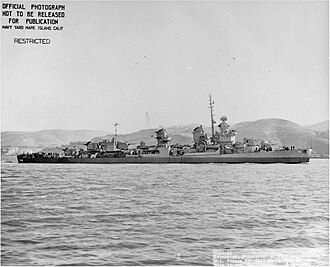
The USS Wadsworth (DD-516) was one of the many destroyers that helped the United States Navy fight its way across the Pacific during the Second World War. At first glance, a destroyer might seem like a relatively small warship compared with the enormous battleships and aircraft carriers that dominate photographs of the era. In practice, however, ships such as Wadsworth were among the Navy’s most versatile and hardest-working combatants. They escorted troopships and aircraft carriers, hunted submarines, bombarded enemy positions, protected vulnerable ships from aircraft, supported amphibious landings and even served as radar picket ships during some of the most dangerous operations of the Pacific War.
Wadsworth was a member of the famous Fletcher class, a group of 175 destroyers designed during the Second World War. These ships became the backbone of the American destroyer force because they combined speed, heavy firepower, useful range and considerable versatility. Wadsworth was laid down at Bath Iron Works in Maine on August 18, 1942, launched on January 10, 1943, and commissioned at Boston Navy Yard on March 16, 1943. She was named for Commodore Alexander Scammel Wadsworth, a U.S. Navy officer whose career included service during the War of 1812.
Building a Fletcher-Class Destroyer
The Fletcher-class design reflected the realities of modern naval warfare. American destroyers had to be fast enough to keep up with carriers and battleships, but they also needed enough endurance to operate for long periods far from American bases. They had to fight surface ships, defend against aircraft and submarines, escort convoys and provide gunfire support for troops coming ashore.
Wadsworth was about 376 feet long and 39 feet 7 inches wide. Her machinery produced roughly 60,000 shaft horsepower, driving two propeller shafts and giving the ship a speed of approximately 37 to 38 knots, depending on the specification used. Her normal complement was about 273 officers and enlisted sailors. The ship’s principal armament consisted of five 5-inch guns, supported by 40 mm and 20 mm antiaircraft weapons, ten 21-inch torpedo tubes and equipment for antisubmarine warfare.
For a modern reader, the most important point is that Wadsworth was not built for just one job. Her 5-inch guns could engage ships and shore targets, her torpedoes gave her a powerful weapon against surface vessels, and her depth charges allowed her to attack submarines beneath the waves. Antiaircraft guns became increasingly important as Japanese aircraft and suicide attacks threatened American ships. This mixture of capabilities made a Fletcher-class destroyer an extremely useful escort and combat ship.
From Maine to the Pacific
After commissioning, Wadsworth began her training in the waters around the United States. She operated in Casco Bay and then went to Guantanamo Bay, Cuba, for shakedown training. After repairs and further preparation at Boston, she began operating with larger fleet units, including aircraft carriers.
In August 1943, Wadsworth reached Pearl Harbor and soon moved into the South Pacific. This was where the destroyer would spend much of her wartime career. The Pacific campaign was a war of enormous distances, and American ships frequently had to travel thousands of miles between bases and combat zones. A destroyer could therefore spend one period escorting a carrier, another searching for submarines and the next supporting an amphibious assault.
Wadsworth Enters Combat
One of Wadsworth’s earliest important combat assignments came in September 1943, when she was sent to search for Japanese submarines in waters south of the Solomon Islands. The destroyer worked with aircraft, using underwater sound contacts to locate possible submarines. On September 1, she attacked a submarine contact with depth charges.
The exact identity and fate of the submarine involved has remained somewhat complicated in historical records, but the episode illustrates the difficult nature of antisubmarine warfare. Destroyers could not simply see a submerged submarine and attack it. Instead, crews had to depend on sonar contacts, aircraft reports, visual observations and careful interpretation of incomplete information. A successful attack could therefore require patience as well as aggressive action.
Wadsworth soon became involved in the fighting around the Solomon Islands. She escorted supply and troop convoys and supported the American advance toward Bougainville. On November 1, 1943, she participated in the initial landings at Cape Torokina in Empress Augusta Bay. Her guns opened fire before dawn, striking Japanese positions and barges along the shoreline. For the soldiers and Marines approaching the beaches, naval gunfire was an essential part of the operation because it could suppress enemy positions before and during the landing.
Fighting Through the Solomon Islands
The Solomon Islands campaign placed enormous demands on American destroyers. The ships had to protect transports, escort supply vessels and remain ready to fight Japanese aircraft and surface forces. Wadsworth repeatedly moved between bases and forward operating areas, helping maintain the flow of men, ammunition, fuel and food that made the American advance possible.
In February 1944, she supported operations around Green Island and then conducted a bombardment mission near Rabaul and Kavieng. Her 5-inch guns attacked Japanese supply facilities, troop concentrations and other targets. Later, she continued escorting convoys and supporting operations connected with the capture of Emirau Island.
These missions reveal why destroyers were so important to the Pacific war. The destruction of an enemy battleship might make headlines, but amphibious warfare depended on thousands of less glamorous tasks. Ships such as Wadsworth carried out the escort and bombardment missions that allowed larger formations to move safely and allowed troops on isolated islands to receive regular supplies.
The Marianas and the Battle of the Philippine Sea
By the middle of 1944, American forces were pushing toward the Mariana Islands. Wadsworth joined the force preparing for operations against Saipan, Tinian and Guam. On June 14, she supported the bombardment of Tinian and subsequently operated around Guam.
The campaign coincided with one of the most important naval battles of the war: the Battle of the Philippine Sea. Wadsworth joined Vice Admiral Marc Mitscher’s fast carrier force and took part in the fleet’s defense against Japanese carrier aircraft. The battle was disastrous for Japanese naval aviation. American fighter pilots and antiaircraft defenses inflicted such severe losses that Japan’s carrier air power was greatly weakened. The engagement became popularly known as the “Great Marianas Turkey Shoot.”
Wadsworth then returned to the dangerous work of supporting the invasion of Guam. Her guns fired against Japanese positions, and she later served in a fighter-director role. This meant that she was not simply shooting at aircraft herself; she could also help direct friendly fighters toward approaching enemy aircraft.
Okinawa: Wadsworth’s Most Dangerous Assignment
Wadsworth’s most demanding period came during the Battle of Okinawa in 1945. She arrived off the island on April 1, the day the invasion began. Initially, she provided fire support for troops ashore, using her 5-inch guns against Japanese positions, troop concentrations and defensive installations.
The situation changed dramatically when Wadsworth began radar picket duty. Radar picket ships were positioned ahead of the main fleet to detect approaching Japanese aircraft and provide early warning. This was extremely dangerous work because the picket stations were exposed to enemy attack and were among the targets selected by Japanese pilots.
Between April 17 and June 24, Wadsworth completed nine radar-picket assignments. According to the Naval History and Heritage Command account, she fought off 22 enemy aircraft attacks, shot down six aircraft herself and helped destroy seven others. Fighters directed by her also accounted for 28 enemy aircraft. During one particularly intense engagement on April 28, the destroyer endured six attacks by 12 Japanese aircraft over more than three hours.
Surviving Kamikaze Attacks
The danger of Okinawa’s radar-picket duty is perhaps best illustrated by Wadsworth’s encounters with Japanese suicide aircraft. On April 22, her gunners destroyed a Japanese aircraft that exploded only about 20 feet from the ship. Six days later, another attacker made repeated approaches. The Japanese aircraft eventually struck the ship’s forward port 40 mm gun and smashed into equipment before falling into the sea.
The ship escaped with relatively minor damage, but these incidents demonstrate how narrow the margin between survival and destruction could be. A Fletcher-class destroyer was fast and heavily armed for its size, but it was still a relatively small ship facing aircraft deliberately attempting to crash into it.
By the time Wadsworth was relieved from radar-picket duty on June 24, she had gone to general quarters 203 times and had detected and reported hundreds of approaching enemy aircraft. Her performance earned the ship the Presidential Unit Citation, one of the U.S. military’s highest unit awards.
The End of the War and Occupation Duty
After Okinawa, Wadsworth continued operating in the western Pacific. She took part in antishipping sweeps in the East China Sea and remained in the region after Japan surrendered in August 1945.
Her postwar duties were very different from the combat missions of the previous two years. In September, Wadsworth went to Nagasaki, where she helped evacuate Allied prisoners of war. She took 125 liberated prisoners aboard, including Americans, British, Dutch and Australians, and transported them to Okinawa. She subsequently performed occupation and transportation duties between Japanese ports.
Wadsworth finally returned to the United States late in 1945. She was decommissioned on April 18, 1946, and placed in reserve at Charleston, South Carolina. For many World War II destroyers, this might have been the end of the story. Wadsworth, however, would eventually receive a second career.
A New Life in West Germany
During the Cold War, the United States transferred a number of older warships to friendly nations. In 1959, Wadsworth was selected for transfer to West Germany. On October 6, 1959, she was handed over and entered German service as Z-3, later commonly identified as Zerstörer 3 (D 172). She continued serving with the West German Navy for more than two decades after her American career had ended.
This second career is an important part of Wadsworth’s story because it shows the longevity of the Fletcher-class design. A ship built rapidly during the Second World War could still be useful during the very different strategic environment of the Cold War. Wadsworth was ultimately removed from the U.S. Navy list in 1974 and sold to West Germany. In 1980 she was transferred to Greece, where she was renamed Nearchos. She was eventually stricken in 1991.
Why USS Wadsworth Matters
USS Wadsworth was not the largest or most famous warship of the Second World War, but her career represents what destroyers actually did in a global naval war. She escorted carriers, protected transports, searched for submarines, bombarded enemy positions, supported amphibious assaults, directed fighter aircraft and stood exposed on radar picket stations while Japanese aircraft attacked.
Her seven battle stars and Presidential Unit Citation reflect the scale and intensity of her wartime service. More importantly, Wadsworth demonstrates why the Fletcher class became one of the most respected destroyer designs of the war. Fast, heavily armed and versatile, these ships could perform almost any task a fleet commander required.
Wadsworth’s story also continued long after the guns fell silent in 1945. Her transfer to West Germany and later service with Greece extended her operational life for decades. In that sense, USS Wadsworth was both a World War II veteran and a Cold War warship—a useful reminder that naval technology designed for one conflict can sometimes remain valuable long after the circumstances that created it have disappeared.
USS Wadsworth (DD-516) Technical Specifications
| Specification | Details |
|---|---|
| Ship type | Fletcher-class destroyer |
| Hull number | DD-516 |
| Builder | Bath Iron Works, Bath, Maine |
| Keel laid | August 18, 1942 |
| Launched | January 10, 1943 |
| Commissioned | March 16, 1943 |
| Decommissioned by U.S. Navy | April 18, 1946 |
| Length | 376 ft 6 in (approximately 114.8 m) |
| Beam | 39 ft 7 in (approximately 12.1 m) |
| Mean draft | 13 ft (approximately 4.0 m) |
| Displacement | About 2,050 tons, as listed by NHHC; figures for full-load displacement vary by source and configuration |
| Propulsion | Geared steam turbines, two shafts |
| Power | Approximately 60,000 shaft horsepower |
| Maximum speed | Approximately 37–38 knots (about 69–70 km/h) |
| Crew | Approximately 273 officers and enlisted personnel |
| Main guns | 5 × 5-inch guns |
| Antiaircraft armament | 40 mm and 20 mm guns; configuration changed during the war |
| Torpedoes | 10 × 21-inch torpedo tubes |
| Antisubmarine weapons | Depth-charge projectors and depth-charge tracks |
| World War II awards | 7 battle stars; Presidential Unit Citation |
| Later service | West German Navy as Z-3/Zerstörer 3; Greek Navy as Nearchos |
| Final disposition | Greek service ended in 1991 |
Technical figures can differ slightly between historical references because wartime configurations changed and sources may use different displacement measurements. The U.S. Navy’s Naval History and Heritage Command gives Wadsworth’s principal dimensions, speed, complement and armament in its official ship history, while NavSource provides additional as-built and full-load figures.
_off_the_Mare_Island_Naval_Shipyard,_California_(USA),_on_5_December_1944.jpg)