Ducati 450 Scrambler: The Legendary Italian Single That Bridged Two Motorcycle Worlds
The Ducati 450 Scrambler is one of the most distinctive motorcycles ever produced during Ducati’s classic single-cylinder era. Introduced in 1969, it represented the largest and most powerful version of Ducati’s original Scrambler family and brought together two motorcycle cultures that had traditionally developed in very different directions. On one side was the European tradition of lightweight, technically sophisticated road motorcycles; on the other was the American enthusiasm for dirt-track riding, freedom and motorcycles capable of leaving the pavement behind. Ducati’s own heritage archive describes the Scrambler as a meeting point between the American and European schools of motorcycling, while the 450 version became particularly popular in Italy as the motorcycle culture of the late 1960s and early 1970s embraced American-inspired ideas of freedom and outdoor recreation.
The 450 was also a significant technical development for Ducati. The Scrambler family had begun in 1962 at the request of American importer Joe Berliner, who wanted a Ducati capable of serving the emerging dirt-track and recreational market. By 1968, Ducati had introduced its new wide-case engine architecture in the 250 and 350 versions, and in 1969 the same basic concept was extended to the 450. The resulting motorcycle combined a 436 cc air-cooled single-cylinder engine with bevel-drive overhead-camshaft technology, a five-speed gearbox, a tubular steel chassis and large spoked wheels. It was not designed to be the fastest motorcycle of its generation, but its balanced riding position, relatively light weight and versatile engine gave it a character that has kept the model highly desirable among classic Ducati enthusiasts.
The Origins of the Ducati 450 Scrambler
From American Dirt Tracks to Italian Roads
The history of the 450 Scrambler begins with an idea that came from across the Atlantic. During the early 1960s, American motorcyclists were developing a taste for machines that could perform beyond the boundaries of normal road riding. Dirt-track racing and recreational off-road riding were becoming increasingly influential, particularly in California and other parts of the United States. Riders wanted motorcycles that could be ridden to the countryside, used on unpaved roads and enjoyed in a variety of environments without the expense or specialization of a dedicated competition machine.
Ducati’s American importer, Joe Berliner, recognized the opportunity and asked the factory to create a motorcycle suitable for this market. The first Scrambler appeared in 1962, using Ducati’s existing single-cylinder technology but adapting the chassis and riding position for a more versatile purpose. The recipe was straightforward but effective: an upright handlebar, large wheels, suitable tires, increased ground clearance and a lightweight engine were combined into a machine that could comfortably move between pavement and dirt. Ducati’s historical material identifies the model as primarily designed for the American market before it gradually became popular in Europe.
The arrival of the 450 took the concept to its logical conclusion. With more displacement and stronger performance than the smaller Scramblers, it offered enough power for longer road journeys while retaining the practical characteristics that made the range attractive away from the pavement. The 450 was therefore not a stripped-down road racer and not a true motocross machine. Instead, it occupied the increasingly popular middle ground between the two.
The 450 Arrives With the Wide-Case Engine
A Major Step in Ducati Single-Cylinder Development
The introduction of the 450 Scrambler in 1969 coincided with one of the most important developments in Ducati’s single-cylinder history: the adoption of the wide-case engine. Ducati had introduced the new architecture first in the 250 and 350 Scramblers in 1968 and then extended it to the 450 a year later.
The new engine displaced approximately 436 cc, making the 450 one of the largest and most substantial single-cylinder Ducati road motorcycles of the period. The commonly cited bore and stroke are approximately 85 x 75 mm, while compression was around 9.3:1. Published specifications vary slightly depending on production year and source, but Ducati itself lists the 450 at 436 cc, 27 horsepower and a maximum speed of approximately 130 km/h.
The engine was air-cooled and used Ducati’s characteristic overhead-camshaft arrangement driven through bevel gears. This bevel-drive system was one of the defining engineering features of classic Ducati singles and gave the engine a mechanical appearance unlike that of most competing motorcycles. The tall bevel tower rising beside the cylinder became almost a visual signature of Ducati’s engineering philosophy.
Although the engine was relatively simple compared with modern power units, it was not crude. Ducati’s single-cylinder engines featured sophisticated construction, with an alloy cylinder head and barrel arrangement, roller and ball bearings and specialized valve-spring technology. The result was a motorcycle engine that could deliver respectable performance while retaining the mechanical simplicity necessary for an adaptable all-purpose motorcycle.
The Character of a Large Single
The 450 Scrambler’s engine is important not simply because of its specifications but because of the way it delivers its performance. A large single-cylinder engine produces a very different riding experience from a multi-cylinder motorcycle. Rather than building power through a high-revving rush, the 450 relies on the distinctive pulse and torque of one large piston.
That characteristic suited the Scrambler concept extremely well. The motorcycle did not need to be pushed to extreme speeds to be enjoyable. Instead, the rider could make use of the engine’s flexible nature on winding roads, gravel tracks and urban streets. Ducati’s own description emphasizes the engine’s versatility and the motorcycle’s ease of riding rather than outright performance.
The approximately 27 horsepower available from the 436 cc engine might seem modest today, but it was enough to make the 450 a genuinely useful middleweight motorcycle in its era. Ducati quotes a maximum speed of around 130 km/h and a dry weight of approximately 145 kg, figures that helped give the motorcycle a favorable balance between performance and manageability.
Ducati 450 Scrambler Styling
A Design That Still Looks Right Today
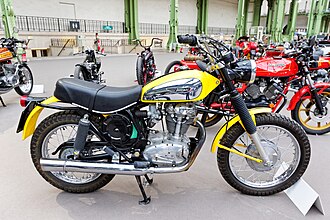
The visual appeal of the Ducati 450 Scrambler is one of the strongest reasons for its enduring popularity. It has the proportions enthusiasts now associate with the classic scrambler formula: a slim motorcycle, exposed engine, high handlebars, relatively narrow fuel tank, spoked wheels and a raised exhaust system.
But there is something more distinctive about the Ducati. The combination of a black chassis, polished and chrome components, rounded bodywork and bright paintwork gave the motorcycle a sophisticated Italian character. Ducati specifically highlights the colorful schemes used on the Scrambler, including yellow and orange combinations on early series and green and blue themes on later versions.
These colors were unusual for Ducati at the time. Traditional Ducati motorcycles tended to have a more restrained sporting appearance, whereas the Scrambler was intentionally expressive. Its colors and styling were designed to appeal to younger riders and to communicate a sense of freedom rather than competition.
That visual philosophy helped transform the motorcycle from a functional machine into a cultural object. The 450 Scrambler could be recognized instantly, even by people who knew little about motorcycles.
The Chassis: Designed for Versatility
Tubular Steel Construction
The 450 Scrambler used a tubular steel single-cradle frame, providing a strong but comparatively lightweight foundation for the large single-cylinder engine. The chassis was one of the reasons Ducati’s Scrambler developed such a strong reputation for versatility.
Ducati notes that the Scrambler’s frame was sufficiently capable that it was even used for racing, an unusual achievement for a motorcycle originally conceived as a versatile road-and-dirt machine. This strength gave the 450 a useful combination of stability and durability without forcing the motorcycle into the specialized configuration of a competition bike.
The suspension consisted of telescopic forks at the front and a swingarm with twin shocks at the rear. These were conventional components for the period but well suited to the motorcycle’s intended role. The rider could tackle imperfect roads and unpaved surfaces without the chassis becoming excessively complicated or heavy.
Large Wheels and an Upright Riding Position
The classic 450 Scrambler used large spoked wheels, commonly specified as a 19-inch front and 18-inch rear. Period specifications commonly list approximately 3.50 x 19 front and 4.00 x 18 rear tires. (Wikipedie)
The large front wheel was particularly valuable on rough terrain because it could roll over potholes, stones and other obstacles more easily than the smaller wheels common on purely road-oriented motorcycles. It also contributed to the motorcycle’s unmistakable appearance.
Equally important was the riding position. The handlebars were relatively high and wide, giving the rider plenty of leverage when steering over loose surfaces. The seating position placed the rider centrally on the motorcycle rather than forcing an aggressive forward lean. Ducati specifically identifies the centered riding position as one of the characteristics that made the Scrambler particularly enjoyable to ride.
The 450 Scrambler’s Brakes and Transmission
Five-Speed Gearbox
The 450 used a five-speed transmission with a wet multi-plate clutch and chain final drive.
For a motorcycle of this size and performance level, five ratios provided a useful spread. Lower gears allowed the rider to control the motorcycle on slower tracks and rough roads, while the upper ratios made it possible to cruise comfortably on paved roads. The gearbox also complemented the single-cylinder engine’s relatively broad usable range.
The transmission is an important part of what makes the 450 feel like a proper motorcycle rather than a basic trail machine. It allows the rider to interact closely with the engine and exploit the available torque rather than simply selecting a gear and leaving the rest to the motorcycle.
Traditional Drum Brakes
Braking was provided by drum brakes, as was typical for the period. Later examples received updates, and sources indicate that the 1973 version gained a double-sided front brake along with electronic ignition and lighting and instruments associated with the Mark 3 roadsters.
This illustrates how the 450 evolved during its production life. It should therefore not be assumed that every example has precisely the same braking and electrical specification. A collector researching an individual motorcycle should pay close attention to its production year and original equipment.
By modern standards, the brakes are obviously modest. However, they were appropriate to a relatively lightweight motorcycle producing approximately 27 horsepower. More importantly, they form part of the authentic riding experience of a classic Ducati single.
The Ducati 450 Scrambler and Italian Youth Culture
More Than an Off-Road Motorcycle
The 450 Scrambler became particularly significant in Italy because it arrived at a time when American culture was strongly influencing a new generation of Italian riders. Ducati describes the motorcycle as an expression of the influence of America, California, surfing, outdoor living and the broader West Coast lifestyle on Italian youth in the late 1960s and early 1970s.
This cultural connection helps explain why the 450 became more than a practical motorcycle. It represented an attitude. The rider did not necessarily need to be a serious off-road competitor; the motorcycle communicated independence and a desire to explore.
Its bright colors, relaxed riding position and unconventional styling were perfectly suited to this new image. Instead of emphasizing speed or racing pedigree, Ducati marketed an experience based around freedom and versatility.
The 450 was therefore an early example of a motorcycle becoming a lifestyle product. This concept would eventually become central to Ducati’s modern Scrambler brand.
The Desmodromic Connection
Not Every 450 Scrambler Was the Same
An interesting detail in the history of the original Scrambler family is that some versions featured Desmodromic cylinder heads, while others used conventional valve springs. Ducati’s heritage archive specifically notes that the Scrambler series included models with Desmodromic heads and continued to receive technical updates until production ended in 1974.
This is an important point for enthusiasts because “Ducati 450 Scrambler” does not necessarily describe one completely uniform specification. Differences in engine configuration, ignition, carburetion and other components appeared throughout the production run.
The 450 is nevertheless strongly associated with Ducati’s bevel-drive single-cylinder architecture. Whether fitted with conventional or Desmodromic valve control, these engines represent a fascinating period in Ducati engineering, when the company was developing highly specialized technology for relatively small-capacity motorcycles.
Production and the End of the Classic Single
1969 to 1974
The Ducati 450 Scrambler was produced from approximately 1969 through 1974, with total production commonly estimated at around 11,000 motorcycles. The model was also produced under license in Spain by MotoTrans.
Ducati eventually ended production of its overhead-camshaft single-cylinder motorcycles in 1974. Remaining motorcycles were subsequently sold from existing stocks, and some examples were marketed after the factory’s production ended.
The end of the 450 Scrambler was therefore part of a much larger transition within Ducati. The company’s future would increasingly revolve around twin-cylinder engines, particularly the designs that would eventually establish Ducati as a major force in the international superbike market.
The 450 thus represents the end of an important chapter. It was among the final expressions of Ducati’s classic single-cylinder engineering tradition before the company moved decisively toward the twin-cylinder motorcycles for which it would become famous.
The Ducati 450 Scrambler as a Collector’s Motorcycle
Why the 450 Remains Desirable
Today, the 450 Scrambler is valued for its combination of historical importance, distinctive styling and mechanical character. It is rare enough to attract collectors but recognizable enough to appeal to enthusiasts who simply appreciate classic Italian motorcycles.
Originality is particularly important. Because the Scrambler family was frequently customized during its lifetime, finding an example retaining its correct tank, colors, exhaust, wheels, carburetor, instruments and other period components can be challenging.
The mechanical condition of a surviving motorcycle is equally significant. A prospective owner should pay close attention to the condition of the bevel-drive system, valve train, engine bearings, carburetor, ignition system, gearbox, drum brakes and suspension. These are motorcycles that can be immensely rewarding when properly maintained, but a neglected example can require considerable specialist attention.
The best examples preserve the characteristics that made the original motorcycle special: its simple silhouette, colorful bodywork, exposed single-cylinder engine and unmistakable Italian personality.
What Is the Ducati 450 Scrambler Like to Ride?
The Appeal of Mechanical Simplicity
The experience of riding a 450 Scrambler is fundamentally different from riding a modern Ducati. There is no electronic riding mode, traction control system or sophisticated digital dashboard. The rider is much more directly connected to the motorcycle.
Starting the engine is an event in itself. The large single-cylinder engine responds with a deep, rhythmic mechanical pulse, and the exposed valve train and bevel-drive components provide a reminder that the motorcycle was designed during an era when mechanical engineering was visible rather than hidden behind layers of electronics.
On the road, the 450’s modest power output encourages a relaxed but involved riding style. The rider can work the five-speed gearbox, use the engine’s torque and enjoy the lightweight chassis without approaching modern motorcycle speeds.
This is where the Scrambler concept remains so effective. It does not need enormous performance to provide entertainment. Its appeal lies in the sensation of traveling, the sound of the engine and the freedom provided by a motorcycle capable of handling different types of roads.
The 450 Scrambler’s Legacy
The Original Foundation of Today’s Scrambler
Ducati eventually revived the Scrambler name in the modern era. The new generation was presented in 2014 and entered production in 2015, deliberately recalling the philosophy and styling of the original motorcycles from the 1960s and 1970s. Ducati describes the modern Scrambler as retaining the original concept while combining it with contemporary technology.
The modern machines are dramatically different mechanically, but the philosophical connection is clear. Both generations emphasize easy riding, individuality, distinctive styling and a sense of freedom rather than pure racing performance.
The original 450 is therefore not simply a forgotten predecessor. It is one of the motorcycles that helped establish the identity that Ducati would eventually turn into a separate global brand.
The modern Scrambler’s success demonstrates how durable the original idea was. More than forty years after the last classic 450 disappeared from production, Ducati was able to return to essentially the same concept and introduce it to an entirely new generation.
Ducati 450 Scrambler Technical Specifications
The following table summarizes commonly published specifications for the Ducati 450 Scrambler. Exact figures can vary according to production year, market and equipment, so collectors should verify the specification of an individual motorcycle rather than treating every 450 as mechanically identical. Ducati’s official heritage archive lists 436 cc, 27 hp at 6,500 rpm, a 130 km/h maximum speed and a 145 kg dry weight for the historical model.
| Specification | Ducati 450 Scrambler |
|---|---|
| Production | 1969–1974 |
| Class | On/off-road scrambler |
| Engine | Air-cooled 4-stroke single-cylinder |
| Valve arrangement | SOHC, depending on version conventional or Desmodromic |
| Camshaft drive | Bevel gear |
| Displacement | 436 cc |
| Bore × stroke | Approx. 85 × 75 mm |
| Compression ratio | Approx. 9.3:1 |
| Maximum power | 27 hp |
| Peak power | Approx. 6,500–7,000 rpm, depending on source/version |
| Maximum speed | Approx. 130 km/h |
| Fuel system | Dell’Orto carburetor, specification varies by year |
| Ignition | Points/coil; later electronic ignition |
| Starting system | Kick starter |
| Clutch | Wet multi-plate |
| Transmission | 5-speed manual |
| Final drive | Chain |
| Frame | Tubular steel single cradle |
| Front suspension | Telescopic fork |
| Rear suspension | Swingarm with twin shocks |
| Front brake | Drum; later versions received upgraded front braking |
| Rear brake | Drum |
| Front wheel | 19-inch |
| Rear wheel | 18-inch |
| Front tire | Approx. 3.50 × 19 |
| Rear tire | Approx. 4.00 × 18 |
| Wheelbase | Approx. 1,380 mm |
| Length | Approx. 2,120 mm |
| Width | Approx. 940 mm |
| Height | Approx. 1,150 mm |
| Seat height | Approx. 770 mm |
| Dry weight | Approx. 145 kg |
| Fuel capacity | Approximately 11–12 litres |
Final Thoughts
The Ducati 450 Scrambler deserves its place among the most interesting motorcycles in Ducati’s history because it succeeded at something surprisingly difficult: combining two very different motorcycle traditions into a single coherent machine. It took the technical sophistication of the Italian single-cylinder motorcycle and blended it with the practical, relaxed and adventurous spirit of the American scrambler.
Introduced in 1969 with Ducati’s new wide-case architecture, the 450 represented the largest development of the classic Scrambler family. Its 436 cc bevel-drive single produced approximately 27 horsepower, while the relatively light chassis, large spoked wheels and upright riding position made the motorcycle useful on both paved roads and rougher surfaces. Ducati itself emphasizes that the model was not the fastest motorcycle of its era; its appeal came from the combination of performance, balance, ease of riding and distinctive design.
Its cultural impact may ultimately be even more important than its engineering. The 450 arrived during a period when American influences were reshaping Italian youth culture. California, outdoor recreation, music and the idea of personal freedom all contributed to the motorcycle’s image. Ducati’s bright colors and unconventional styling helped transform the Scrambler from a practical motorcycle into a symbol of a generation.
The model’s relatively short production life also gives it a special place in Ducati history. When the factory ended production of its overhead-camshaft singles in 1974, an important chapter in Ducati engineering came to a close. The company would soon become increasingly associated with its twin-cylinder motorcycles, leaving machines such as the 450 Scrambler as representatives of a very different era.
Yet the story did not really end. Ducati eventually revived the Scrambler name in the twenty-first century, deliberately drawing inspiration from the motorcycles that had established the concept decades earlier. The modern Scrambler is vastly more powerful, sophisticated and technologically advanced, but the fundamental idea remains recognizable: a motorcycle designed to be approachable, versatile, stylish and fun. (Ducati)
That is ultimately why the Ducati 450 Scrambler remains so appealing. It does not need modern performance figures to be exciting. Its attraction comes from the sound of a large Italian single, the distinctive bevel-drive engine, the feel of a lightweight chassis and the unmistakable appearance of a motorcycle created during one of the most interesting periods in Ducati’s history. The 450 Scrambler is not merely an old motorcycle; it is a snapshot of the moment when European engineering, American motorcycle culture and the idea of personal freedom came together—and created a Ducati that continues to inspire enthusiasts more than half a century later.
