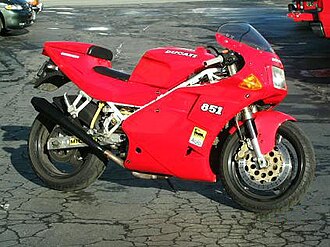
Ducati 851: The Motorcycle That Launched Ducati’s Modern Superbike Dynasty
The Ducati 851 occupies a special place in motorcycle history because it was far more than another Italian sport bike. It was the machine that carried Ducati into the modern superbike era and introduced an engine architecture that would dominate the company’s sporting motorcycles for more than a decade. Developed during a period when Ducati was undergoing major technical and financial changes, the 851 replaced the increasingly outdated two-valve air-cooled performance motorcycles with something radically more advanced: a liquid-cooled 90-degree L-twin, four valves per cylinder, desmodromic valve control, and electronic fuel injection. The combination became known as Desmoquattro, and it transformed Ducati’s prospects both on the road and on the racetrack. The production 851 appeared in 1987, while the racing version made its World Superbike debut at Donington Park in 1988. Just two years later, Raymond Roche won Ducati’s first World Superbike riders’ championship on an 851.
The importance of the 851 is difficult to overstate. Its basic 851 cc engine eventually grew to 888 cc, its racing development produced increasingly sophisticated SP and racing versions, and its technical DNA flowed directly into the 888 and eventually the legendary 916. Ducati’s modern superbike identity was effectively born with this motorcycle. The 851 combined traditional Ducati characteristics—a 90-degree L-twin, desmodromic valve operation, and a tubular steel trellis frame—with technologies that were then at the forefront of motorcycle engineering. It was a motorcycle designed not simply to keep Ducati competitive, but to make the company a serious force in international superbike racing.
The Origins of the Ducati 851
Ducati Needed a New Generation of Performance
By the middle of the 1980s, Ducati’s sporting motorcycles were increasingly dependent on the company’s air-cooled, two-valve V-twin architecture. Models such as the 750 F1 had impressive character and racing credibility, but the competition was changing rapidly. Japanese manufacturers were producing sophisticated liquid-cooled four-cylinder motorcycles with increasingly impressive power, while European manufacturers were also exploring advanced four-stroke technology.
Ducati needed something new. The company had been acquired by Cagiva in 1985, bringing new investment and engineering resources at a critical moment. Massimo Bordi, whose earlier academic work had examined a four-valve Ducati twin, was able to develop that concept into a production-oriented engine with Gianluigi Mengoli. The earliest prototype used a 748 cc configuration and electronic fuel injection, but the displacement was eventually increased to 851 cc for the road-going motorcycle. Ducati’s own heritage archive identifies the resulting engine as the first Ducati twin-cylinder four-stroke to combine desmodromic valve actuation, liquid cooling, four valves per cylinder, and electronic fuel injection.
This was an enormous technological step for Ducati. The company was not simply adding another cylinder or increasing displacement. It was developing an entirely new approach to the performance V-twin, one capable of operating at higher engine speeds while maintaining the mechanical character that made Ducati distinctive.
The Desmoquattro Revolution
The name Desmoquattro described the combination of two important Ducati technologies: desmodromic valve control and four valves per cylinder. Conventional valve springs were replaced by a mechanical system that positively controlled both the opening and closing of each valve. Combined with four valves per cylinder, this allowed Ducati to pursue high engine speeds and improved breathing while retaining precise valve control.
The liquid-cooling system represented another major departure from Ducati’s traditional air-cooled twins. Better control of cylinder-head temperatures allowed the engineers to operate the engine more aggressively and provided greater consistency under racing conditions.
Electronic fuel injection was equally significant. Instead of relying on carburetors, the 851 used electronically controlled fuel delivery. Ducati’s early development work used a Weber-Marelli electronic injection system, and the technology became an essential component of the motorcycle’s modern character. The 851 was therefore a genuine technological bridge between Ducati’s classic bevel-drive and Pantah-derived era and the sophisticated fuel-injected superbikes that followed.
The Ducati 851 Engine
A New 851 cc L-Twin
The production 851 engine displaced 851 cc from a 92 mm bore and 64 mm stroke. It was a 90-degree liquid-cooled L-twin with four valves per cylinder and DOHC desmodromic valve actuation. Later road specifications commonly quote around 93 horsepower for the 1991–92 Strada, while earlier versions produced more according to period specification and market. This variation is one reason it is important to identify the exact year and version when discussing 851 performance.
Regardless of the exact published output, the engine’s character was unmistakable. It produced the muscular pulse associated with a Ducati twin while breathing and revving more like a modern superbike engine. The 851 was not simply a large-capacity cruiser-style twin producing effortless low-rpm torque. It was designed to accelerate hard and continue building power as the engine speed climbed.
The 90-degree cylinder arrangement also provided excellent primary balance. Ducati’s engineers could exploit the smoothness of the configuration while keeping the motorcycle relatively narrow. The front cylinder projected almost horizontally from the crankcases, creating the characteristic L shape that became one of Ducati’s most recognizable visual signatures.
Fuel Injection and High-Performance Breathing
The electronic fuel-injection system was one of the most important innovations of the 851. Early Desmoquattro development used electronic injection and two large throttle bodies, with later racing versions receiving increasingly sophisticated systems. The technology helped Ducati deliver predictable fueling and provided engineers with much greater control over the engine than traditional carburetors allowed.
For a motorcycle manufacturer trying to establish itself in a new era of superbike racing, this was crucial. The ability to refine fueling, ignition, intake, and exhaust characteristics became an important part of the continuous development process. Ducati could evolve the engine from one season to the next rather than treating the road motorcycle as a largely fixed mechanical package.
That philosophy became a defining characteristic of the 851 family. The motorcycle was continually improved, and each iteration became a stepping stone toward the 888 and eventually the 916. Ducati itself notes that the Desmoquattro engine was continuously updated for roughly fifteen years and remained highly competitive throughout that period.
The Chassis and Ducati’s Trellis Philosophy
A Steel Frame With Racing Intent
The 851 retained Ducati’s tubular steel trellis frame, connecting the steering head and rear structure around the engine. This was an important link with the company’s earlier motorcycles. Ducati did not abandon its traditional frame philosophy simply because the engine had become dramatically more sophisticated.
The trellis construction provided a rigid and relatively lightweight structure while also leaving much of the engine exposed. That combination of engineering function and visual drama became one of the defining characteristics of Ducati motorcycles.
The chassis was developed alongside the engine rather than treated as a secondary component. As power increased and racing requirements became more demanding, Ducati continually revised suspension, wheels, brakes, geometry, and frame details. The result was a motorcycle whose development was almost as important as its initial specification.
From 16-Inch Wheels to 17-Inch Wheels
One of the most interesting details in the 851’s development was the evolution of its wheels. Early motorcycles used 16-inch wheels, but the handling characteristics were not universally appreciated. Ducati subsequently moved to 17-inch wheels, which provided more predictable handling and greater compatibility with modern high-performance tires.
This change illustrates the experimental nature of the early 851. Ducati had created an extremely advanced engine, but the complete motorcycle still required development. The company was learning how to exploit the engine’s performance through the chassis, and the lessons learned would influence the later versions and the 888.
Later 851 versions used a 120/70-17 front tire and 180/55-17 rear tire, dimensions that became familiar across the superbike industry.
Suspension and Brakes
The early 851 employed Marzocchi suspension, with later models receiving increasingly sophisticated components. Some high-performance versions used Öhlins suspension, including the 851 SP2. The development of fully adjustable suspension was particularly important for motorcycles intended to compete in racing because it allowed teams and riders to adapt the chassis to different circuits, tires, and riding styles.
Braking hardware was equally serious. Later road versions used twin 320 mm front discs with four-piston calipers and a 245 mm rear disc. The large front discs provided the stopping power necessary for a motorcycle that could approach superbike speeds, while the chassis and suspension were designed to keep the motorcycle stable under hard braking.
These components helped establish a formula that would become standard for Ducati’s later superbikes: powerful twin front brakes, fully adjustable suspension, lightweight wheels, a rigid trellis chassis, and a high-performance V-twin.
The Ducati 851 Tricolore
The Beginning of a New Era
The early road-going 851 is particularly significant in Ducati history because of its distinctive Tricolore presentation. The Italian-flag-inspired livery reflected the motorcycle’s status as a new national sporting symbol, while the technical specification made it clear that Ducati intended to compete at the highest level.
Ducati’s heritage archive describes the 851 Tricolore as the first representative of a new generation of high-performance Ducati road motorcycles. The company lists the model with an 851 cc engine and approximately 102 horsepower at 9,000 rpm, although published figures differ between versions and markets.
The motorcycle was packed with details intended to support competition use. Ducati even employed a quick-release fuel-tank system on the racing-oriented machines to allow mechanics rapid access to components beneath the tank during pit stops. That feature tells us something important about the 851: racing was not an afterthought. Competition requirements were central to the motorcycle’s development from the beginning.
The 851 SP Family
Turning the Road Bike Into a Homologation Special
Ducati developed a series of SP models to meet racing homologation requirements. These motorcycles became increasingly specialized as the competition program developed. The SP versions could receive larger-displacement engines, improved internal components, close-ratio gearboxes, upgraded suspension, and lighter or more competition-oriented equipment.
The 851 SP2, for example, used an 888 cc engine despite retaining the 851 designation. It featured Pankl connecting rods, a 300-watt alternator, a close-ratio gearbox, Öhlins suspension, and upgraded braking components. Contemporary specifications place its output around 116 horsepower and torque around 81 Nm.
The SP series demonstrates how Ducati used production motorcycles as the foundation for racing development. Instead of creating a completely separate competition motorcycle, the company built increasingly specialized road-legal versions that could satisfy homologation requirements and provide customers with direct access to race-derived engineering.
This approach eventually produced the 888 and became one of the defining characteristics of Ducati’s superbike strategy.
The 851 and World Superbike
The Donington Debut
The 851’s racing importance became apparent almost immediately. On April 3, 1988, the motorcycle made its debut at the opening round of the new World Superbike Championship at Donington Park. Ducati’s official history records that the four-valve, water-cooled twin-cylinder racer made an immediate impact.
Marco Lucchinelli played an important role in the motorcycle’s development and competition career. Ducati credits him with helping develop the Superbike version and records his victory in the inaugural World Superbike event at Donington as one of the defining moments in the 851’s history.
For Ducati, the result was much more than a race victory. It proved that a twin-cylinder motorcycle could challenge the powerful Japanese four-cylinder machines that dominated much of the performance motorcycle market.
Raymond Roche Wins the World Championship
The ultimate breakthrough came in 1990. French rider Raymond Roche won eight races during the season and secured the World Superbike riders’ championship on the Ducati 851. It was Ducati’s first World Superbike riders’ title and a milestone that established the Desmoquattro as a genuine world-class racing engine.
The achievement also demonstrated the value of Ducati’s continuous development philosophy. The original 851 had evolved dramatically in only a few years, with changes to displacement, chassis, suspension, wheels, brakes, electronics, and engine internals.
Ducati’s 851-based racing family would subsequently contribute to multiple riders’ and manufacturers’ championships. Ducati’s historical records note that the 851/888 family ultimately achieved three riders’ titles and three manufacturers’ titles during the early 1990s, while accumulating 78 race wins and 170 podiums between 1990 and 1994.
From 851 to 888
The Engine Keeps Growing
The development of the 851 naturally led to increased displacement. To remain competitive under racing regulations and provide greater performance, Ducati enlarged the engine to 888 cc in the SP racing derivatives. This was an important transitional step because the motorcycle could retain the 851 identity while incorporating the larger engine that would eventually become the 888’s defining specification.
The transition demonstrates how closely Ducati’s road and racing programs were connected. Racing demanded more power, while homologation requirements encouraged Ducati to build limited-production road motorcycles incorporating the latest competition developments.
By the early 1990s, the 851 name was increasingly associated with a previous stage of the Desmoquattro’s development, while the 888 represented the next major step. The basic architecture, however, remained recognizable.
The Road-Going 851 Strada
The Strada versions provided a more usable interpretation of the superbike concept. The later 851 Strada Biposto used the 851 cc engine, electronic fuel injection, six-speed transmission, Showa suspension, twin 320 mm front discs, and a 245 mm rear disc. Published specifications for the 1991–92 Strada commonly list around 93 horsepower and 72 Nm of torque, although output and equipment varied throughout the model’s production run.
The Strada was still an uncompromising sport motorcycle. Its full fairing, committed riding position, narrow seat, and high-performance engine made it much closer to a race replica than an ordinary road bike. Yet the availability of a two-seat configuration and road-oriented equipment made it more practical than the specialized SP machines.
This dual identity was central to Ducati’s strategy. The company wanted to sell motorcycles that could be ridden on public roads while simultaneously proving their credentials on racetracks. The 851 Strada was perhaps the clearest expression of that philosophy.
The Riding Character of the Ducati 851
A Very Different Ducati
The 851 feels different from the classic air-cooled Ducatis that came before it. The engine is more powerful, the cooling system is more sophisticated, the fuel delivery is electronically controlled, and the four-valve heads allow it to breathe at high engine speeds. Yet it retains the unmistakable pulse and mechanical presence of a 90-degree Ducati twin.
The motorcycle rewards active riding. The engine encourages the rider to use the gearbox and explore its upper rev range, while the chassis responds to deliberate steering inputs and precise braking. The combination of a narrow V-twin and trellis frame creates a riding experience that feels fundamentally different from a contemporary four-cylinder superbike.
There is also a sense of mechanical connection that modern motorcycles can struggle to reproduce. The rider is aware of the engine, the drivetrain, the intake system, and the chassis working together. The electronics are there to control the engine, but the motorcycle remains fundamentally mechanical in its character.
Why the Ducati 851 Still Matters
The 851 is historically important because it created the blueprint for Ducati’s modern superbike. Before it, the company was already respected for performance V-twins, but the Desmoquattro transformed that reputation into something much larger.
The engine combined four valves per cylinder, desmodromic actuation, liquid cooling, and electronic fuel injection in a package that Ducati could continuously develop. The result was not simply one successful motorcycle but an entire family of engines and superbikes that remained competitive for years.
The motorcycle also established a direct technological link between Ducati’s road bikes and its World Superbike program. The 851 was designed around homologation and competition from the beginning, and the lessons learned in racing quickly returned to production motorcycles.
Its influence is visible in the 888, the 916, the 996, and the 998. Each motorcycle changed the formula, but the essential idea remained: a powerful 90-degree L-twin, desmodromic four-valve heads, a trellis frame, and a chassis developed with racing as a central objective.
Ducati 851 Technical Specifications
Because the 851 evolved substantially throughout its production life, the figures below represent a later 851 Strada/S3 road specification, rather than the racing-only 851 F90 or the 888 cc SP homologation specials. Earlier Tricolore and SP models can have substantially different power, suspension, wheels, and weight figures.
| Specification | Ducati 851 Strada / S3 |
|---|---|
| Production | 1987–1992 |
| Engine | 90° L-twin, 4-stroke |
| Cooling | Liquid-cooled |
| Displacement | 851 cc |
| Bore × stroke | 92 × 64 mm |
| Valves | 4 per cylinder |
| Valve actuation | Desmodromic DOHC |
| Compression ratio | Approx. 10.5–11.0:1, depending on version |
| Fuel system | Electronic fuel injection |
| Maximum power | Approx. 93 hp @ 9,000–9,600 rpm |
| Maximum torque | Approx. 72 Nm @ 7,000 rpm |
| Transmission | 6-speed |
| Final drive | Chain |
| Frame | Tubular steel trellis |
| Front suspension | Upside-down fork, later Showa specification |
| Rear suspension | Adjustable monoshock |
| Front brakes | Twin 320 mm discs, 4-piston calipers |
| Rear brake | 245 mm disc, 2-piston caliper |
| Front tire | 120/60- or 120/70-17, depending on year |
| Rear tire | 180/55-17 |
| Wheelbase | Approx. 1,415 mm |
| Fuel capacity | Approx. 20 litres |
| Dry/road weight | Approximately 199 kg dry for later Strada specifications |
| Top speed | Approximately 225–230 km/h for later Strada versions |
The Legacy of the Ducati 851
The Ducati 851 is one of those motorcycles whose importance becomes clearer with every generation that followed it. At the time of its introduction, it was a bold answer to the technological challenge presented by Japanese superbikes. In retrospect, it was the foundation upon which Ducati built its modern sporting identity.
The motorcycle introduced a combination that became almost synonymous with the brand: a 90-degree L-twin, liquid cooling, four valves per cylinder, desmodromic operation, electronic fuel injection, and a tubular trellis chassis. Ducati’s own heritage documentation calls the Desmoquattro engine a milestone that remained in continuous development for around fifteen years.
Its racing achievements were equally important. Marco Lucchinelli’s early successes demonstrated the potential of the new machine, while Raymond Roche’s 1990 World Superbike championship proved that Ducati could defeat the best competition in the world. The subsequent development of the 888 and later the 916 showed that the 851 was not an isolated experiment but the beginning of an entirely new Ducati philosophy.
Today, the Ducati 851 deserves recognition as one of the pivotal motorcycles of the modern superbike era. It may lack the instantly recognizable beauty of the 916 or the cult status of some earlier Ducati classics, but its technical importance is arguably even greater. Without the 851, the Ducati superbike story would have looked very different.
The 851 was the motorcycle that proved Ducati could take its traditional L-twin formula and transform it into a modern, liquid-cooled, fuel-injected, four-valve racing engine. It gave the company its first World Superbike riders’ championship and established an engineering platform that would remain competitive for years. Most importantly, it demonstrated that Ducati did not need to follow the four-cylinder formula to compete at the highest level.
That is the lasting achievement of the Ducati 851. It was not simply the predecessor to the 888 or the distant ancestor of the 916. It was the machine that created the modern Ducati superbike—and in doing so, changed the trajectory of the entire company.
