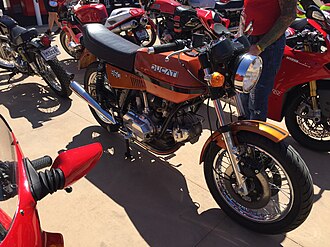
Ducati 860 GT: The Bold Italian Twin That Took Ducati in a New Direction
The Ducati 860 GT is one of the most intriguing motorcycles in Ducati history because it represents a moment when the company deliberately stepped away from the styling and engineering formula that had made its earlier 750 twins so admired. Introduced in 1974 as the successor to the Ducati 750 GT, the 860 GT combined Fabio Taglioni’s evolving 90-degree L-twin engine with a completely new visual language created by legendary automotive designer Giorgetto Giugiaro. Its angular fuel tank, squared engine cases, large side panels and sharply defined bodywork looked nothing like the flowing lines of the earlier Ducati twins. Underneath that controversial exterior was an 863.9 cc air-cooled L-twin with bevel-driven overhead camshafts, conventional valve springs, two Dell’Orto carburetors and a five-speed gearbox. Ducati’s own heritage archive describes the 860 as a significant evolution of the previous generation and notes that its street version did not achieve immediate commercial success, even though the underlying motorcycle later demonstrated impressive potential in endurance racing.
Today, the 860 GT is fascinating precisely because it was not an instant commercial triumph. It was a motorcycle caught between two eras: the elegant “round-case” Ducatis of the early 1970s and the later “square-case” machines that would provide the mechanical foundation for a new generation of Ducati twins. The 860 GT introduced a redesigned engine architecture that was easier to manufacture and service than the earlier round-case motor, while its chassis and styling attempted to make Ducati more relevant to a changing international motorcycle market. The motorcycle’s reception was lukewarm when new, but its importance has become increasingly apparent with age. It represents the beginning of the square-case bevel-drive era and occupies an important position in the lineage that eventually produced the 900 Super Sport, 900 Darmah and other legendary Ducati twins.
The Birth of the Ducati 860 GT
Replacing the 750 GT
The 750 GT had established Ducati as a serious manufacturer of large-capacity sporting twins, but by the beginning of the 1970s the company needed a motorcycle that could be produced more efficiently and appeal to a wider international audience. The 860 GT was conceived as a more modern successor, retaining the essential 90-degree L-twin configuration while introducing a redesigned engine and chassis.
The new motorcycle was first shown publicly at the Milan motorcycle show in November 1973 and entered production in 1974. The basic engine philosophy remained recognizably Ducati: an air-cooled 90-degree twin with overhead camshafts driven by bevel gears. But the crankcases were redesigned with angular exterior surfaces, giving the engine a much more geometric appearance. The result became known as Ducati’s “square-case” engine, distinguishing it from the rounded crankcases of the earlier 750 GT and related models.
The 860 GT was not merely a larger version of the 750 GT. Fabio Taglioni and his engineering team revised the engine internally, simplifying the bevel-drive arrangement and improving the lubrication system. The new engine was intended to be easier and faster to assemble while retaining the performance characteristics that made Ducati’s large twins attractive. The engine also used larger Dell’Orto carburetors, while the new cases were designed to complement the radically different bodywork.
A New Direction for Ducati
The timing of the 860 GT was significant. Ducati had already demonstrated its sporting potential with the 750 Super Sport and its competition successes, but the 860 GT was deliberately conceived as a Grand Touring motorcycle rather than a stripped-down racing replica. The “GT” designation reflected an intention to provide comfortable high-speed road transportation rather than simply chasing maximum horsepower.
That approach helps explain some of the motorcycle’s engineering choices. The engine was tuned for broad torque and tractability rather than extreme peak performance, the seating position was relatively upright, and the motorcycle carried substantial bodywork and a reasonably large fuel tank. It was intended to be a fast road machine that could cover long distances while retaining the distinctive character of a Ducati twin.
Giorgetto Giugiaro’s Controversial Design
The “Folded Paper” Ducati
The most famous feature of the 860 GT is undoubtedly its styling. Ducati commissioned Giorgetto Giugiaro and his Italdesign studio to create the motorcycle’s exterior. Giugiaro was already an internationally celebrated automotive designer, responsible for influential automobiles including the Volkswagen Golf and numerous other landmark designs. His approach to the Ducati was dramatically different from the rounded, organic appearance of the previous generation.
The 860 GT looked as though it had been constructed from folded sheets of metal. The fuel tank featured sharply defined edges and flat surfaces, while the side covers and engine cases continued the same geometric theme. The seat and tail section reinforced the angular profile, producing a motorcycle that looked more like a product of industrial design than a conventional Italian sport bike.
The design was technically coherent, but motorcycle enthusiasts of the period were not necessarily looking for coherence in the automotive-design sense. Ducati’s earlier 750 twins had established a beautiful visual identity based on flowing fuel tanks, exposed mechanical components and traditional Italian proportions. Against that background, the 860 GT appeared almost confrontational.
The motorcycle’s styling therefore became one of its greatest commercial weaknesses. Period reception was far less enthusiastic than Ducati had hoped, and sales suffered. The company’s decision to restyle the machine only a short time later demonstrates how seriously Ducati regarded the market’s response. The 860 GT would eventually evolve into the softer-looking 860 GTS and later 900 GTS.
A Design That Aged Better Than Expected
There is an interesting irony in the story of the 860 GT. What was considered awkward or unattractive when new has become one of its most recognizable qualities. Modern collectors are no longer comparing the motorcycle directly with a new 750 Super Sport sitting in a showroom; instead, they see the 860 GT as a remarkably authentic example of 1970s industrial design.
The angular styling also makes historical sense. The same decade that produced the 860 GT saw automobiles, furniture and consumer products become increasingly geometric. Giugiaro’s design was not random or incompetent; it was an expression of a broader design movement. The motorcycle simply arrived at a time when Ducati’s traditional audience was particularly attached to the organic shapes of its earlier machines.
For today’s enthusiast, that makes the 860 GT unusually interesting. Its styling tells the story of a manufacturer attempting to reinvent itself, and few Ducati motorcycles make that historical transition as visible.
The 864 cc Square-Case L-Twin
A Bigger Evolution of Taglioni’s Formula
At the center of the 860 GT was an 863.9 cc air-cooled 90-degree L-twin. Bore and stroke measured approximately 86.0 × 74.4 mm, giving the engine a relatively large bore compared with its stroke. The architecture remained SOHC with two valves per cylinder, and each camshaft was driven by Ducati’s characteristic bevel-gear system.
Unlike the later high-performance Ducati Super Sport engines, the 860 GT used conventional valve springs rather than desmodromic valve actuation. This distinction is important because Ducati’s Desmo technology is now so closely associated with the company that it is easy to assume every classic Ducati twin employed it. The 860 GT did not. Its valves were opened by the camshaft and closed by conventional springs, making the cylinder heads simpler and more appropriate for a relatively relaxed GT motorcycle.
The engine’s power figures vary somewhat between period and modern sources, with commonly quoted figures ranging from approximately 57 horsepower to around 60 horsepower. Some specifications list approximately 57 hp at 7,700 rpm, while contemporary descriptions place peak output around 60 hp at approximately 6,900 rpm. Ducati’s later racing-oriented versions of the square-case engine were considerably more powerful. For a road-going GT, however, the engine’s broad torque delivery was more important than its peak number.
Bevel Gears Without the Desmo Complexity
The bevel-drive camshaft system remained a defining Ducati characteristic. A vertical shaft and bevel gears transferred rotational motion from the crankshaft to the overhead camshafts. It was a beautifully mechanical solution, and the gear train was visible in the design of the engine even though much of it was enclosed.
One of the important changes introduced with the 860 was a simplified bevel arrangement. The redesign was intended to make engine assembly easier and more economical while retaining accurate camshaft drive. This was a significant engineering improvement because the earlier round-case engine had become relatively complicated and expensive to manufacture.
The 860 therefore represented an important transition in Ducati engineering. It kept the company’s signature bevel-drive concept but adapted it for a more practical production environment. The square-case motor would go on to underpin numerous Ducati models, making the engineering changes far more consequential than the commercial performance of the original GT might suggest.
Carburetion and Everyday Performance
The 860 GT used twin Dell’Orto carburetors, with 32 mm PHF units commonly specified for the 1974–75 motorcycle. This was a straightforward arrangement by modern standards, but the carburetors suited the engine’s character well. Rather than delivering an abrupt surge of high-rpm power, the large-capacity twin generated substantial low- and midrange response.
The engine was particularly suited to real-world road riding. The 90-degree configuration provided excellent primary balance, while the relatively long stroke and generous displacement of each cylinder gave the motorcycle a strong mechanical pulse. The result was a motorcycle that could accelerate confidently without requiring the rider to keep the engine near its redline.
This is an important part of the 860 GT’s identity. It was not intended to be the fastest Ducati of the decade. Ducati already had motorcycles such as the 750 Super Sport for that role. The 860 GT instead occupied the position of the fast, characterful road motorcycle, where strong torque, stability and long-distance capability mattered more than ultimate lap times.
The Five-Speed Gearbox
A Traditional Transmission
Power was transmitted through a wet multi-plate clutch and five-speed gearbox, with final drive by chain. The transmission was relatively conventional in concept, but the 860 GT’s gear ratios were selected to suit its broad torque curve. The motorcycle did not require a large number of closely spaced ratios because the engine could pull strongly across a useful range.
One unusual feature of early 860 models was the location of the gearshift. Ducati traditionally placed the shift on the right, but changing regulations and market expectations—particularly in the United States—created pressure to adopt left-side shifting. The company developed a crossover mechanism to relocate the control. This arrangement was not universally admired because it added complexity to the linkage, but it illustrates the compromises Ducati was making as it attempted to sell its motorcycles internationally.
The issue became increasingly important as international motorcycle markets converged around left-side gear shifting. Later versions of the square-case family adopted more refined solutions, and the experience eventually contributed to the development of Ducati’s subsequent models.
The Chassis of the Ducati 860 GT
A Steel Frame Built Around the Twin
The 860 GT retained Ducati’s tubular steel frame philosophy, although the frame was modified to accommodate the redesigned engine. The chassis incorporated a stressed-engine concept and used an open double-cradle-style tubular arrangement. The engine’s compact 90-degree configuration allowed Ducati to keep the motorcycle relatively narrow despite its substantial capacity.
With a wheelbase of approximately 1,550 mm, the motorcycle was designed more for stability than razor-sharp steering. The long wheelbase worked well with the GT’s intended purpose, giving the motorcycle a planted character at speed. The relatively upright riding position also made long-distance riding more practical than on Ducati’s racing-oriented Super Sport models.
The chassis was not excessively heavy for the era. Period specifications commonly give the 860 GT a dry weight of approximately 185 kg, although other sources quote considerably higher figures when fuel, oil, battery and other equipment are included. This distinction explains many of the apparently contradictory weight figures found in surviving documentation.
Ceriani Forks and Marzocchi Rear Shocks
The front suspension consisted of a conventional telescopic fork, with 38 mm Ceriani forks commonly specified for the early 860 GT. At the rear were twin Marzocchi shocks with multiple adjustment positions. This arrangement was typical of high-performance European motorcycles in the 1970s and provided a good compromise between comfort and control.
The twin-shock layout also contributed to the motorcycle’s visual identity. The exposed rear suspension, spoke wheels and tubular frame gave the 860 GT a distinctly mechanical appearance despite the angular bodywork.
The motorcycle was fitted with 18-inch wheels, typically carrying a 3.50-18 front tire and 4.00-18 rear tire. These relatively tall wheels complemented the long wheelbase and helped provide stable steering behavior on imperfect roads.
Braking Performance
The early Ducati 860 GT used a single 280 mm front disc with a one-piston caliper and a 200 mm rear drum. This combination sounds modest today, particularly for an 864 cc motorcycle, but it reflected the braking technology available in the mid-1970s. The single front disc was a significant improvement over the drums still found on many motorcycles of the era.
Later versions of the 860 family gained more substantial braking equipment, including twin front discs on the GTS and subsequent models. This progression is another example of how Ducati developed the square-case platform in response to changing expectations and performance requirements.
For a modern rider, the brakes are perhaps one of the clearest reminders that the 860 GT belongs to another era. Its performance has to be understood in context: approximately 180–195 km/h was very serious road performance in the mid-1970s, and the braking systems were designed around the tires, suspension and speeds of that period.
The 860 GT on the Road
A Grand Tourer Rather Than a Superbike
The riding character of the 860 GT is defined by its engine. The L-twin is smooth for a large air-cooled two-cylinder motorcycle, and the substantial torque makes the five-speed transmission easy to exploit. The engine does not demand constant gear changes, and its broad response makes the motorcycle well suited to winding roads and open-country riding.
The motorcycle’s approximately 825 mm seat height and upright ergonomics give it a more accessible riding position than Ducati’s dedicated Super Sport machines. The large fuel tank and relatively relaxed engine tuning also reinforce the GT designation. It is a motorcycle intended to travel, not simply to attack corners.
At higher speeds, the long wheelbase contributes to stability, while the narrow engine keeps the motorcycle from feeling excessively wide. Period road tests were generally more impressed by the engine than by the styling, and that distinction remains relevant today. The 860 GT’s mechanical character is arguably stronger than its contemporary reputation suggested.
The Sound and Feel of the Square-Case Twin
A classic Ducati is rarely about numbers alone, and the 860 GT is an excellent example. The mechanical sounds of the bevel gears, the intake noise from the Dell’Orto carburetors and the deep exhaust note of the 90-degree twin create an experience that cannot be reproduced by simply looking at a specification sheet.
The engine also has an unmistakable rhythm. Each combustion event contributes to a physical sensation that is very different from the smoother, higher-revving character of a four-cylinder motorcycle. The 860’s torque arrives in a substantial, deliberate manner, making acceleration feel more like a mechanical event than a simple increase in speed.
That character is one reason the model has become more interesting to collectors with time. The motorcycle’s imperfections are part of its identity.
Why the 860 GT Struggled in the Marketplace
The 860 GT’s biggest problem was not necessarily its engineering. It was the combination of its appearance, timing and competition within Ducati’s own showroom.
The motorcycle appeared alongside the much more exotic 750 Super Sport, a model that had already developed an enormous reputation among enthusiasts. The 860 GT’s conservative GT mission and angular design therefore struggled to generate the same emotional response. Period accounts describe the reception as poor, with Ducati eventually deciding to redesign the motorcycle rather than continue with the original styling.
The situation is particularly ironic because Giugiaro’s design was not inherently unsuccessful. Its geometric philosophy was extremely influential in the automotive world. The problem was that Ducati customers had developed a strong attachment to the beautiful rounded forms of the earlier twins. The 860 GT arrived as a stylistic revolution when many buyers were expecting an evolution.
As a result, the motorcycle’s original appearance became relatively short-lived. The 860 GTS arrived in 1976 with softer styling, a redesigned fuel tank, a different seat profile and narrower, lower handlebars. The broader square-case family continued evolving, eventually leading to the 900 GTS and other models.
The 860 GT and Ducati’s Racing Story
Although the road-going GT was not designed primarily as a race replica, the 860 engine platform had considerable sporting potential. Ducati’s official heritage history notes that an 860 Desmo prototype appeared in 1973 for endurance competition and subsequently achieved victory in the demanding 24 Hours of Montjuïc. In 1975, Salvador Cañellas and Benjamin Grau again won the event on a Ducati twin under NCR team colors.
These racing motorcycles should not be confused with a standard 860 GT. They used substantially different specifications, including desmodromic cylinder heads and competition preparation. Nevertheless, the victories demonstrated the potential of the basic enlarged L-twin architecture and helped ensure that the square-case engine became an important part of Ducati’s sporting development.
This distinction is essential when discussing the 860. The road GT was a relaxed, conventional-valve motorcycle, while the racing machines represented the high-performance evolution of the same basic engine family. Ducati could therefore use one mechanical foundation for very different purposes.
The Beginning of the Square-Case Ducati Era
More Than a Failed Design
The 860 GT’s historical significance becomes much clearer when viewed from the perspective of the motorcycles that followed it. The square-case engine introduced in the 860 would become the foundation for a large family of Ducati twins. The basic architecture was refined, enlarged and given desmodromic cylinder heads for sporting applications.
The 750 and 900 Super Sport models subsequently combined the square-case engine with desmodromic heads, high-compression pistons and other performance modifications. This created a particularly interesting contrast: the 860 GT’s relatively mild road engine had provided the foundation for some of Ducati’s most exciting sporting motorcycles.
The 900 Darmah later took the square-case concept into another generation of road-oriented Ducati twins, while the mechanical lessons learned during this period helped shape the company’s later bevel-drive motorcycles.
In that sense, the 860 GT was not a dead end. It was an engineering transition.
Ducati 860 GT Technical Specifications
The following figures refer primarily to the original 1974–75 Ducati 860 GT/GTE specification. Exact figures can vary according to market, model year and whether the motorcycle is quoted dry or fully fueled. The 860 GTS and later 900 GTS were related but substantially revised versions and should not be treated as identical motorcycles.
| Specification | Ducati 860 GT / GTE |
|---|---|
| Production | 1974–1975 for GT/GTE |
| Engine | Air-cooled 90° L-twin, 4-stroke |
| Displacement | 863.9–864 cc |
| Bore × stroke | 86.0 × 74.4 mm |
| Valve arrangement | SOHC, 2 valves per cylinder |
| Valve actuation | Conventional valve springs |
| Camshaft drive | Bevel gears |
| Compression ratio | Approximately 9.0:1 |
| Carburetors | 2 × 32 mm Dell’Orto PHF |
| Ignition | Electronic/CD ignition |
| Cooling | Air |
| Maximum power | Approximately 57 hp @ 7,700 rpm |
| Period power figures | Approximately 57–60 hp, depending on specification/source |
| Transmission | 5-speed |
| Clutch | Wet multi-plate |
| Final drive | Chain |
| Frame | Tubular steel |
| Front suspension | 38 mm Ceriani telescopic fork |
| Rear suspension | Twin Marzocchi shocks |
| Front brake | 280 mm disc, single-piston caliper |
| Rear brake | 200 mm drum |
| Front tire | 3.50 H18 |
| Rear tire | 4.00 H18 |
| Wheelbase | 1,550 mm |
| Seat height | Approx. 825 mm |
| Fuel capacity | Approx. 18 litres |
| Dry weight | Approx. 185 kg |
| Wet weight | Approx. 206 kg |
| Claimed/typical top speed | Approx. 180–195 km/h |
| Starter | Kick on early GT; electric starter on GTE |
The Legacy of the Ducati 860 GT
The Ducati 860 GT is a motorcycle whose reputation has improved dramatically with distance. When it was new, its styling seemed to alienate many of the enthusiasts who loved Ducati’s earlier round-case twins. Its commercial performance suffered, and the company soon moved toward the softer styling of the 860 GTS. Yet history has given the 860 GT a different role.
It was the first production Ducati to introduce the square-case bevel-drive engine, a design that would become one of the most important mechanical foundations in the company’s classic twin-cylinder history. The engine was simpler to assemble than its predecessor, retained the characteristic 90-degree L-twin layout, and provided a platform that could be developed into much more powerful desmodromic sporting engines.
It also represents an unusual meeting of two famous Italian engineering disciplines. Fabio Taglioni’s mechanical thinking created the motorcycle’s engine and chassis philosophy, while Giorgetto Giugiaro brought an automotive designer’s radically geometric vision to its bodywork. The result was not universally loved, but it was undeniably distinctive.
The 860 GT therefore deserves to be judged on more than sales figures or first impressions. It was a transitional Ducati, and transitional motorcycles are often among the most revealing machines in a manufacturer’s history. It showed Ducati experimenting with manufacturing efficiency, international market requirements, new styling, larger displacement and a more practical Grand Touring mission, all while retaining the mechanical character of its famous L-twin.
Most importantly, the 860 GT laid the groundwork for what came next. The square-case engine would evolve into the powerplant of increasingly desirable Ducati Super Sport models, and its influence would continue through the company’s classic bevel-drive era. What looked like an awkward departure from Ducati tradition in 1974 eventually became an important chapter in that tradition.
Today, the 860 GT is compelling precisely because it is different. It does not have the universally celebrated styling of a 750 Super Sport, nor the immediate racing glamour of a 900 SS. Instead, it tells a more complicated story about Ducati’s attempt to reinvent itself. Its angular Giugiaro bodywork, square engine cases, bevel-driven camshafts, conventional valve springs and torquey 864 cc L-twin make it unmistakably a product of the 1970s, yet the engineering ideas behind it helped shape Ducati motorcycles for years afterward.
The Ducati 860 GT may once have been regarded as the awkward member of the family, but today its historical importance is impossible to ignore. It was the beginning of the square-case Ducati era—and sometimes the motorcycle that changes a company’s future is not the one that sells the most, but the one that introduces the ideas everyone else builds upon.
.jpg)